On Mount Hood Events
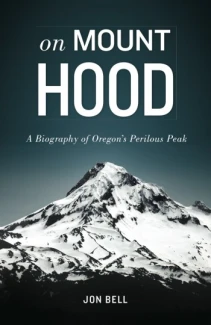
 It’s shaping up to be a busy season of books around here, with On Mount Hood scheduled for five events in the next few weeks. There’s one slideshow, a couple big author/artist festivals, a Friday night art walk, and a 30% off sale at a great college bookstore. Surely one of them will help check a name or two off your Christmas list . . .
Book signing, 12-4 p.m. Saturday, Nov. 19, at the Audubon Society of Portland’s annual Wild Arts Fesitval.
Book signing, 1 p.m. to 3 p.m. Thursday, Dec. 1, at The Willamette Store’s annual book blowout in Salem.
Book signing, 6:30-9 p.m. Friday, Dec. 2, at Chapters Books and Coffee during First Friday Art Walk in Newberg.
Book signing, noon to 4 p.m. Sunday, Dec. 4, at The Oregon Historical Society’s Holiday Cheer author celebration in downtown Portland.
Slideshow, 7 p.m. Wednesday, Dec. 7, at The Mazamas in southeast Portland.
Mount Hood questions — and answers
Every time I give a slideshow or presentation about On Mount Hood — the next one’s coming up on Saturday, Nov. 19 — I get some questions near the end. A lot of them I have answers to; some take a little more digging, and still others find me punting altogether or simply admitting that I have no clue.
My ultimate goal is to be able to answer any question about Mount Hood or, at least, On Mount Hood, that comes my way. That’s a steep goal, considering just how much material Mount Hood, the mountain, encompasses. But to me, it’s also a fascinating goal worth pursuing.
A few questions from recent events:
Q: What does Wy’east mean?
A: The mountain’s modern name, Mount Hood, comes from an Englishman, Samuel Hood, who never saw the mountain and who actually fought against the United States during the Revolutionary War. William Broughton, a member of an expedition under the command of Captain George Vancouver, is credited with naming the mountain after admiral Hood in 1792. But for hundreds of years before that, many Native Americans who lived in the area supposedly called the mountain Wy’east. Lewis McArthur’s invaluable Oregon Geographic Names, says that Wy’east does not appear in any available books on on native dialects of the area, but the term nonetheless found its way into Native American folklore. Nobody seems to know exactly what the word Wy’east means, but according to the lore of the Klickitat tribe, who lived along the north shore of the Columbia River, Wy’east was one of the mythical sons of the Great Spirit. He got into a massive and fiery fight with his brother, Pahto, over a beauty named Loowit. Their battle scorched the land and so infuriated their father that he turned all three into volcanic peaks: Loowit is Mount Saint Helens, Pahtoh is Mount Adams, and Wy’east is Mount Hood.
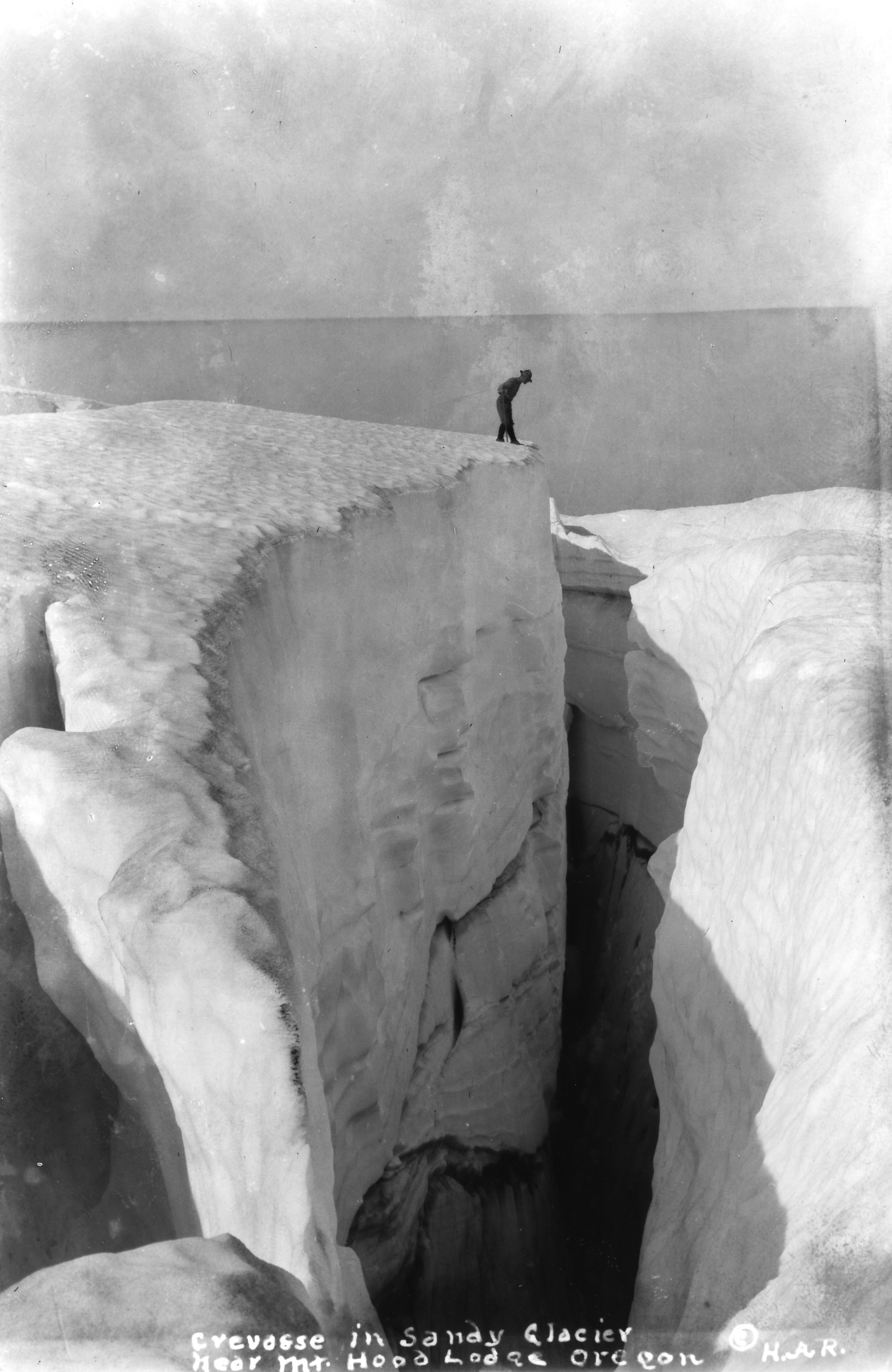
Q: What’s so bad about the fact that the glaciers on Mount Hood are shrinking?
Courtesy of the Mazamas
A: In the very near term, maybe not much. But if global warming continues on pace and the scientific models play out they way geologists suppose they may, glacial shrinkage on Mount Hood could have some very noticeable effects. Shrinking glaciers mean less water to irrigate orchards in the Hood River Valley. The ice that currently blankets the mountain also helps cement its unstable volcanic mass together. Less ice holding Hood together means more landslides, erosion and flooding, which already comes into play whenever Highway 35 washes out on the mountain’s east side. Mountain maps are already highly inaccurate because they depict glacial coverage that simply doesn’t exist anymore, which can be challenging for climbers and other folks working their way up or around the mountain. And as the temperatures rise, so do the snow levels. Eventually, Hood’s renowned ski and snowboard industry could feel a mighty pinch.
Q: What kind of skis do you use?
A: Rentals. (See the “Down the Hill Chapter” of On Mount Hood.)
Q: What’s the latest on the Cooper Spur land swap?
 A: At present, the Forest Service is reportedly moving slowly through the process that will likely approve a swap of 770 acres of land owned by Mt. Hood Meadows on the north side of the mountain for about 120 acres of developable property in Government Camp. The swap, which is dependent upon environmental reviews, appraisals and other considerations, will ultimately protect the acreage on the north side of the mountain from development and will give Meadows the opportunity to develop land in Government Camp. The original timeline for the process appears to have extended past its deadline, but last I was told, the process is still moving forward, albeit slowly.
Good stories
One of the things that I’ve found really interesting and unique in my time with Mount Hood is that almost everyone seems to have their own stories and connections with the mountain.
I met a guy on the beach in Clearwater, Florida, last spring who used to make annual skiing trips to Timberline Lodge with his college friends. Another guy, Rocky Henderson, kicked off a long stint of search and rescue missions on Mount Hood in 1986. His first mission ever was the search for a group of Oregon Episcopal School students lost in a storm on the mountain’s south side in 1986.
A sister of an editor I work for used to work up at Timberline Lodge, and she put me in touch with the guy who’s been running Silcox Hut for Timberline since 1993. One woman who read my book contacted me about a brief passage where I mentioned a plaque left on a boulder up near Cooper Spur. The plaque, which reads in part “Walk gently, friend, you are walking in the path of those who went before,” memorializes five Mazama climbers who were killed in a fall while descending Cooper Spur in 1981. One of those climbers was the woman’s husband. She herself helped place the plaque.
With Mount Hood, the stories go on and on.
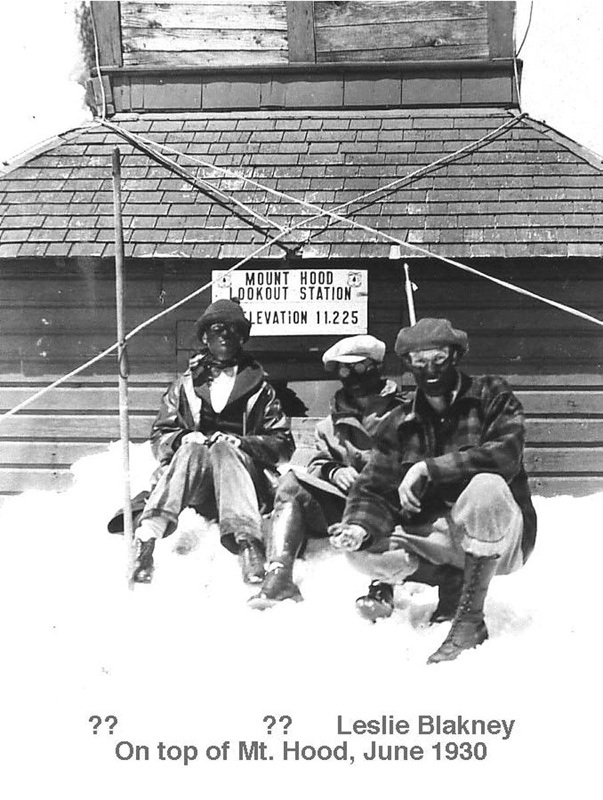
Just the other day, a reader from Bremerton, Washington, Tom Blakney, dropped me a note to share some of his Mount Hood recollections. He remembered watching his father and other climbers through a telescope at Timberline Lodge in the 1940s as they made their way toward the summit. His father, an amateur climbing guide on Hood and St. Helens, once found himself on the summit of Hood with a frightened Irishman who refused to walk back along the exposed summit ridge when he saw how steep the north side drop off was. With no other options, Blakney’s father and another guide blindfolded the man and led him, tied between the two guides, across the ridge.
Blakney, who twice climbed the mountain himself, also sent along a couple great old photos of his father on the summit of Mount Hood, back when there was a lookout up top.

Courtesy of Tom Blakney
Courtesy of Tom Blakney
Ever since I first started exploring Mount Hood back in 1997, I’ve been fascinated by not only the mountain, but by all of the stories that help make it the spectacular peak it is. That’s part of the reason that I wrote a book about Mount Hood, and it’s a big part of the reason why I’ll keep exploring the mountain and writing about it.
Have your own Mount Hood story to share? I’d love to hear it. Drop me a line.
A reminder
The first of probably a few reminders this week about the official launch of On Mount Hood at the Hawthorne Powell’s this Thursday night at 7:30 p.m.! (Not the Burnside Powell’s!)

Off we go
A month ago, I kicked off this web site and blog with a post about why I was doing it. It’s for the book and for the mountain, primarily.
But part of the reason I kicked it off when I did was also because I could then be a part of the 2011 WordCount Blogathon, a 31-day blogging marathon run by an editor of mine, Michelle Rafter. The goal is to blog every day in the month of May. It’s not easy to do, but with a little discipline, a little hard work, and some easy, photo-only posts, it can be done.
Something close to 200 bloggers signed up for it this year, and while I’m not sure how many made it the entire month, I can officially say that, with this post, I did.
To end the Blogathon and officially shift into book promo mode, I thought I’d offer up another brief excerpt of the book, this one about the start of our 41-mile epic trip on the Timberline Trail. Thanks for reading . . .
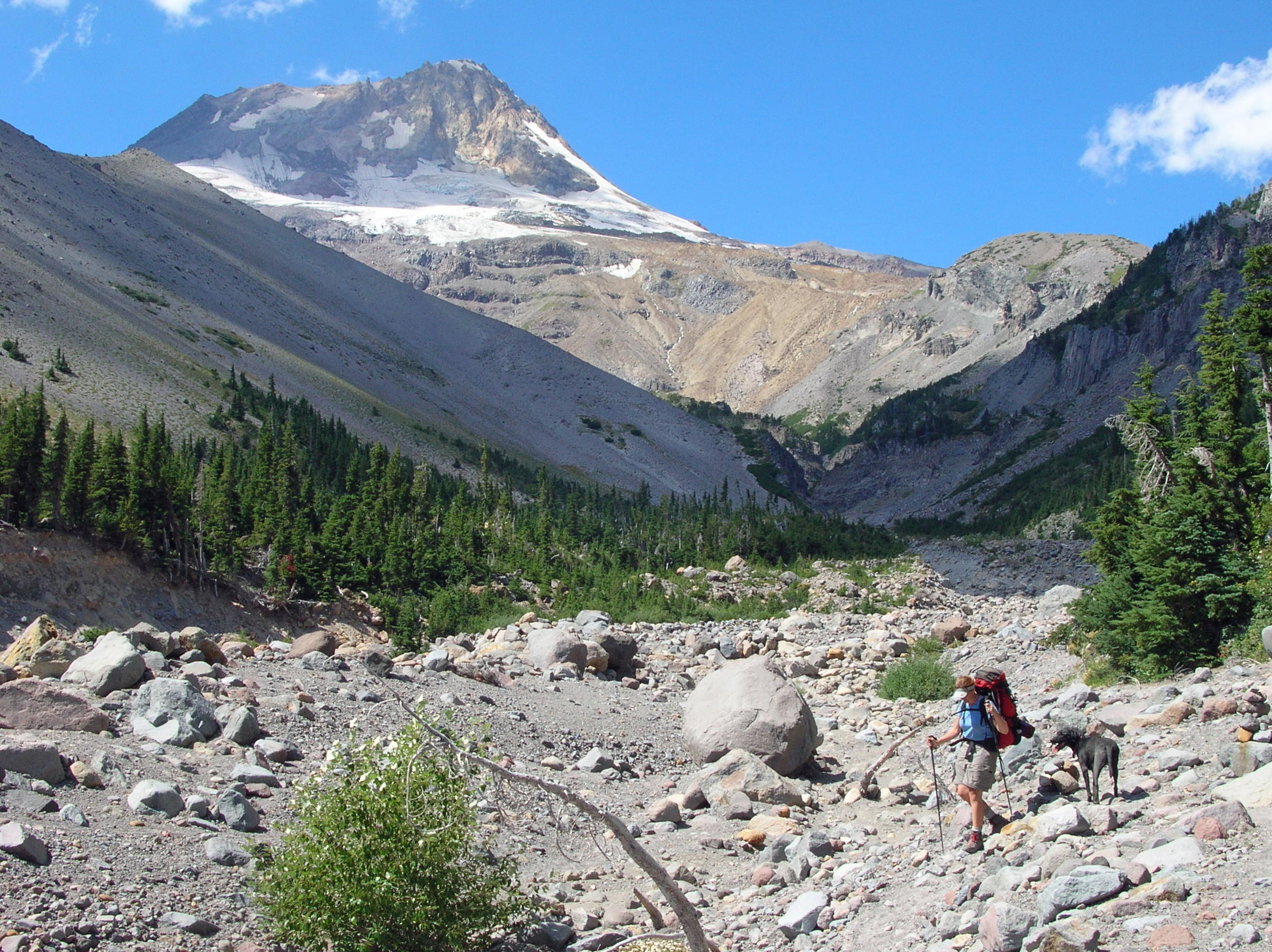
Amy and Oliver approaching Newton Creek on the Timberline Trail, 2005.
Misty here at 6,000 feet on the south side of Mount Hood. Very misty. In fact, come to think of it, this isn’t mist anymore at all. It’s real rain and the drops are engorging by the minute. Isn’t this August, one of the months it’s supposed to be safe to venture outside in Oregon?
The parking lot here at Timberline Lodge is empty for good reason, but here we are, Amy and I, and our trail hound, Oliver, setting out to tread the Timberline Trail in its entirety. The 41-mile loop encircles the mountain, covers close to 10,000 feet of total elevation gain, tops out at 7,300 feet on the north side, crosses countless streams and rivers, offers views of at least five major Cascade peaks, and attracts thousands of hikers each and every year. And it’s been around since 1938. So in more ways than one, this is the hike to do on Mount Hood.
Although most people knock off the Timberline Trail in three days, I’ve just been laid off from my reporting gig at a Portland newspaper, freed from work obligations for the time being, and Amy and I like to enjoy ourselves on the trail, so we’ve budgeted just enough Jack Daniels and Johnny Walker for four evening cocktail hours.
By then, August 2005, we’d lived in Portland for eight years and had backpacked all over Oregon and Washington. Mount Hood had become an obvious go-to favorite for us because we lived just an hour’s drive away. We’d already spent countless days and nights hiking and camping at places like Burnt Lake, McNeil Point, Elk Meadows, Elk Cove, Cooper Spur, Ramona Falls, Zigzag Mountain, and so on. Last-minute escapes to the Muddy Fork of the Sandy River or Lost Lake were always a weekend option (still are).
Our original plan for this trip had been to head up to Washington’s North Cascades, but logistics and unknowns had made it seem more stressful than such an outing should be. We considered other options too: back to the Wallowas in eastern Oregon, the Three Sisters near Bend, the redwoods. Everywhere, it seemed, but fifty miles east of home.
Amy refocused, however—saw the trees for the forest, if you will—and suggested we give the Timberline Trail a go. Perfect.
Except for this rain, which has soaked us damn near through before we even step off the pavement. Even Oliver, who’s usually delighted and indifferent to the elements, seems dejected already, droplets beading off his Labrador blackness and drenching his overloaded pack. (I think Amy’s stashed her hooch inside it.) But what are you going to do? When else will you have five days off— and then some—to devote to one of the most classic backpacking trails around? This is what we are here to do, the Timberline Trail. And goddamn, we are going to do it.
The mountain is hidden. The day is soggy, blowing. The massive, seventy-year-old lodge looks quaint and so inviting. I’m sure fires are burning warm and bright within its giant stone fireplaces and hot soup is heating the innards of guests looking out at us through big, bowing windows and thinking, What in the hell are those people doing out there?
Off we go.
Music with Mount Hood II
A couple weeks ago, I wrote about my first experience at the indie music festival Pickathon and its relation to Mount Hood.
It was partly to spread the word about a book project that my friend, Tim Labarge, was hoping to get funding through Kickstarter and to which I contributed. My essay for the book was all about seeing a band called the Heartless Bastards, who struck me at Pickathon and who’ve not since let go.
Well, yesterday, Tim met his fund-raising goal, so the book will be published. Awesome.
Looking forward to the finished product in August. Until then, check out the lineup for this year’s festival and sample some of the music.

 On MOUNT HOOD