The Book. The Mountain. Everything in between.

Latest

Where to get it

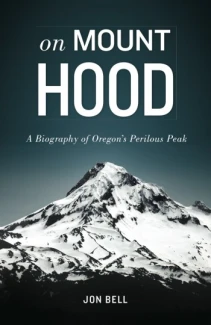
For months now, On Mount Hood: A Biography of Oregon’s Perilous Peak has been available for preorder on Amazon.com. But something shifted this week, right about the time I got my author copies of the book in the mail.

Amazon switched from preorder to In Stock.

So, it’s official now. You can actually buy On Mount Hood.

I was talking to the sales manager at Sasquatch Books last week, and she noted that Amazon these days is usually the first to have books available. After that, bigger bookstores, then smaller ones and various retailers, libraries and other outfits begin offering new releases for sale. So although the official release date of this book is June 2, the actual release is more of a rolling one. It’s available at Amazon now and can also be ordered from Powell’s Books, from where it will be shipped in 1-3 days or where it can be picked up in 7 to 12.

On Mount Hood will ultimately be available at bookstores and retail outlets around Oregon and Washington. The initial list of places that have ordered copies is down below. More to come.

Have any questions about where you can find the book? Drop me a line. And a big, hearty thank-you to anyone and everyone who buys a copy. Thanks for your support. Enjoy!

Mount Hood National Park?

Thirty-one years ago today, Mount St. Helens blew away 1,300 feet of its upper reaches, bowled over and scorched 230 square miles of forest , and killed 1,500 elk, 5,000 deer and 57 people in the most devastating volcanic eruption in the history of the United States.

Traversing the summit ridge of St. Helens, June 2009.

In the wake of the eruption, St. Helens and the land surrounding it was designated a National Volcanic Monument, which preserved the area in a relatively natural state while also providing opportunities for scientific research, tourism and recreation. But dwindling federal budgets — the Forest Service is the agency in charge of the monument — have led some groups to advocate for national park status for Mount St. Helens.

In fact, today, in commemoration of the 1980 eruption, the National Parks Conservation Association, the Cowlitz County Tourism Bureau, EcoPark Resort, and other supporters are staging a press conference to renew the call for a Mount St. Helens National Park.

So how does this relate to Mount Hood?

Since about the mid 2000s, there has been a similar campaign pressing for a Mount Hood National Park. 

Launched and guided by Portlander Tom Kloster, a transportation planning manager at Metro, the Mount Hood National Park Campaign posits that the Forest Service, which oversees the Mount Hood National Forest, has been charged with an impossible task: to simultaneously protect the mountain and exploit it through timber sales, energy corridors and the like. Turning the area into a national park, according to the campaign, would put it under the auspices of the National Park Service, an agency guided by a much clearer mission . . .

“…to conserve the scenery and the natural and historic objects and the wildlife therein and to provide for the enjoyment of the same in such manner and by such means as will leave them unimpaired for the enjoyment of future generations.”

It is an interesting idea to be sure, and one that, to those of a more conservation-based persuasion, would seem to be a worthwhile endeavor.

The campaign’s web site and Kloster’s accompanying WyEast blog make a strong case for national park status. There would, of course, be lots of opposition from timber companies — even though the annual cut in the Mount Hood National Forest is now a fraction of what it once was — utility providers, off-road vehicle groups and many others. The hordes and the accompanying amenities I’ve encountered at many national parks like Yosemite and the Grand Canyon also make me wonder just what Hood might turn into as a national park.

But I’m a big fan of protecting beautiful places, and Mount Hood, to me, is worthy of protection. If making it a national park would help accomplish that, I’d be all for it.

Hood History

Some of the most interesting stories about Mount Hood come from the early days of its exploration by the people who came to live in Portland and its surrounds. Like the disputed first summit by  Thomas J. Dryer, publisher of what became The Oregonian, in 1854. (Three years later, one of Dryer’s employees, Henry Pittock, was part of a team that bagged the official first ascent.) And the reason that Illumination Rock, a prominent outcropping at about 9,500 feet on Hood’s southwest shoulder, is called Illumination Rock. (Various parties in the 1870s and 1880s hauled a substance known as red fire to the rock and the mountain’s summit and set about illuminating the peak for the masses back in Portland to see.)

One of my favorites is the story of where the Mazamas, a long-standing mountaineering and outdoor club based in Portland, got its start in 1894. From the group’s web site:

Responding to an advertisement run in the Morning Oregonian of June 12, 1894:  “To Mountain Climbers and Lovers of Nature . . . It has been decided to meet on the summit of Mt. Hood on the 19th of next month …” more than 300 people encamped on the flanks of Mt. Hood on July 18. By 8:00 am the next day, the first climbing party reached the 11,239’ summit, followed by the rest of the 193 men and women who were to reach the summit that day. One hundred and five climbers became charter members.

And here’s a photo from that very day, courtesy of the Mazamas.

Mazamas on summit

PRC number 4

In addition to climbing on Mount Hood, there is also climbing to be done all around Mount Hood — and all around the greater Portland area. The best guidebook for all of that kind of climbing — from Bulo Point and French’s Dome to Rocky Butte and Beacon Rock — has long been Tim Olson’s Portland Rock Climbs.

My copy dates from 2001 and is nicely dog-eared and tattered from a good three- or -four-year stint of regular rock climbing back in the days before kiddos. These days, that book sits on the shelf more than I’d like, but it’s still there, and I still pull it out every now and then.

For those who are still able to hit the Portland-area rock hard, however, Olson has just released the 4th edition of Portland Rock Climbs.

Portland Rock Climbs

Updated and revised, the new volume covers all the classic climbing spots around Portland, the Gorge and Mount Hood. The new version also includes information on places like Ozone out on the Washington side of the Gorge and also a little write-up of Beacon Rock giant Jim Opdycke by yours truly.

Pick up a copy at Tim’s web site or at one of the retail locations he’s got listed there.

A South Side Climb

Mount Hood, with 8,000-10,000 prospective summit climbers annually, is one of the most-climbed mountains in the world. Most of the people who take it on do so up the South Side route, a roughly 3-mile climb that ascends 5,000 non-technical feet from Timberline Lodge to the 11,239-foot summit. The most welcoming season is mid to late spring, when the bad weather is mostly gone but the good snow’s still there, and the prime time to head out is in the middle of the night. The goal is to reach the summit right around sunrise, not only because that’s a beautiful time of day to be standing on top of a mountain, but because that’s when Hood is still frozen solid and the risk of rock and ice fall is substantially lower than it is later in the day.

What follows is a trip report I wrote up for the Oregonian earlier this year about a climb that some friends and I made up the South Side in 2010. It was one to remember.

The night is, finally, perfect.

Brisk but bearable, a hint of alpine wind, a blue-black sky that would be strewn with stars if not for the nearly full and golden moon rising in the east. From the parking lot at Timberline Lodge, Mount Hood fades into the last light of the day as snowcats quietly rumble up the Palmer Snowfield, their headlights inching slowly, like satellites across an icy expanse.

It’s well past 10 p.m., late June and, it seems, the first weekend of nice weather of the entire season. Since mid-May, my friends Alan, Daryl, Trin and I have been planning and canceling a climb up Hood’s South Side, calling it off week after week for mostly meteorological reasons.

But now, summer has finally arrived, and we are at last suiting up, stretching out and stepping from pavement onto snow. We’ve all done this before — my very first time was in 1999 — but it’s been awhile, so it seems both familiar and new again.

We stop to catch our breath at the top of the Palmer lift at 8,500 feet and confirm what we’d already suspected: everyone else who’s been postponing their climbs is taking advantage of this first nice stint, too. Supposedly 10,000 people climb Mount Hood every year. Tonight, I believe it.
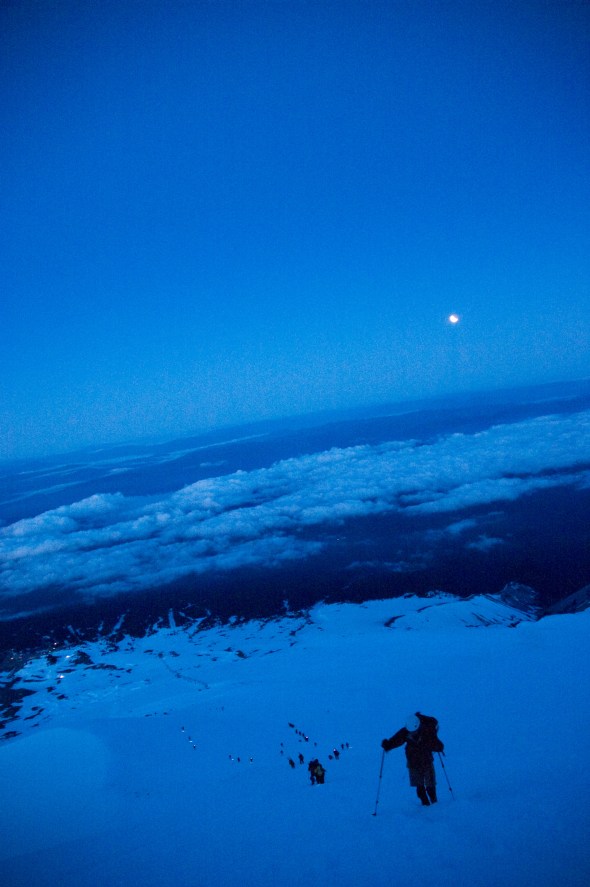
Now in crampons, our group at first stays together as we climb toward the most prominent reminder of Hood’s last eruption 200 years ago, Crater Rock. But we’re catching up to people and people are catching up to us, and the bodies begin to blend. There are times when I’m sure I’m following Daryl, only to find out it’s Alan; times when I think that’s Trin right behind me until a friendly stranger passes by.

A few hours in, the moon has crested its arc in the southern sky, but something is different about it now. What had been a moon one day short of full is now more of a waning gibbous, with the right edge shaded over. It’s subtle at first, but the higher up we get, there’s no mistaking it: a lunar eclipse.

At the base of Crater Rock, it gets even better. The sunrise slowly and silently projects Hood’s massive morning shadow onto the southwestern sky. It’s always been one of my favorite spectacles, but now, with the early sky pale blue, pink and orange, the dark mountain shadow rising like a pyramid and the eclipsing moon hanging over it all, there is little to do but stop and wonder.

Not for long though. A sluggish rope team has just crept up to our vantage point. Why they are on a rope here, atop this gradual slope, we’re not sure, but we take it as a sign that we better keep moving.

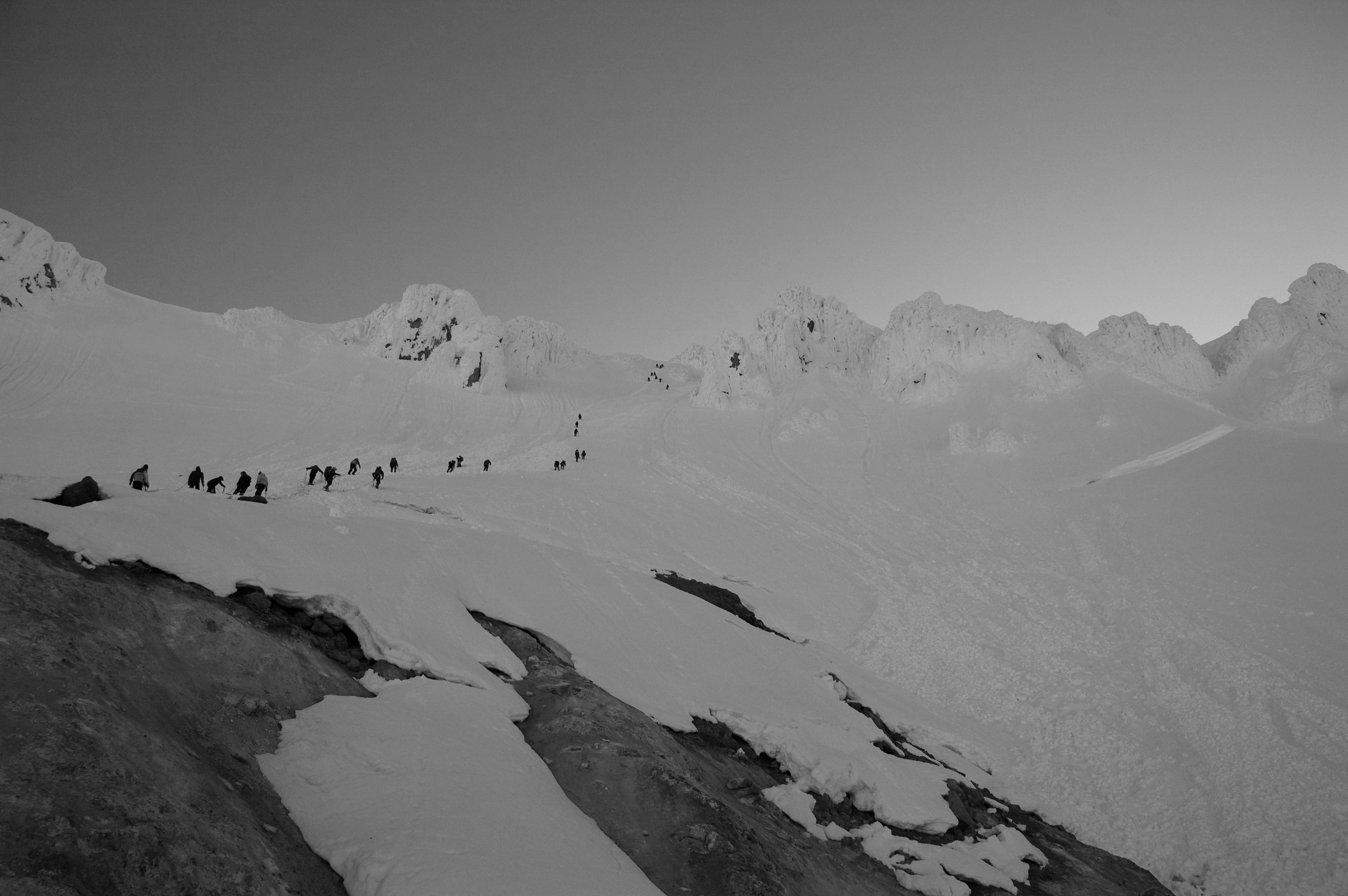
Trin drops back a little but isn’t far behind as we cross the Hogsback and head up the broad, steep face known as the Old Chute. It’s amazing how many people are already ahead of us, inadvertently kicking down ice chunks, clogging the chute and otherwise imparting a real sense of unease. Rope teams inch up; one has eight people, most of them teenagers without packs who have tied the rope directly around their waists.
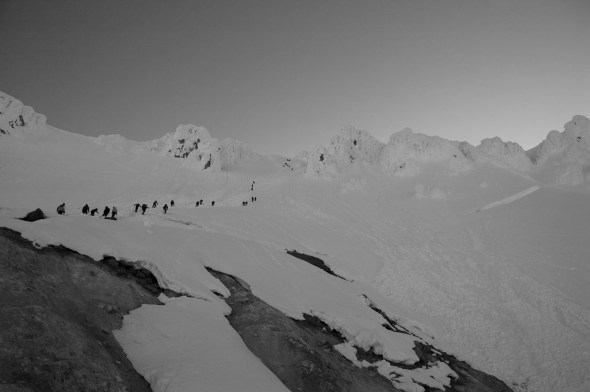
We skirt some of these uneasy teams by heading out of the boot track. It makes the climbing much faster, but also steeper and harder. By the time we hit the summit ridge, Daryl has had enough, so he enjoys the view from there. I hear him say something, but my focus is absolutely frozen on the path in front of us: for the first 25 feet of the traverse over to the true summit, the narrow track is edged on the left by little more than fresh air.

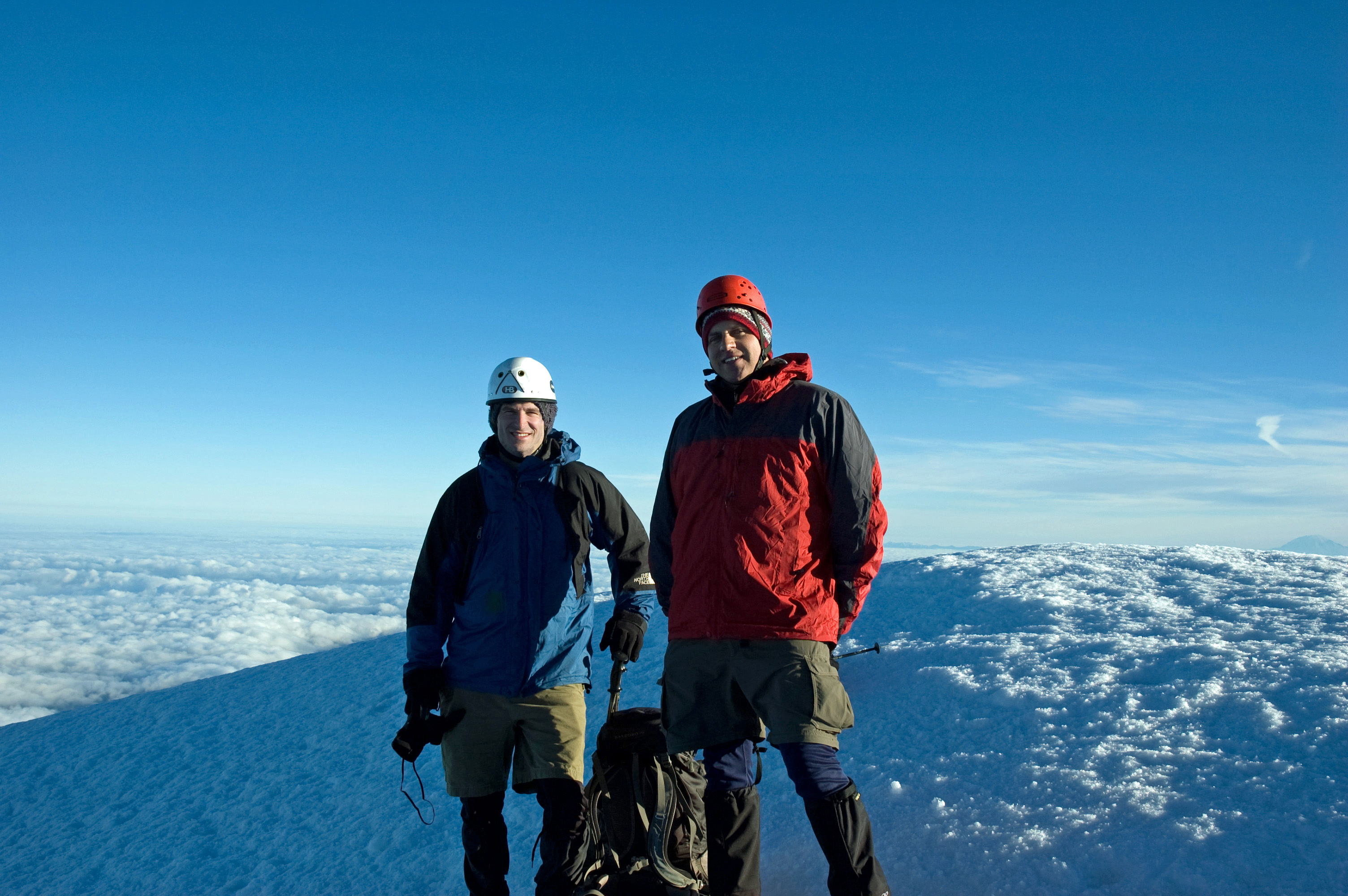
The summit view is as expansive as always: St. Helens, Rainier, Adams, Jefferson, the Three Sisters, everything. We relish it, but briefly. More and more people are on their way up, so Alan and I stand atop Oregon just long enough for a photo, a refresh and a high five.

On the way down, we pass Trin, who’s gotten stuck behind the slow-moving train. He’s done Hood by himself before, but I still can’t help but feel that we should have all stayed together. We didn’t though; we just didn’t.

The climb down the chute is sketchy. Not only is it steep, but it’s crowded as an amusement park. There are rope teams coming down and going up and tumbling ice all around. People make lighthearted comments to ease the tension, but it’s neither the time nor place. I vow, once more, to never again climb the South Side on a weekend.

Finally, we make it back down to the relative safety of the Hogsback. Daryl and Alan head down, but I hang there in the mountain sunshine to wait for Trin. At one point, I count at least 62 people in the chute. Crazy.

At last there’s Trin in my telescope, making his way down the chute so, reassured, I turn and take the first of many more steps back down the mountain.
Mountain View

All over the city of Portland there are fantastic views of Mount Hood. Council Crest. Rocky Butte. Mount Tabor. Waterfront Park. The list goes on. The view of Mount Hood from Portland, actually protected by the city in the 1970s and again in 1991, makes for one of the most unique horizons from a downtown anywhere.

But there’s one vista that’s been eluding me for years. I’ve been meaning to take it in ever since it became accessible in 2006, but for one reason or another, I haven’t.

On Friday, however, I finally did.
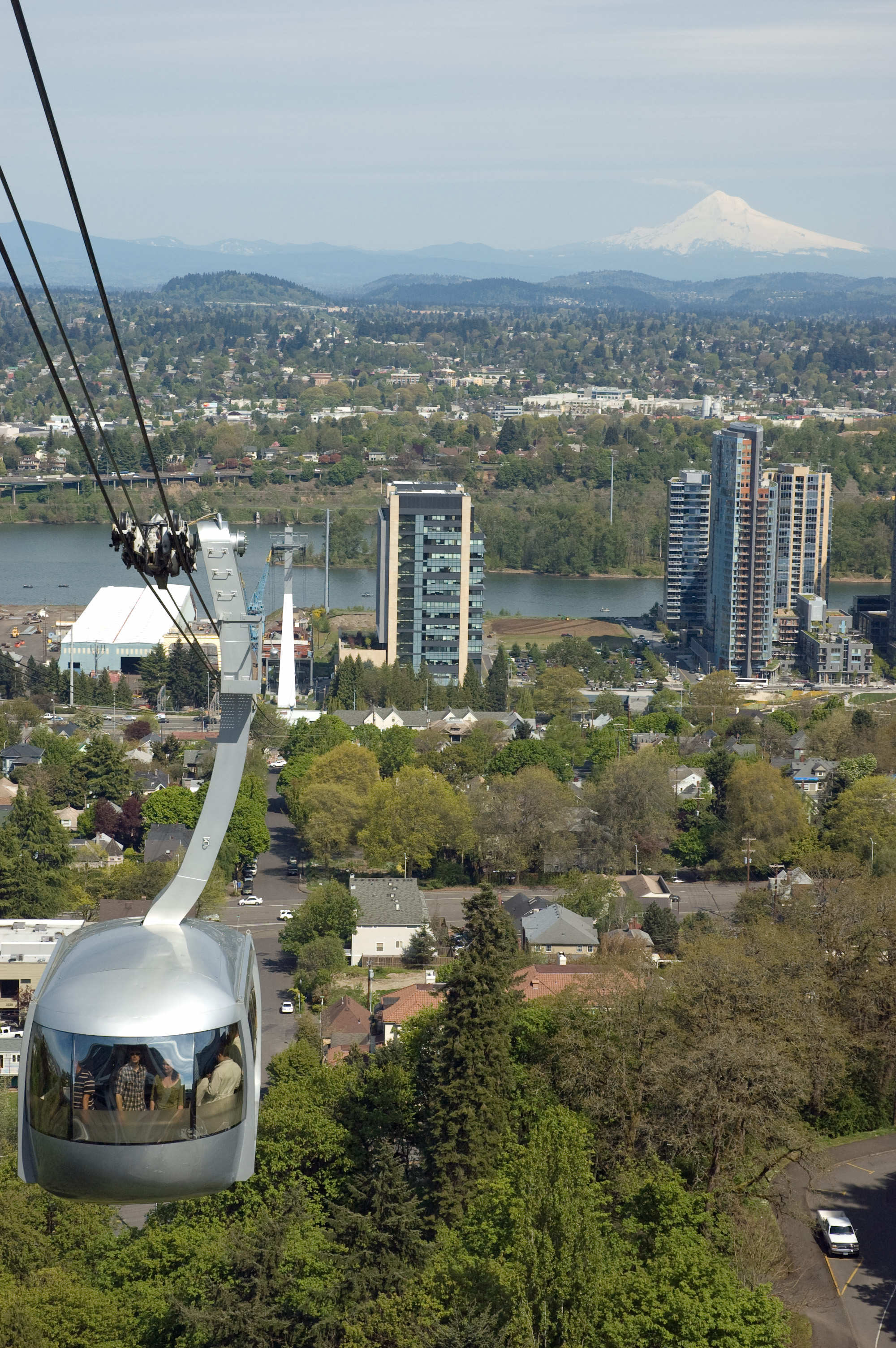
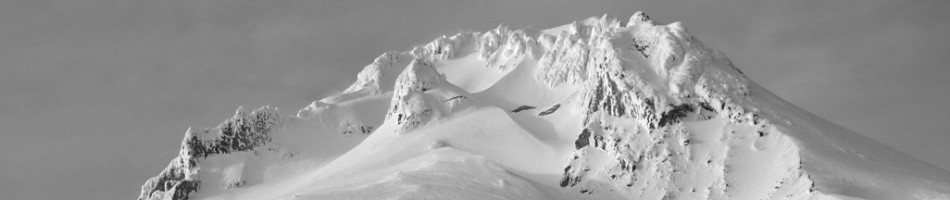
We took advantage of an unseasonably warm and sunny afternoon and headed to OHSU to ride the tram up to the top of Pill Hill. Just $4 for a roundtrip ride, the tram offers a smooth though swingin’ trip 3,300 feet up the hill. It cruises at about 22 miles an hour, takes about three minutes to make it from one end to the other, and offers incredible views of Portland, the Willamette River, Mount St. Helens, Mount Adams, and, yes, Mount Hood. A view worth taking in, for sure.