The Book. The Mountain. Everything in between.

Latest

Music with Mount Hood

I had my first Pickathon experience last summer, and it was a great one.

But I’m not going to write about that experience here or now. Instead, I’m going to share a quick photo that illustrates just how an incredible music festival just outside of Portland is somewhat tied to Mount Hood.

Pickathon 2010

I’m also going to share a cool Pickathon project that a friend of mine, Portland photographer Tim Labarge, has embarked on. It’s one that I contributed a story to and that I’m hoping gets all the support it needs.

I’ll just let the words from his Kickstarter site do the talking:

Pickathon is one of the finest music festivals in the world. We want to celebrate this festival by creating an equally beautiful and inspiring book.

Each summer, thousands of folks gather at Pendarvis Farm near Portland, Ore. to enjoy amazing music and each others’ company. This festival has quietly become a model worth emulating for the quality line-up of musicians, the eco-friendly details and the presence of so many kind people in one place. It’s an event to remember.

I was recently sifting through my archive of images from the past five years at Pickathon and decided it was time to gather some of them into a book. So designer Patrick Barber and I began to add layers: essays from writers, words and observations from musicians who have performed at the event and more.

Through pictures and words, compiled and shaped into a beautifully produced book, we want to take you to Pickathon. Maybe you’ve been to the festival. Maybe you haven’t. This collection of images and thoughts will give you a sense of what kind of magic all these amazing people can create over three days in August.

Pickathonography Vol. 1 will be:

  • 96 pages of beautiful, full-color photographs
  • essays by music writers and musicians
  • softbound with heavy cover stock
  • keepsake quality
  • sewn binding
  • FSC certified paper
  • designed by McGuire Barber Design
  • limited to 2000 copies
  • available at the festival this year and online through Pickathon

Your support will help cover the costs of production and printing. Thank you for helping make this happen.

25 years ago . . . the OES tragedy on Mount Hood

Today marks 25 years since the worst climbing accident in all Mount Hood history: Nine dead, seven of them high school students from the Oregon Episcopal School. They’d been part of a team climbing the mountain for OES’ annual Basecamp Wilderness Education Program. The weather turned hellish, they didn’t turn around, the climb fell apart. Searchers found three bodies two days later; six more the next day in a snow cave buried under five feet of snow, but also, miraculously, two survivors.

For a number of reasons, I didn’t dwell too deeply on the OES disaster in On Mount Hood. I did touch on it, of course, and I also wrote briefly about its legacy on Mount Hood 25 years later for Portland Monthly this month. The latter story included an interview with Rocky Henderson, a well-known search-and-rescue volunteer whose very first mission ever with Portland Mountain Rescue was the OES climb.

“It was so frustrating,” Henderson told me of the search efforts. “When the weather finally cleared, we thought, ‘OK, now we’re definitely going to find them.’ But we didn’t. By then, there were no clues as to where they were. They had been completely obliterated by the storm.”

Something about climbing accidents intrigues people, myself included. And Mount Hood has had its share of them. But even though I was 12 and living in Ohio when it happened, there’s something singular about the OES accident. The scale of it, the what-ifs, the age of the victims. It’s heartbreaking. I read The Mountain Never Cries, a book by Ann Holaday, mother of Giles Thompson, one of the two OES survivors. I read all of the stories in the Oregonian from during and after the accident, the People magazine story, the piece in Backpacker, and on and on.

It is a sad but incredible story. One worth remembering, always.

Jack Grauer

One of the reasons that I decided to write a book about Mount Hood was because, surprisingly, there really aren’t that many books out there about the mountain.

There are plenty of coffee table picture books and hiking guidebooks, a few great ones on Timberline Lodge, but not many narratives or even history books. The one narrative I could find, Wy’East: The Mountain, was written by journalist Fred McNeil — the name behind beautiful McNeil Point on Hood’s west face —  back in 1937. It is a good read and touches on many different aspects of the mountain. But so much has happened since it was first published and even since it was revised in 1991 that it’s definitely a look at the mountain from another time.

The other prominent book in the story of Mount Hood is a giant volume of mountain information, tales, data, photos, and minutiae compiled, written, and published by a man named Jack Grauer. It’s called Mount Hood: A Complete History.

When I first started researching my book, I bought a copy of McNeil’s book and then two of Grauer’s, one from its original publication in 1975, and then a brand new edition, published in January 2010. The amount of information in his 420-page book is staggering. It includes everything from early pioneer history and climbing stories to detailed biographies of some of the important characters on the mountain and long lists of members of various search and rescue organizations. Unlike my book, Grauer’s is more encyclopedia or reference manual than narrative, but it is an essential volume for anyone who really wants to know about Mount Hood.

The deeper I got into my research, the more I consulted Grauer’s book and the more I heard his name mentioned. Everyone I talked to seem to bring up Jack Grauer. So I finally decided that I simply had to meet him and talk about his book and his own experiences with the mountain.

We met at Home Town Buffet in southeast Portland last summer, and for a couple hours over salad and baked chicken and mashed potatoes, we talked about Mount Hood. Charming and sharp at 89 years old, Grauer told me how he’d first fallen for the Cascades after a stint in the U.S. Army Air Corps during World War II. He started climbing in Seattle, then made his first climb of Mount Hood in 1947. By the time he stopped climbing the mountain for good in 1994, he’d hit the top 227 times.

Trained in journalism, Grauer told me he’d taken on his Mount Hood book in the early 1970s simply because nobody else had. The information in his book, the information behind the mountain, is important, he said, and it needed to be compiled and preserved.

Since its first publication in 1975, Mount Hood: A Complete History has gone through numerous revisions and editions. The one I bought in January of 2010 was the eighth edition, but Grauer continually prints new ones to keep up-to-date and to correct past errors. My version was printed on January 18, 2010. As of our meeting last summer, he was still printing them and binding them himself at his home in Vancouver.

At the end of our lunch, I thanked Grauer, shook his hand, and headed out. I felt glad that I’d gotten the chance to sit down and talk with someone who seemed to have such a true reverence for Mount Hood, someone who felt it was important to write about the mountain and share its story with other people. I felt like I’d talked with one of the mountain’s most important advocates. And I had.

Save the Date!

Even though I got an advance copy of my book last week, it’s still not technically available. Yet.

But on June 2, On Mount Hood: A Biography of Oregon’s Perilous Peak will officially be available online and on the shelves at places like Powell’s Books, Annie Bloom’s Books, and Barnes & Noble. (More locations to come.)

To officially kick off the book, we’ll be having a launch event at Powell’s Books on Hawthorne in Portland at 7:30 p.m. Thursday, June 9. There will be a mountain slideshow, some hors d’oeuvres and, of course, books. And after that, maybe a few beers in the neighborhood to celebrate.

Everyone’s invited. Everyone!

Head for the mountains

Just as there is great food to be had around Mount Hood, so too are there great beers.

Certainly, just about anything hits the spot after an all-night climb, a three-day backpack, or even a lazy day on the Muddy Fork of the Sandy River. But when discretion is yours, there are plenty of fantastic, locally-made brews available to render mass-produced swill entirely irrelevant.

A few favorites:

Hood River’s stalwart brewery — and the third-largest in Oregon — Full Sail has always been a favorite for post-hike unwinding on the north side of the mountain. (I profiled the brewery’s founder and CEO in 2010 too.) There was a time when the only reason to visit this scenic brewery and pub overlooking the Columbia River was the beer — no real problem with that — but they’ve since renovated the pub and broadened the menu, upping the ante. I’ve long been partial to their hoppy and refreshing IPA, but their Session lager, in its stubby 11 oz bottles, is great for river days, and Wassail is one of the best holiday brews every yuletide season.

A little pricey at times up on the mountain, Mt. Hood Brewing Co. nonetheless brews a few fine beers, namely their Ice Axe IPA. And not only does a pint taste even better when you score a window seat in the Ram’s Head Bar with a clear view of Mount Hood just outside, but their old-school logos and alpine-inspired names — Hogsback Oatmeal Stout for one — make Mt Hood Brewing’s just the right kind of libations for the mountain.

Now in its fourth year, Double Mountain Brewery in Hood River makes a heavy IPA — Hop Lava — and they fire a great pizza. Even better: this small brewery’s beers are on tap at its Hood River pub, at more than two dozen local establishments, and at more than 100 places in the Portland metro region.

Happy Mother’s Day

It’s Mother’s Day, and every year on Mother’s Day, I not only remember to call and send my love to my mom in Ohio, but I also think about a particular Cascade mountain. Not Mount Hood, but St. Helens, which lies about 60 miles northwest of Hood.

There’s an incredible tradition that happens every year on Mount St. Helens on Mother’s Day. Amy and I have been part of it twice during our time in the Northwest, and I have to say, it’s one of the most unique ways to express appreciation for the mother in your life that I’ve ever come across.

In honor of Mother’s Day 2011, here’s a column I wrote about that tradition back on May 18, 2002, when I was honing my chops as a reporter and photographer for the Canby Herald newspaper.

Enjoy, and Happy Mother’s Day.

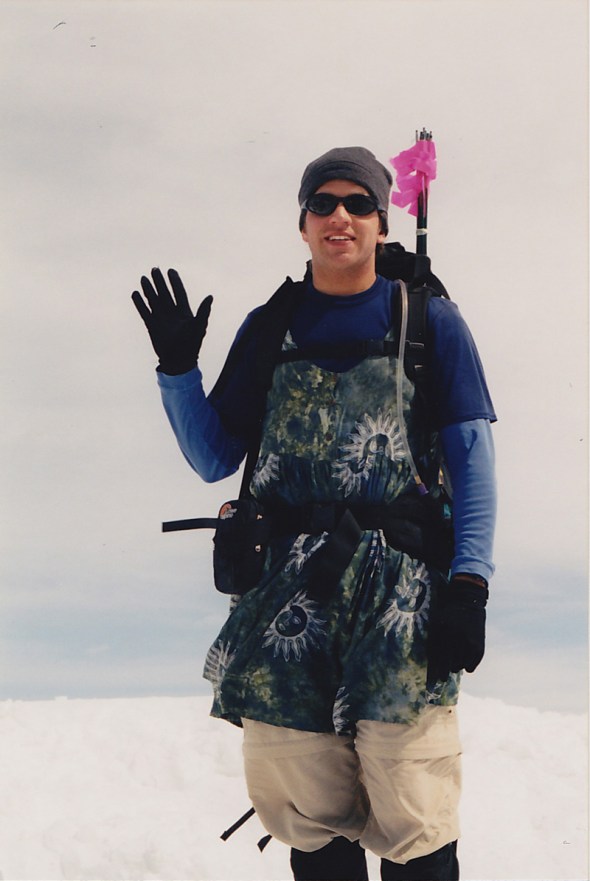
Last Sunday was Mother’s Day, and in honor of my wonderful mother, I sent a card, made the ritual phone call, and donned a blue and green tie-dyed dress for a climb to the top of Mount St. Helens.

Indeed, it was not your average Mother’s Day tribute.

But like all of those faithful sons and daughters who either bought Mom a bouquet or made her breakfast in bed on Sunday, I was not alone in my gesture of appreciation.

For one, my fiancée, Amy, was with me on the mountain. She, too, paid homage to her wonderful mother  — my soon-to-be mother-in-law  — by wearing a dress for the long slog up the Pacific Northwest’s most infamous volcano. (By the way, St. Helens, also known as Loowit, blew its top exactly 22 years ago today.) I reluctantly concede that Amy’s dress, with its purple, blue and pink floral patterns, was much more flattering on her than mine was on me.

And then there were the literally hundreds of other climbers who made their way up and down the mountain on Sunday. The majority of them were bedecked in dresses, skirts and gowns similar to those no doubt on display at Mother’s Day brunches — or weddings, proms, square dances or Scottish caber tosses — across the country.

On our way up and down, we saw polka dots and stripes, flowers and paisleys. There were miniskirts, bridesmaid dresses, kilts, and old schoolmarm frocks. We also noticed costume pearls, a hot-pink feather boa, and at least one blonde wig.

Amy making her way up St. Helens on Mother’s Day 2002. 

Lest the reader be mislead, these garments were worn, in most cases, over the standard climbing ensemble. Under the sunshine and blue skies of last Sunday, that included stiff boots, synthetic pants and shirts, backpacks, sunglasses, and the most essential of accessories, the ice axe.

There were, of course, those fellow climbers who were unaware of the fashion protocol of the day. One bewildered alpinist heaved up to us just below the summit, a perplexed look on his face.

“Can you explain something to me?” he asked. “What’s with all the dresses?”

We smiled between gulps of water and wished him a happy Mother’s Day.

Rumors abound as to the origin of the Mount Saint Helens Mother’s Day tradition. Perhaps it began with the Bergfreunde Ski Club, a Portland-based ski club formed in 1966 to promote skiing and other recreational activities. I called these “mountain friends,” but they weren’t sure if their club had formally come up with the dress idea or not.

I next tried the Mazamas, one of the larger and more well- known mountaineering groups in the Northwest. Their club, the name of which is Nahuatl for mountain goat, has been associated with the local mountaineering scene since July 19, 1894. It was on that date that prospective members of the club first convened on the summit of Mount Hood.

“It may have just been one of those spontaneous things that caught on,” one club member said of the Mother’s Day tradition. “Who really started it, I don’t know.”

There’s also the Ptarmigans, another climbing club that has been exploring the Cascades since the mid 1960s. Mike Dianich, a member and longtime mountaineer who has climbed Saint Helens 22 times as of Sunday, said other than the local climbing clubs, he didn’t know who may have slipped into the first Mother’s Day dress on Mount Saint Helens.

But if the origin of the tradition remains a mystery, the reasoning behind it is a bit more definitive. Simply put, those who climb the 8,300-foot volcano in a dress on Mother’s Day are honoring their moms, thanking them for all they have done over the years.

It is also a gesture of obeisance from those sons and daughters who live far away from their mothers; from those who, like me, cannot express their gratitude in person every year on Mother’s Day.

So this year, as Amy and I plodded more than 5,000 feet up the flanks of St. Helens in our dresses, I thought of my mother and how she has helped me become who I am; how she has shared her kindness with me and given so much of herself  — all so that I can enjoy the life that I do.

And when we got to the top of the mountain, with Spirit Lake down below and Mount Rainier and Mount Hood floating in the distance, I looked east toward Ohio, and waved to my mom.