Mount Hood stories
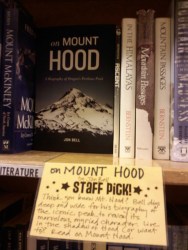
One reason that a book about Mount Hood seems like such a natural fit is that just about everyone here in Oregon and, really, the Northwest, seems to have a story about it. Theirs may be that they climb it or ski on it, look at it from afar, or simply spend time up at Timberline Lodge every so often. Whatever it is, I’ve found that just about everyone I come across has a story to share about the mountain.
Today, at the Atkinson Book and Author Fair, I talked to a great bunch of authors, who’ve written books about everything from the Civil War and the history of Estacada to being paralyzed and in a wheelchair for nearly 30 years.
Each of the authors I talked to, however, also had their own stories to share about Mount Hood. One recounted a climb he made years ago that found him in a complete whiteout on the descent, all the way back down. His party couldn’t tell they’d returned safely until their ice axes scraped against the asphalt of the parking lot at Timberline Lodge. Another woman had a brother who climbed Hood years and years ago. The person in front of him on the rope fell into a crevasse and died, but he himself was fine. Another author, who ended up in a wheelchair after a tragic accident more than two decades ago, remembered with humor a trip to Timberline Lodge that found her crammed into a tiny elevator full of tables and chairs, that being the only way she could access the main area of the lodge.
The stories are great — and just keep coming and coming. To me, it says something about just how influential Mount Hood is in the lives of so many people.
Remembering Steiner Cabins
Reading the Oregonian this morning, I came across a bit of sad news: John Steiner, a master craftsmen who, along with his father, Henry, built some of the most unique mountain cabins up near Mount Hood, passed away on Friday. He was 99.
I never got to meet him, but I’ve talked to some people who have. And I’ve also been lucky enough to spend a little time in one of his unique and charming Mount Hood cabins. In honor of such a one-of-a-kind legacy, here’s a post I wrote up last year about a memorable weekend in a most memorable Steiner Cabin.
STEINERS
Father’s Day weekend this year was a rainy and gray one. The water came in a nearly unending stream and the wooly clouds parked overhead and didn’t budge.
I’d had a book signing at Wy’East Book Shoppe & Art Gallery in Welches that Friday night — the last sign of sunshine for a few days — but rather than head back home afterwards, we decided to make a weekend out of it.
We did so in a Steiner cabin up in Government Camp, thanks to some very generous friends who were lucky enough to come across one of these unique little getaways a few years ago.
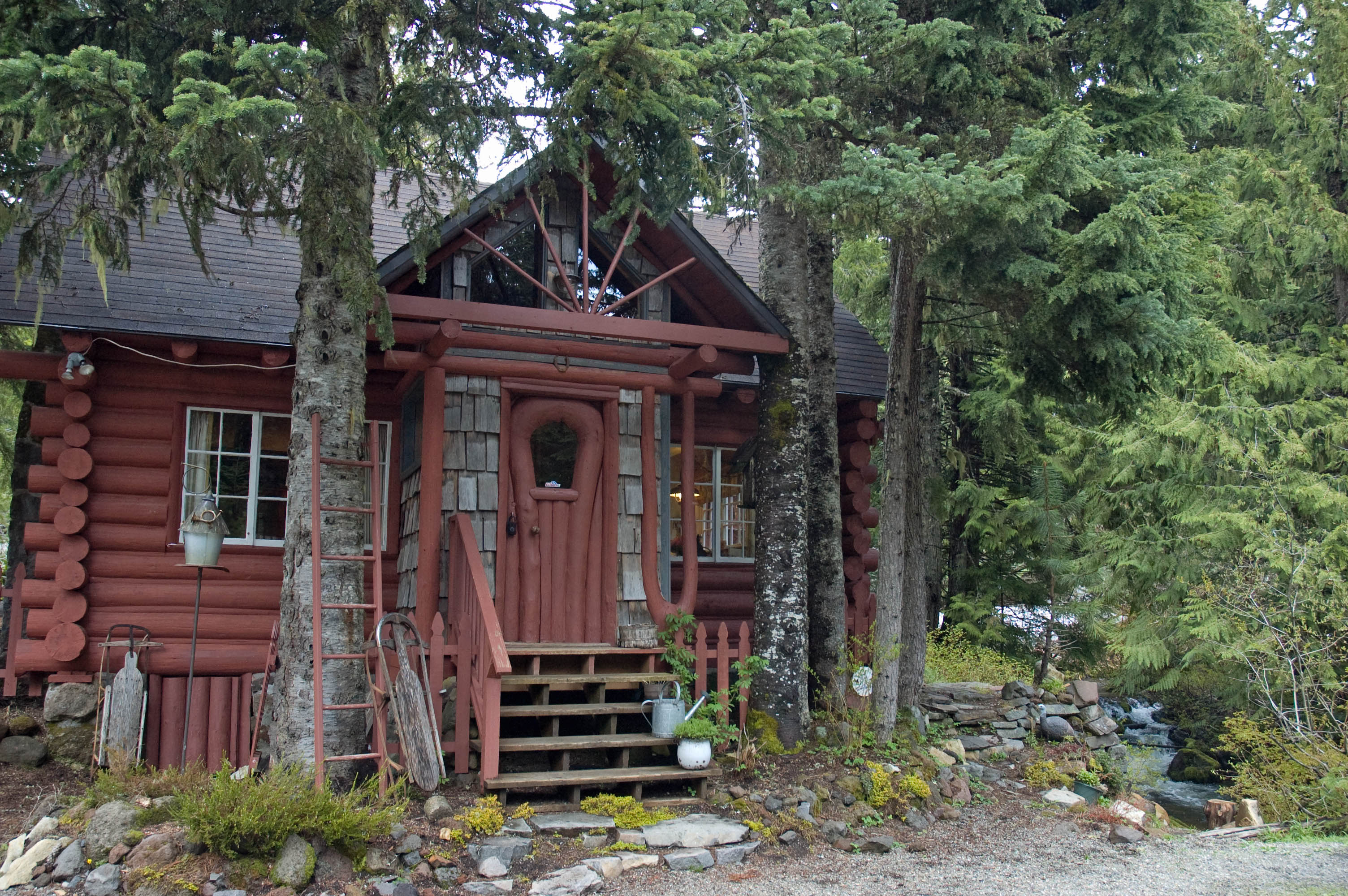
Built over two decades by a German craftsman named Henry Steiner beginning in the late 1920s, Steiner cabins stand apart from other alpine hideaways on Mount Hood for their singular accents and ingenious incorporation of natural elements. Steiner and later, his son, John, built the cabins by hand — without power tools — and used nearby materials as much as possible: glacial stones, river rocks, Douglas firs and other on-site timbers they hewed themselves. (Henry Steiner also hand-hewed the towering fir columns at Timberline Lodge over just two weeks in the late 1930s.)

One of the most unique features of many of the 30 or so cabins sprinkled between Rhododendron and Government Camp are snow-bent timbers that the Steiners used for rounded doors and other architectural elements.
The Steiners also fashioned natural, functional accents for their cabins, using burls from trees for doorknobs and hand-carving pegs and lever mechanisms to open and close doors and windows. 
The weekend we stayed in a Steiner, raindrops slid off the overhead boughs outside and a crystalline stream gushed without end. An ugly mist kept us from venturing out beyond a few trips to the general store and a quick jaunt up to Timberline Lodge for an afternoon outing. Inside the cabin, the rustic smell of woodsmoke permeated the timbers in a welcoming way. A fire in the stone fireplace added warmth and a glow to the room. We stayed close inside the Steiner for nearly two days straight, and it was just right.
Lakes of Mount Hood — and Oregon
Mount Hood and the Mount Hood National Forest are home to an absolute trove of hydrological resources: creeks, streams, rivers, hidden tarns, ponds, and, of course, lakes. Add up all the surface water across the entire national forest, and you get something close to 71,000 acres — about half the size of Lake Tahoe. There’s so much important and pristine water around Mount Hood that I wrote a whole chapter about it in my book.
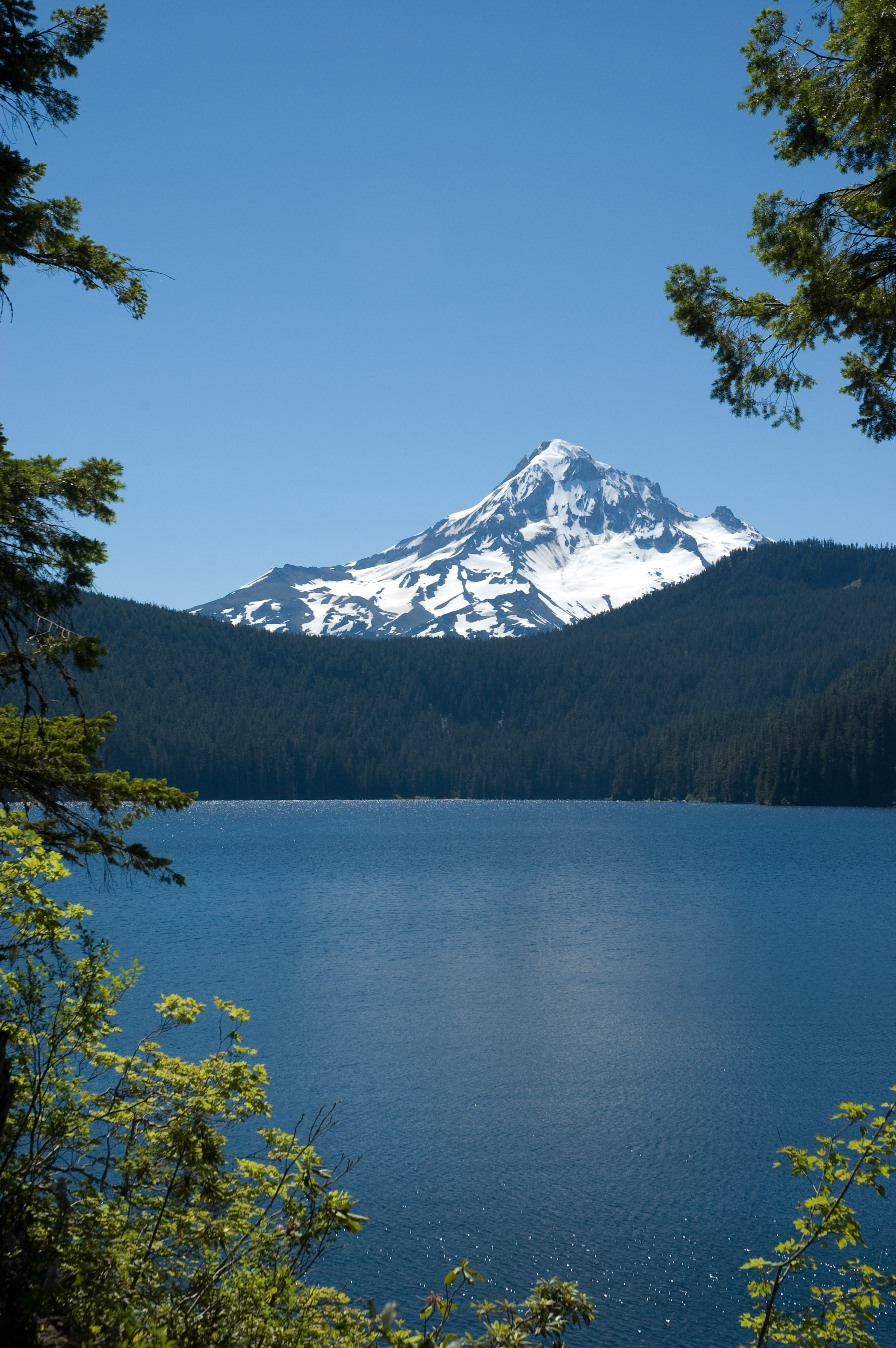
Bull Run Lake
With the spring sun shining and hints of the coming season in the air, today seems an ideal day to share Portland State University’s new Atlas of Oregon Lakes. The online index, which I read about this morning on Terry Richard’s blog at The Oregonian, contains 215 lakes all over Oregon. The majority of the entries include maps, detailed descriptions, interesting stories and lore, photos, and other great information for either planning a trip or just broadening knowledge.
It’s not comprehensive by any means, but it is fairly extensive and includes some of the gems around Mount Hood: Lost Lake, Bull Run Lake, Trillium Lake, and many others. Another great resource for exploring not only the mountain, but the national forest and the entire state.
Shorty’s Corner
On the way to Mount Hood from Portland, there’s a little gas station and cafe just southeast of Sandy on the right side of Highway 26. I’ve passed it countless times on the way to the mountain and back over the past 15 years, but never stopped there. I’m not sure why. Maybe I’ve just never needed gas or a quick bite to eat right then and there. (And to be quite honest, whenever we’re coming back from a hard day on the mountain, a day on which we’ve earned it, we’re stopping for Mexican at El Buro Loco in Welches or burgers and beers at Calamity Jane’s in Sandy)
But I’ve almost always been intrigued by the name of this little roadside stop: Shorty’s Corner.
We got one step closer to stopping at Shorty’s Corner this past weekend. Not because we headed up to Mount Hood, but instead because we were toasting the times at Wurstfest, an annual mini Oktoberfest held in tiny Mt. Angel every February.

After a few hours of music, dancing, and a couple nice pilsners from Silverton’s 7 Brides, we walked up the road for a fantastic dinner at the Mt. Angel Sausage Company. Just as we were ordering up, in came three of the members of the Greg Meier Bavarian Quartet, who’d just finished up a great set over at the fest. But they weren’t done playing yet. And because we were one of the only tables in the place at the time, we ended up getting pretty much a private, table side concert from a talented and spirited group of authentic musicians.
 The tie to Shorty’s Corner came as we traded words with Meier, the accordion player and leader of the group. Over a round of “Ein Prosit” and a German-infused medley of Disney tunes, I told Meier about my book and he told us about Shorty’s Corner. His parents have owned it for 33 years.
“Stop by and say hi next time you’re up there,” he said.
Now, we definitely will.
The Mazamas
Probably no other outdoor organization has a closer or more unique tie to Mount Hood than the Portland-based Mazamas.
Now close to 3,000 members, the Mazamas started out much more humbly, with 105 charter members way back in 1894. What’s incredibly unique about the club’s founding is that it happened on the very summit of Mount Hood.
An advertisement in area newspapers invited committed mountaineers on a climb set for July 18, 1894. More than 300 people turned out at various base camps; close to 200 of them summited that day. This picture, probably my favorite historical photo of the mountain, shows a long string of climbers making their way up the Cooper Spur route on that inaugural climb.

Courtesy of the Mazamas
Since that day, the Mazamas have grown and flourished as an organization, teaching thousands of people how to climb, leading countless trips into the Cascades, conducting and supporting scientific research, standing up for the environment, and educating people about all things alpine and outdoors. The club offers more than 700 hikes and 300 climbs annually, has an incredible library and historical archives packed with tens of thousands of documents and photographs — a huge resource during my research for On Mount Hood — and also hosts regular Evening Travel Programs every Wednesday between October and April.
I gave my presentation about On Mount Hood to more than 50 Mazamas and others who turned out at the Mazama Mountaineering Center last night. One of the best turnouts I’ve had so far, and by far one of the most enjoyable. There’s something about being among so many other people who have such a personal connection with the mountain, as I do.
Thanks much to the Mazamas.
Weekend of books
It starts today with the first of three events and runs through 4 p.m. on Sunday afternoon. It’s a great way to find great books — and not just On Mount Hood — on sale for Christmas.
Book signing, 1 p.m. to 3 p.m. Thursday, Dec. 1, at The Willamette Store’s annual book blowout in Salem.

Book signing, 6:30-9 p.m. Friday, Dec. 2, at Chapters Books and Coffee during First Friday Art Walk in Newberg.

Book signing, noon to 4 p.m. Sunday, Dec. 4, at The Oregon Historical Society’s Holiday Cheer author celebration in downtown Portland.

 On MOUNT HOOD