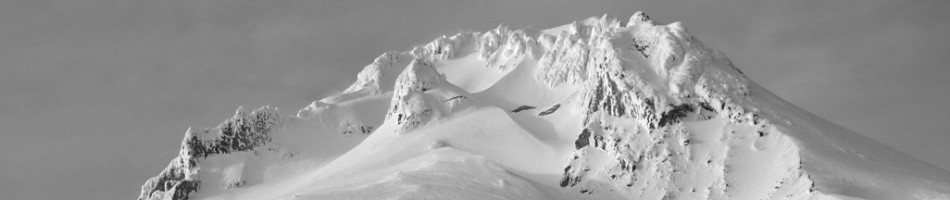
A South Side Climb
Mount Hood, with 8,000-10,000 prospective summit climbers annually, is one of the most-climbed mountains in the world. Most of the people who take it on do so up the South Side route, a roughly 3-mile climb that ascends 5,000 non-technical feet from Timberline Lodge to the 11,239-foot summit. The most welcoming season is mid to late spring, when the bad weather is mostly gone but the good snow’s still there, and the prime time to head out is in the middle of the night. The goal is to reach the summit right around sunrise, not only because that’s a beautiful time of day to be standing on top of a mountain, but because that’s when Hood is still frozen solid and the risk of rock and ice fall is substantially lower than it is later in the day.
What follows is a trip report I wrote up for the Oregonian earlier this year about a climb that some friends and I made up the South Side in 2010. It was one to remember.
The night is, finally, perfect.
Brisk but bearable, a hint of alpine wind, a blue-black sky that would be strewn with stars if not for the nearly full and golden moon rising in the east. From the parking lot at Timberline Lodge, Mount Hood fades into the last light of the day as snowcats quietly rumble up the Palmer Snowfield, their headlights inching slowly, like satellites across an icy expanse.
It’s well past 10 p.m., late June and, it seems, the first weekend of nice weather of the entire season. Since mid-May, my friends Alan, Daryl, Trin and I have been planning and canceling a climb up Hood’s South Side, calling it off week after week for mostly meteorological reasons.
But now, summer has finally arrived, and we are at last suiting up, stretching out and stepping from pavement onto snow. We’ve all done this before — my very first time was in 1999 — but it’s been awhile, so it seems both familiar and new again.
We stop to catch our breath at the top of the Palmer lift at 8,500 feet and confirm what we’d already suspected: everyone else who’s been postponing their climbs is taking advantage of this first nice stint, too. Supposedly 10,000 people climb Mount Hood every year. Tonight, I believe it.
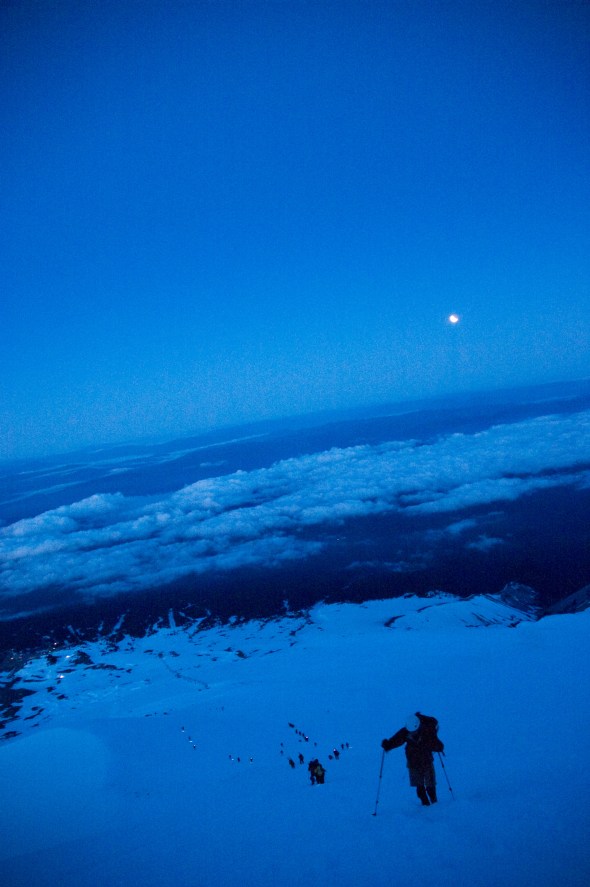
Now in crampons, our group at first stays together as we climb toward the most prominent reminder of Hood’s last eruption 200 years ago, Crater Rock. But we’re catching up to people and people are catching up to us, and the bodies begin to blend. There are times when I’m sure I’m following Daryl, only to find out it’s Alan; times when I think that’s Trin right behind me until a friendly stranger passes by.
A few hours in, the moon has crested its arc in the southern sky, but something is different about it now. What had been a moon one day short of full is now more of a waning gibbous, with the right edge shaded over. It’s subtle at first, but the higher up we get, there’s no mistaking it: a lunar eclipse.
At the base of Crater Rock, it gets even better. The sunrise slowly and silently projects Hood’s massive morning shadow onto the southwestern sky. It’s always been one of my favorite spectacles, but now, with the early sky pale blue, pink and orange, the dark mountain shadow rising like a pyramid and the eclipsing moon hanging over it all, there is little to do but stop and wonder.
Not for long though. A sluggish rope team has just crept up to our vantage point. Why they are on a rope here, atop this gradual slope, we’re not sure, but we take it as a sign that we better keep moving.
Trin drops back a little but isn’t far behind as we cross the Hogsback and head up the broad, steep face known as the Old Chute. It’s amazing how many people are already ahead of us, inadvertently kicking down ice chunks, clogging the chute and otherwise imparting a real sense of unease. Rope teams inch up; one has eight people, most of them teenagers without packs who have tied the rope directly around their waists.
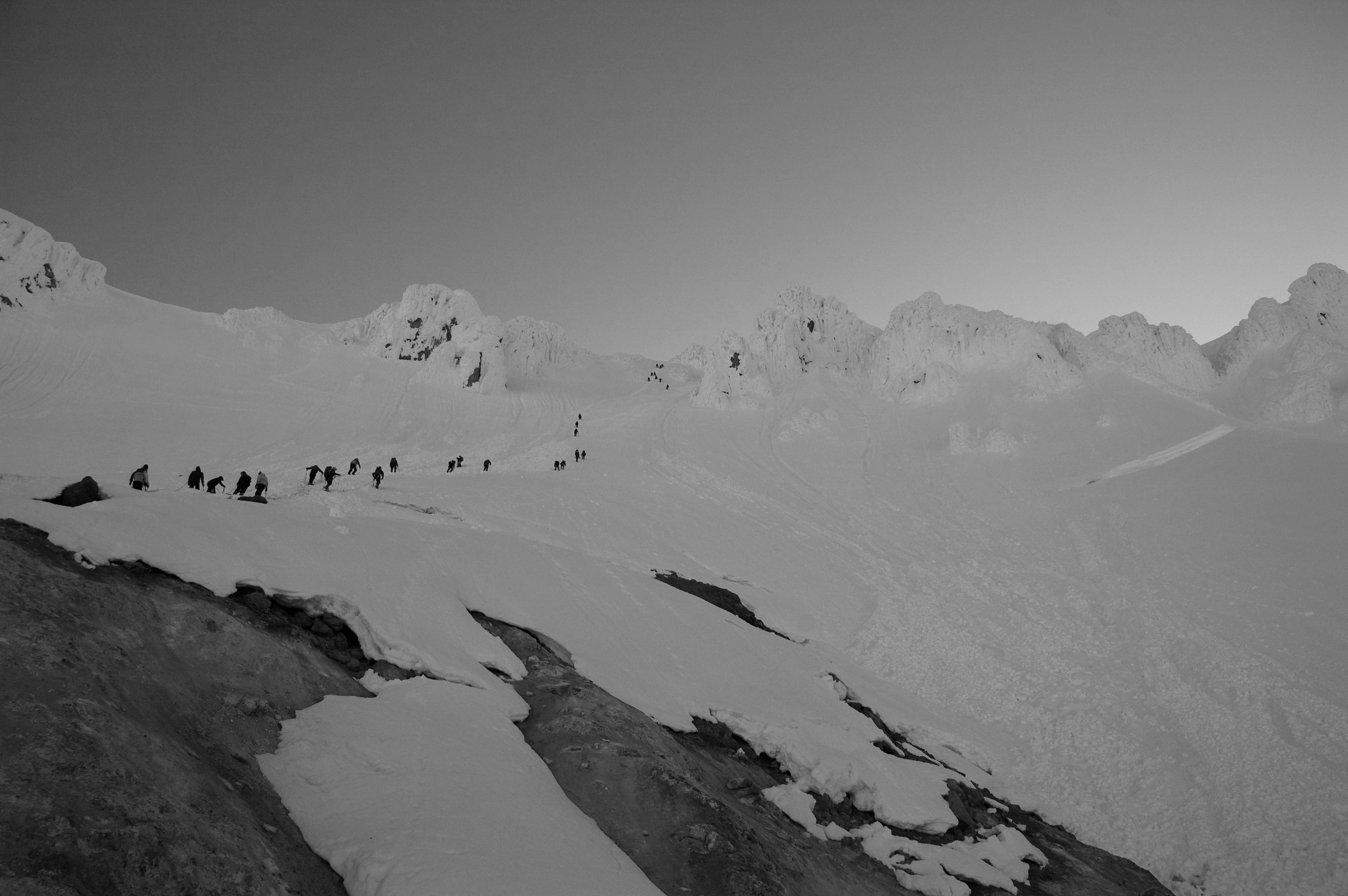
We skirt some of these uneasy teams by heading out of the boot track. It makes the climbing much faster, but also steeper and harder. By the time we hit the summit ridge, Daryl has had enough, so he enjoys the view from there. I hear him say something, but my focus is absolutely frozen on the path in front of us: for the first 25 feet of the traverse over to the true summit, the narrow track is edged on the left by little more than fresh air.
The summit view is as expansive as always: St. Helens, Rainier, Adams, Jefferson, the Three Sisters, everything. We relish it, but briefly. More and more people are on their way up, so Alan and I stand atop Oregon just long enough for a photo, a refresh and a high five.
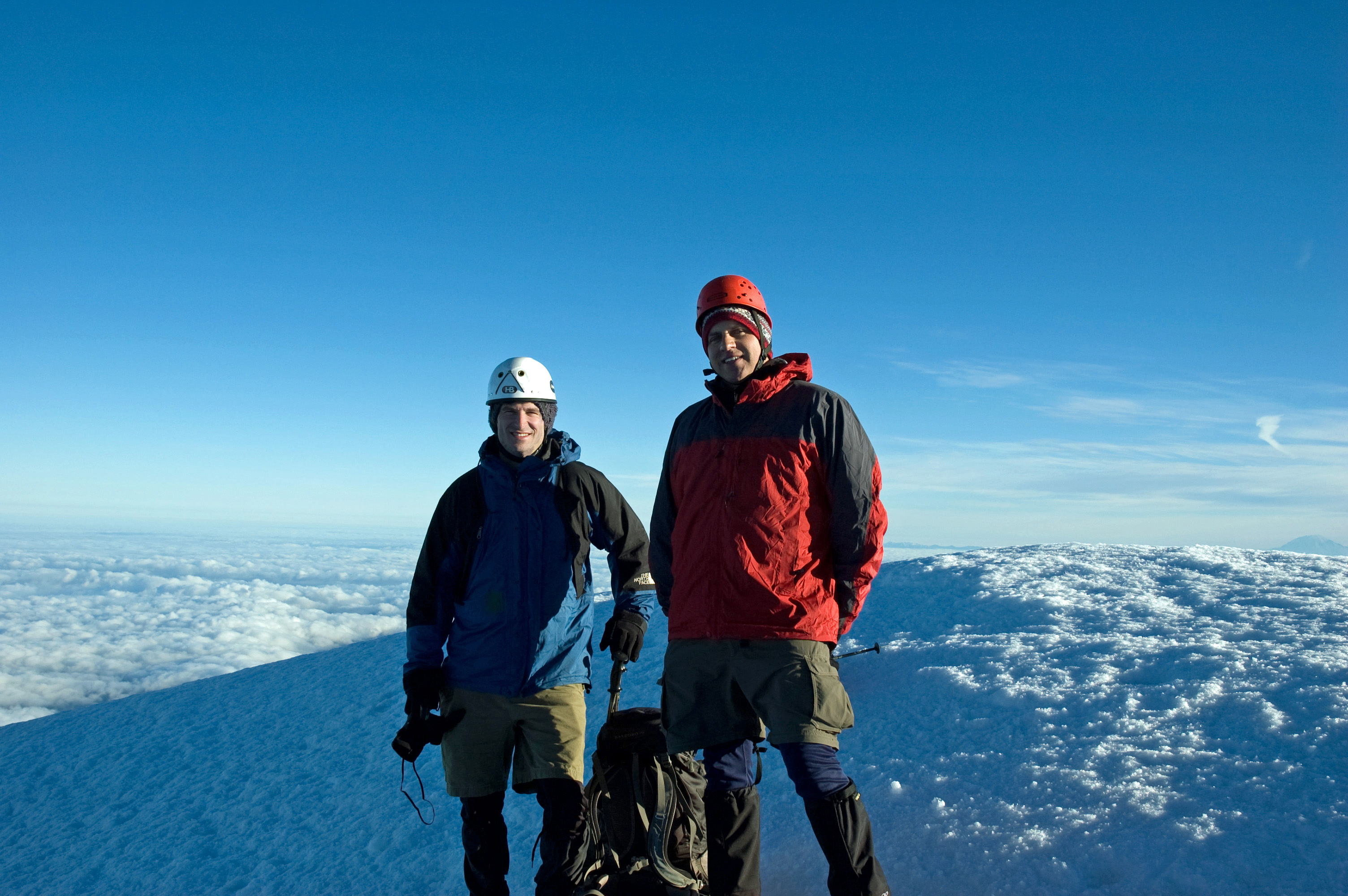
On the way down, we pass Trin, who’s gotten stuck behind the slow-moving train. He’s done Hood by himself before, but I still can’t help but feel that we should have all stayed together. We didn’t though; we just didn’t.
The climb down the chute is sketchy. Not only is it steep, but it’s crowded as an amusement park. There are rope teams coming down and going up and tumbling ice all around. People make lighthearted comments to ease the tension, but it’s neither the time nor place. I vow, once more, to never again climb the South Side on a weekend.
Finally, we make it back down to the relative safety of the Hogsback. Daryl and Alan head down, but I hang there in the mountain sunshine to wait for Trin. At one point, I count at least 62 people in the chute. Crazy.
At last there’s Trin in my telescope, making his way down the chute so, reassured, I turn and take the first of many more steps back down the mountain.
Mountain View
All over the city of Portland there are fantastic views of Mount Hood. Council Crest. Rocky Butte. Mount Tabor. Waterfront Park. The list goes on. The view of Mount Hood from Portland, actually protected by the city in the 1970s and again in 1991, makes for one of the most unique horizons from a downtown anywhere.
But there’s one vista that’s been eluding me for years. I’ve been meaning to take it in ever since it became accessible in 2006, but for one reason or another, I haven’t.
On Friday, however, I finally did.
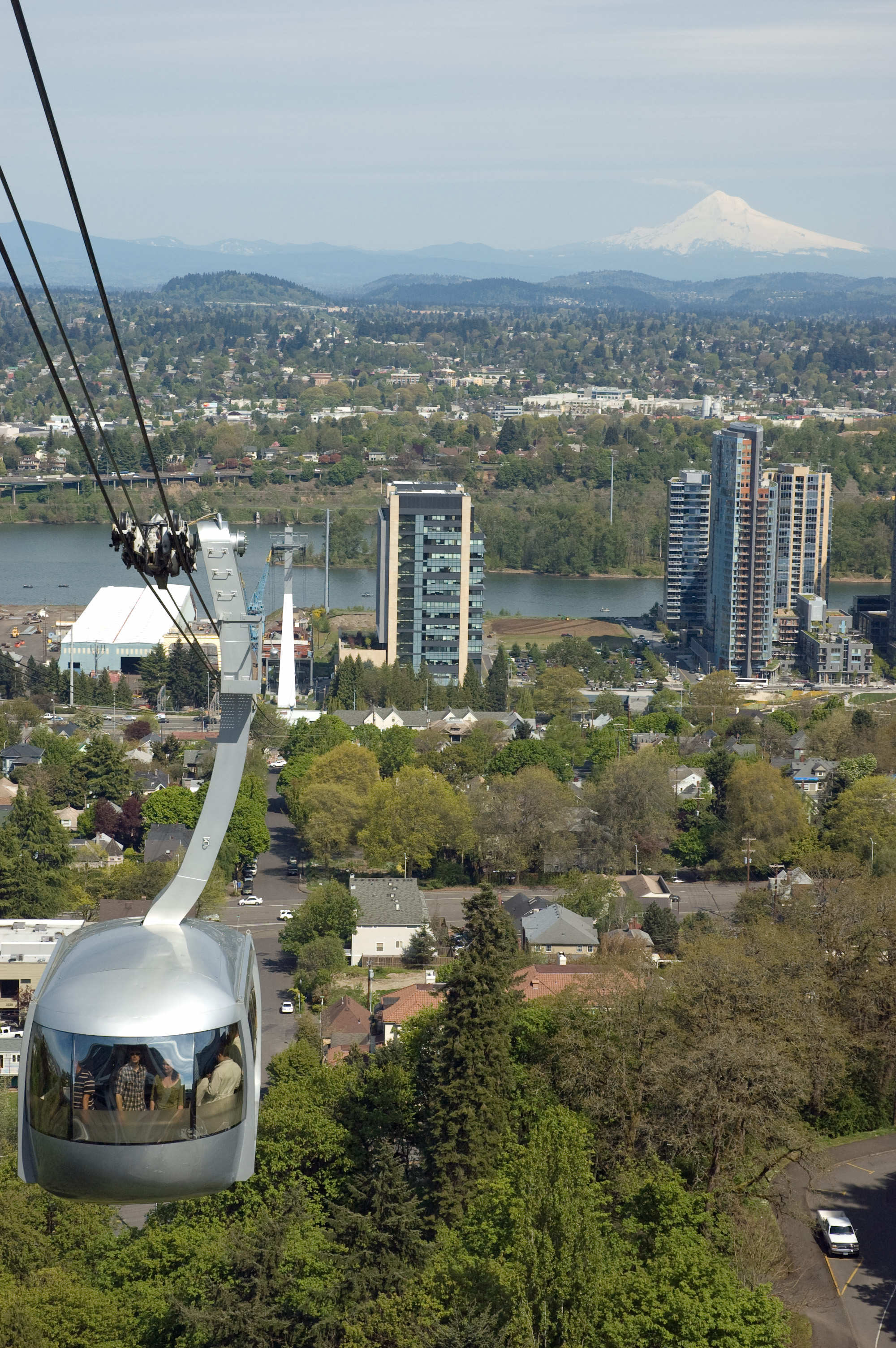 We took advantage of an unseasonably warm and sunny afternoon and headed to OHSU to ride the tram up to the top of Pill Hill. Just $4 for a roundtrip ride, the tram offers a smooth though swingin’ trip 3,300 feet up the hill. It cruises at about 22 miles an hour, takes about three minutes to make it from one end to the other, and offers incredible views of Portland, the Willamette River, Mount St. Helens, Mount Adams, and, yes, Mount Hood. A view worth taking in, for sure.
Music with Mount Hood
I had my first Pickathon experience last summer, and it was a great one.
But I’m not going to write about that experience here or now. Instead, I’m going to share a quick photo that illustrates just how an incredible music festival just outside of Portland is somewhat tied to Mount Hood.

I’m also going to share a cool Pickathon project that a friend of mine, Portland photographer Tim Labarge, has embarked on. It’s one that I contributed a story to and that I’m hoping gets all the support it needs.
I’ll just let the words from his Kickstarter site do the talking:
Pickathon is one of the finest music festivals in the world. We want to celebrate this festival by creating an equally beautiful and inspiring book.
Each summer, thousands of folks gather at Pendarvis Farm near Portland, Ore. to enjoy amazing music and each others’ company. This festival has quietly become a model worth emulating for the quality line-up of musicians, the eco-friendly details and the presence of so many kind people in one place. It’s an event to remember.
I was recently sifting through my archive of images from the past five years at Pickathon and decided it was time to gather some of them into a book. So designer Patrick Barber and I began to add layers: essays from writers, words and observations from musicians who have performed at the event and more.
Through pictures and words, compiled and shaped into a beautifully produced book, we want to take you to Pickathon. Maybe you’ve been to the festival. Maybe you haven’t. This collection of images and thoughts will give you a sense of what kind of magic all these amazing people can create over three days in August.
Pickathonography Vol. 1 will be:
- 96 pages of beautiful, full-color photographs
- essays by music writers and musicians
- softbound with heavy cover stock
- keepsake quality
- sewn binding
- FSC certified paper
- designed by McGuire Barber Design
- limited to 2000 copies
- available at the festival this year and online through Pickathon
Your support will help cover the costs of production and printing. Thank you for helping make this happen.
Happy Mother’s Day
It’s Mother’s Day, and every year on Mother’s Day, I not only remember to call and send my love to my mom in Ohio, but I also think about a particular Cascade mountain. Not Mount Hood, but St. Helens, which lies about 60 miles northwest of Hood.
There’s an incredible tradition that happens every year on Mount St. Helens on Mother’s Day. Amy and I have been part of it twice during our time in the Northwest, and I have to say, it’s one of the most unique ways to express appreciation for the mother in your life that I’ve ever come across.
In honor of Mother’s Day 2011, here’s a column I wrote about that tradition back on May 18, 2002, when I was honing my chops as a reporter and photographer for the Canby Herald newspaper.
Enjoy, and Happy Mother’s Day.
Last Sunday was Mother’s Day, and in honor of my wonderful mother, I sent a card, made the ritual phone call, and donned a blue and green tie-dyed dress for a climb to the top of Mount St. Helens.
Indeed, it was not your average Mother’s Day tribute.
But like all of those faithful sons and daughters who either bought Mom a bouquet or made her breakfast in bed on Sunday, I was not alone in my gesture of appreciation.
For one, my fiancée, Amy, was with me on the mountain. She, too, paid homage to her wonderful mother — my soon-to-be mother-in-law — by wearing a dress for the long slog up the Pacific Northwest’s most infamous volcano. (By the way, St. Helens, also known as Loowit, blew its top exactly 22 years ago today.) I reluctantly concede that Amy’s dress, with its purple, blue and pink floral patterns, was much more flattering on her than mine was on me.
And then there were the literally hundreds of other climbers who made their way up and down the mountain on Sunday. The majority of them were bedecked in dresses, skirts and gowns similar to those no doubt on display at Mother’s Day brunches — or weddings, proms, square dances or Scottish caber tosses — across the country.
On our way up and down, we saw polka dots and stripes, flowers and paisleys. There were miniskirts, bridesmaid dresses, kilts, and old schoolmarm frocks. We also noticed costume pearls, a hot-pink feather boa, and at least one blonde wig.
 Amy making her way up St. Helens on Mother’s Day 2002.
Lest the reader be mislead, these garments were worn, in most cases, over the standard climbing ensemble. Under the sunshine and blue skies of last Sunday, that included stiff boots, synthetic pants and shirts, backpacks, sunglasses, and the most essential of accessories, the ice axe.
There were, of course, those fellow climbers who were unaware of the fashion protocol of the day. One bewildered alpinist heaved up to us just below the summit, a perplexed look on his face.
“Can you explain something to me?” he asked. “What’s with all the dresses?”
We smiled between gulps of water and wished him a happy Mother’s Day.
Rumors abound as to the origin of the Mount Saint Helens Mother’s Day tradition. Perhaps it began with the Bergfreunde Ski Club, a Portland-based ski club formed in 1966 to promote skiing and other recreational activities. I called these “mountain friends,” but they weren’t sure if their club had formally come up with the dress idea or not.
I next tried the Mazamas, one of the larger and more well- known mountaineering groups in the Northwest. Their club, the name of which is Nahuatl for mountain goat, has been associated with the local mountaineering scene since July 19, 1894. It was on that date that prospective members of the club first convened on the summit of Mount Hood.
“It may have just been one of those spontaneous things that caught on,” one club member said of the Mother’s Day tradition. “Who really started it, I don’t know.”
There’s also the Ptarmigans, another climbing club that has been exploring the Cascades since the mid 1960s. Mike Dianich, a member and longtime mountaineer who has climbed Saint Helens 22 times as of Sunday, said other than the local climbing clubs, he didn’t know who may have slipped into the first Mother’s Day dress on Mount Saint Helens.
But if the origin of the tradition remains a mystery, the reasoning behind it is a bit more definitive. Simply put, those who climb the 8,300-foot volcano in a dress on Mother’s Day are honoring their moms, thanking them for all they have done over the years.
It is also a gesture of obeisance from those sons and daughters who live far away from their mothers; from those who, like me, cannot express their gratitude in person every year on Mother’s Day.
So this year, as Amy and I plodded more than 5,000 feet up the flanks of St. Helens in our dresses, I thought of my mother and how she has helped me become who I am; how she has shared her kindness with me and given so much of herself — all so that I can enjoy the life that I do.
And when we got to the top of the mountain, with Spirit Lake down below and Mount Rainier and Mount Hood floating in the distance, I looked east toward Ohio, and waved to my mom.

Mountain legs
I first got into climbing back in 1998, a year or so after we moved to Portland. Amy and I made our way up Mount St. Helens first, then I took a mountaineering course and climbed Mount Hood in 1999. Over the next few years, I ticked off most of the major Cascades, including Shasta, McLoughlin, Thielsen, Diamond Peak, South Sister, Middle Sister, Washington, Adams, and, in 2003, Mount Rainier. I never considered myself a technical climber by any means, just someone who loved — and still loves — to slog up the big boys and see the world from their summits every so often.
But with jobs and houses and, eventually, kids, my climbing slimmed down to a fraction of what it once was. Still, I do my best to tackle at least one of the major Cascades every year. Two years ago, we did St. Helens and Adams; last year, I returned to the top of Mount Hood for the first time in far too many years.
This year, I’m hoping to visit Hood yet again. With On Mount Hood officially coming out in just a few weeks, it only makes sense.
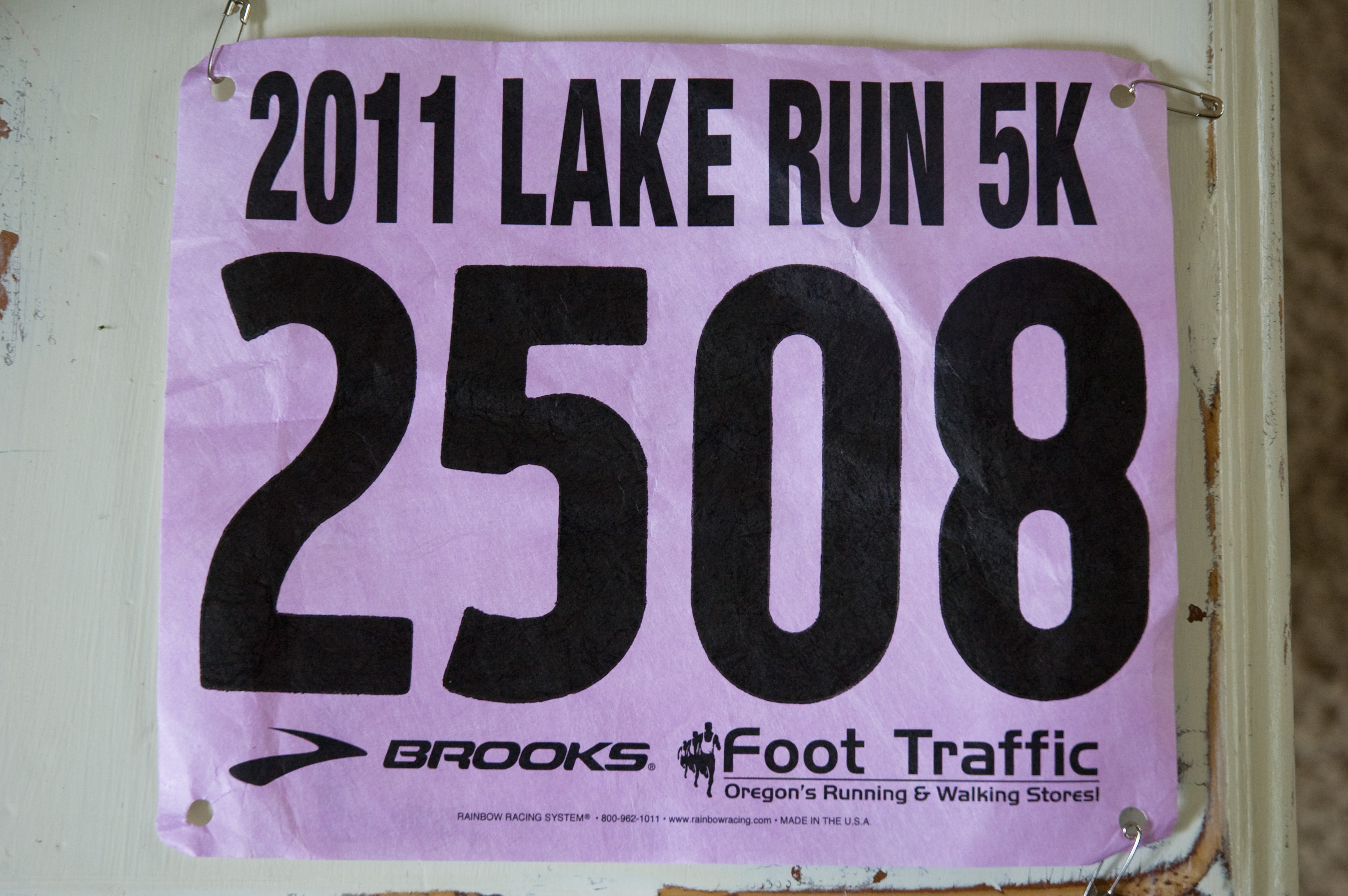
To help get the old mountain legs ready for a heave up the south side of Hood this spring, I’ve been running with Oliver, hiking here and there — a couple miles along Suttle Lake in April and a trip up Angel’s Rest on Easter weekend — and this morning, I joined a few thousand runners for the annual Lake Run around Oswego Lake. I’m not such I runner that I could tackle the whole 12k around the lake, but the 5k, now that I can do.
A few Mount Hood favorites
After fourteen years of exploration, I’ve amassed plenty of photos from on Mount Hood. Sunsets. Hiking trails. Kayaking and canoeing on Trillium Lake and Lost Lake. Timberline Lodge. Cooper Spur. The summit.
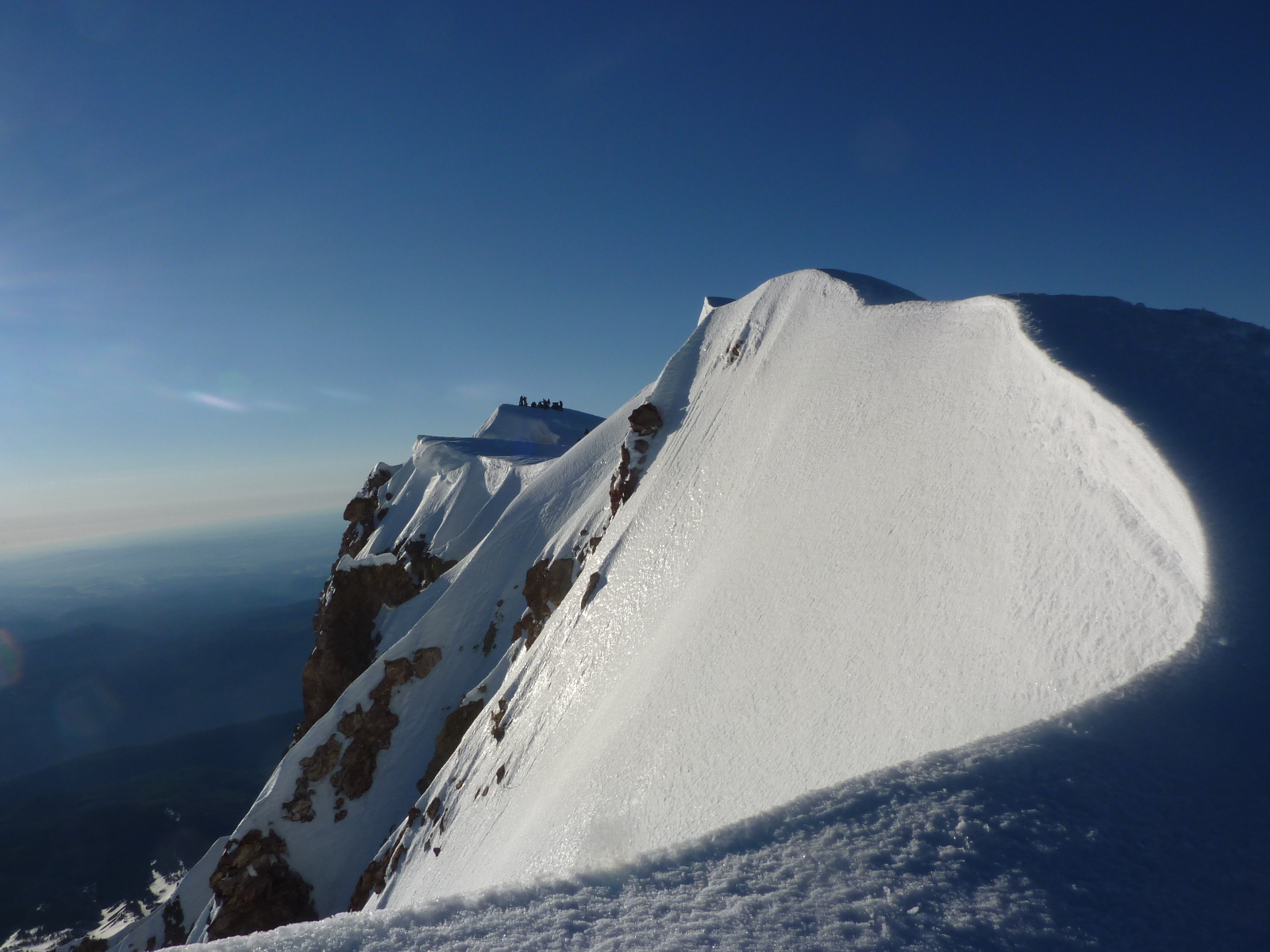
Photo of climbers on the summit of Mount Hood by Daryl Houtman
The mountain is incredibly photogenic. Of course, what you’re doing on the mountain and who you’re with has a big impact too. What follows are a few of my very favorite Mount Hood images.
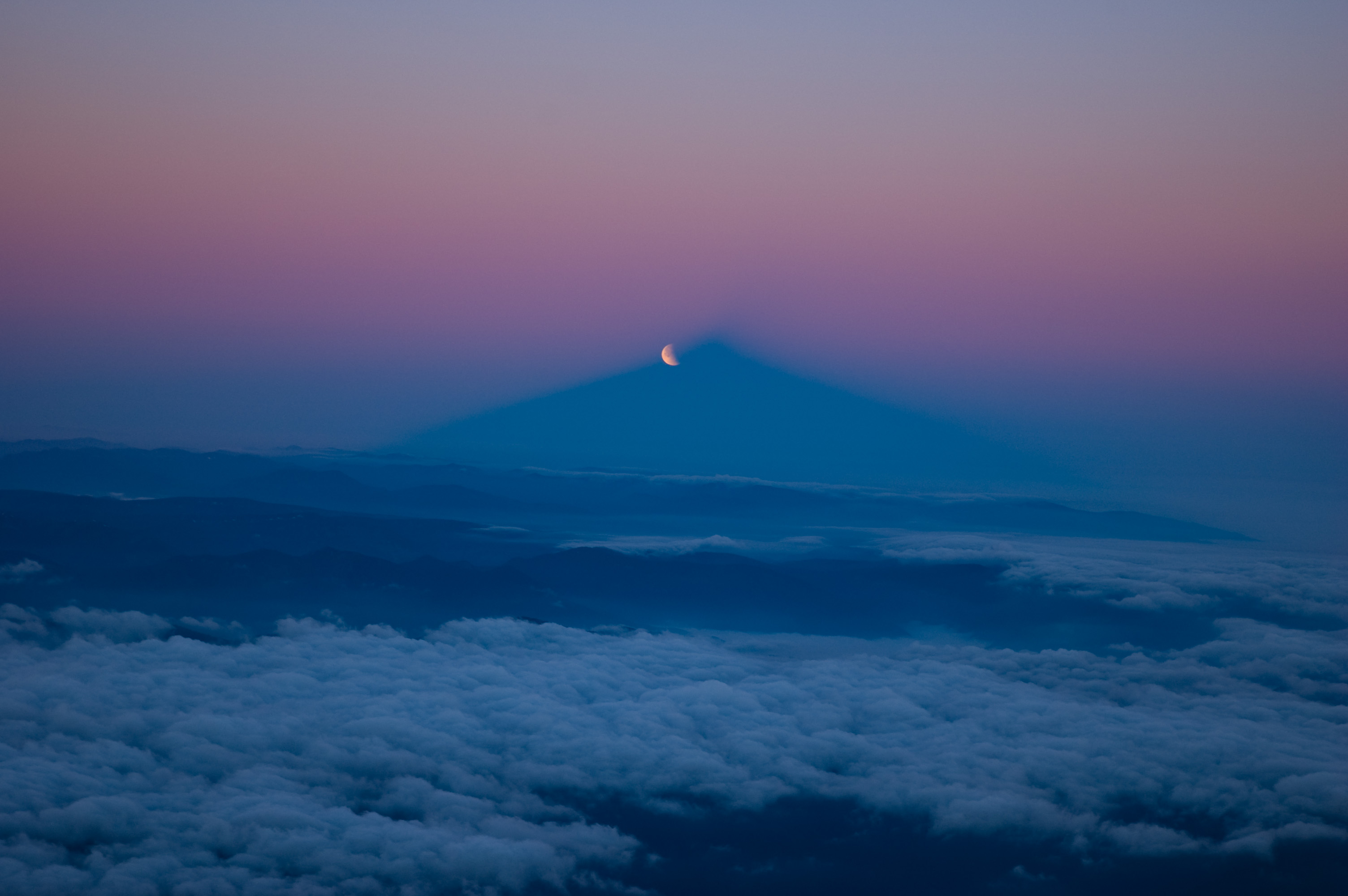 This one’s been published elsewhere, but to me it’s one of the most unique images of the mountain I’ve ever seen with my own eyes. Four of us were climbing the standard South Side route of Mount Hood in June 2010, and as we approached Crater Rock, the sun began to rise and the moon began to shrink. In the early morning light, the mountain’s shadow was cast upon the valley sky down below, and the nearly full moon darkened under an unexpected lunar eclipse.
 You can’t see the mountain in this photo, but it’s there in the background, way off in the distance above the trees. This shot is from the banks of the Muddy Fork, a small but beautiful river that drains from the Sandy Glacier on Mount Hood and eventually joins the Sandy River, which itself emanates from the mountain’s Reid Glacier. We stumbled upon some great campsites along the Muddy Fork, and for four years now have made it a multi-annual outing. We love it, and obviously, Oliver, my Black Lab, does too . . .
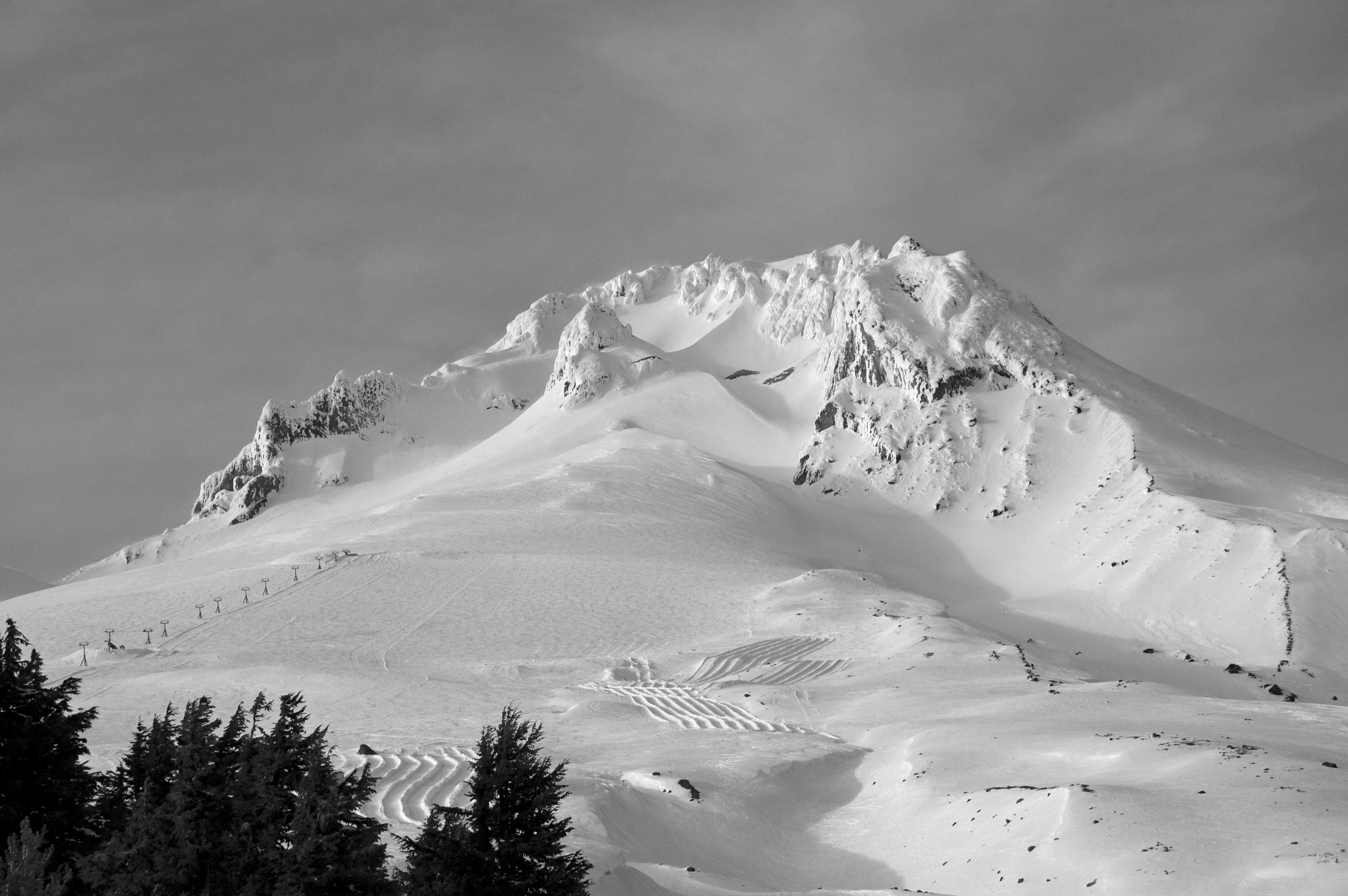 This one, to me, shows just how photogenic Mount Hood is. We’d headed to the mountain for a fairly routine visit. Just drove up when Spencer, my son, was a few weeks old, hung out in a Steiner Cabin, and paid a quick visit to Timberline Lodge. I stepped out of the car, walked up a steep snowbank, and took a few seemingly forgettable pictures of the mountain from a spot that serves most tourists well. But when we got home and I looked at my pictures from the day, I felt like I’d really gotten something.


 On MOUNT HOOD