On the shelf
I just got back from a quick trip back to Ohio for a great family wedding and weekend with some hometown friends. It started off with a redeye, which doesn’t do much for sleep, and ended with a few tornadoes in Cleveland canceling my flight last night. Delta rerouted me through Atlanta this morning — had a 4:15 a.m. wakeup call — but they at least hooked me up with first class for the four-and-a-half-hour flight back home.
So, I’m feeling a little drained.
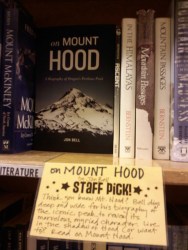
But I did get a nice little jolt once I got off the plane at PDX — and it wasn’t from the java I so badly needed. Instead, it came as I passed through Powell’s Books inside the airport. I was taking a quick gander, just to see if they were carrying a certain book on their shelves just yet.
They were.

Where to get it
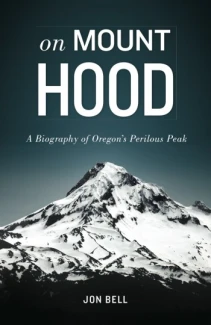
 For months now, On Mount Hood: A Biography of Oregon’s Perilous Peak has been available for preorder on Amazon.com. But something shifted this week, right about the time I got my author copies of the book in the mail.
Amazon switched from preorder to In Stock.
So, it’s official now. You can actually buy On Mount Hood.
I was talking to the sales manager at Sasquatch Books last week, and she noted that Amazon these days is usually the first to have books available. After that, bigger bookstores, then smaller ones and various retailers, libraries and other outfits begin offering new releases for sale. So although the official release date of this book is June 2, the actual release is more of a rolling one. It’s available at Amazon now and can also be ordered from Powell’s Books, from where it will be shipped in 1-3 days or where it can be picked up in 7 to 12.
On Mount Hood will ultimately be available at bookstores and retail outlets around Oregon and Washington. The initial list of places that have ordered copies is down below. More to come.
Have any questions about where you can find the book? Drop me a line. And a big, hearty thank-you to anyone and everyone who buys a copy. Thanks for your support. Enjoy!
- Amazon
- Annie Bloom’s Books (Southwest Portland)
- Banes & Noble (looks like both WA and OR locations and online)
- Borders Books
- Between the Covers (Bend, Oregon)
- Book Worm of Edwards (Edwards, Colorado)
- Broadway Books (Northeast Portland)
- Elliott Bay Book Company (Seattle, Washington)
- OSU Bookstore (Corvallis, Oregon)
- Powell’s City of Books (Portland)
- Queen Anne Ave Books (Seattle, Washington)
- Reed College Bookstore (Southeast Portland)
- Snow Goose Bookstore (Stanwood, Washington)
- Third Place Books (Seattle, Washington)
- Third Street Books (McMinnville, Oregon)
- U of O Bookstore (Eugene, Oregon)
- Village Books (Bellingham, Washington)
- Waucoma Bookstore (Hood River, Oregon)
- Wide World Books & Maps (Seattle, Washington)
Mount Hood National Park?
Thirty-one years ago today, Mount St. Helens blew away 1,300 feet of its upper reaches, bowled over and scorched 230 square miles of forest , and killed 1,500 elk, 5,000 deer and 57 people in the most devastating volcanic eruption in the history of the United States.

Traversing the summit ridge of St. Helens, June 2009.
In the wake of the eruption, St. Helens and the land surrounding it was designated a National Volcanic Monument, which preserved the area in a relatively natural state while also providing opportunities for scientific research, tourism and recreation. But dwindling federal budgets — the Forest Service is the agency in charge of the monument — have led some groups to advocate for national park status for Mount St. Helens.
In fact, today, in commemoration of the 1980 eruption, the National Parks Conservation Association, the Cowlitz County Tourism Bureau, EcoPark Resort, and other supporters are staging a press conference to renew the call for a Mount St. Helens National Park.
So how does this relate to Mount Hood?
Since about the mid 2000s, there has been a similar campaign pressing for a Mount Hood National Park.
Launched and guided by Portlander Tom Kloster, a transportation planning manager at Metro, the Mount Hood National Park Campaign posits that the Forest Service, which oversees the Mount Hood National Forest, has been charged with an impossible task: to simultaneously protect the mountain and exploit it through timber sales, energy corridors and the like. Turning the area into a national park, according to the campaign, would put it under the auspices of the National Park Service, an agency guided by a much clearer mission . . .
“…to conserve the scenery and the natural and historic objects and the wildlife therein and to provide for the enjoyment of the same in such manner and by such means as will leave them unimpaired for the enjoyment of future generations.”
It is an interesting idea to be sure, and one that, to those of a more conservation-based persuasion, would seem to be a worthwhile endeavor.
The campaign’s web site and Kloster’s accompanying WyEast blog make a strong case for national park status. There would, of course, be lots of opposition from timber companies — even though the annual cut in the Mount Hood National Forest is now a fraction of what it once was — utility providers, off-road vehicle groups and many others. The hordes and the accompanying amenities I’ve encountered at many national parks like Yosemite and the Grand Canyon also make me wonder just what Hood might turn into as a national park.
But I’m a big fan of protecting beautiful places, and Mount Hood, to me, is worthy of protection. If making it a national park would help accomplish that, I’d be all for it.
Hood History
Some of the most interesting stories about Mount Hood come from the early days of its exploration by the people who came to live in Portland and its surrounds. Like the disputed first summit by Thomas J. Dryer, publisher of what became The Oregonian, in 1854. (Three years later, one of Dryer’s employees, Henry Pittock, was part of a team that bagged the official first ascent.) And the reason that Illumination Rock, a prominent outcropping at about 9,500 feet on Hood’s southwest shoulder, is called Illumination Rock. (Various parties in the 1870s and 1880s hauled a substance known as red fire to the rock and the mountain’s summit and set about illuminating the peak for the masses back in Portland to see.)
One of my favorites is the story of where the Mazamas, a long-standing mountaineering and outdoor club based in Portland, got its start in 1894. From the group’s web site:
Responding to an advertisement run in the Morning Oregonian of June 12, 1894: “To Mountain Climbers and Lovers of Nature . . . It has been decided to meet on the summit of Mt. Hood on the 19th of next month …” more than 300 people encamped on the flanks of Mt. Hood on July 18. By 8:00 am the next day, the first climbing party reached the 11,239’ summit, followed by the rest of the 193 men and women who were to reach the summit that day. One hundred and five climbers became charter members.
And here’s a photo from that very day, courtesy of the Mazamas.

PRC number 4
In addition to climbing on Mount Hood, there is also climbing to be done all around Mount Hood — and all around the greater Portland area. The best guidebook for all of that kind of climbing — from Bulo Point and French’s Dome to Rocky Butte and Beacon Rock — has long been Tim Olson’s Portland Rock Climbs.
My copy dates from 2001 and is nicely dog-eared and tattered from a good three- or -four-year stint of regular rock climbing back in the days before kiddos. These days, that book sits on the shelf more than I’d like, but it’s still there, and I still pull it out every now and then.
For those who are still able to hit the Portland-area rock hard, however, Olson has just released the 4th edition of Portland Rock Climbs.

Updated and revised, the new volume covers all the classic climbing spots around Portland, the Gorge and Mount Hood. The new version also includes information on places like Ozone out on the Washington side of the Gorge and also a little write-up of Beacon Rock giant Jim Opdycke by yours truly.
Pick up a copy at Tim’s web site or at one of the retail locations he’s got listed there.
25 years ago . . . the OES tragedy on Mount Hood
Today marks 25 years since the worst climbing accident in all Mount Hood history: Nine dead, seven of them high school students from the Oregon Episcopal School. They’d been part of a team climbing the mountain for OES’ annual Basecamp Wilderness Education Program. The weather turned hellish, they didn’t turn around, the climb fell apart. Searchers found three bodies two days later; six more the next day in a snow cave buried under five feet of snow, but also, miraculously, two survivors.
For a number of reasons, I didn’t dwell too deeply on the OES disaster in On Mount Hood. I did touch on it, of course, and I also wrote briefly about its legacy on Mount Hood 25 years later for Portland Monthly this month. The latter story included an interview with Rocky Henderson, a well-known search-and-rescue volunteer whose very first mission ever with Portland Mountain Rescue was the OES climb.
“It was so frustrating,” Henderson told me of the search efforts. “When the weather finally cleared, we thought, ‘OK, now we’re definitely going to find them.’ But we didn’t. By then, there were no clues as to where they were. They had been completely obliterated by the storm.”
Something about climbing accidents intrigues people, myself included. And Mount Hood has had its share of them. But even though I was 12 and living in Ohio when it happened, there’s something singular about the OES accident. The scale of it, the what-ifs, the age of the victims. It’s heartbreaking. I read The Mountain Never Cries, a book by Ann Holaday, mother of Giles Thompson, one of the two OES survivors. I read all of the stories in the Oregonian from during and after the accident, the People magazine story, the piece in Backpacker, and on and on.
It is a sad but incredible story. One worth remembering, always.
 On MOUNT HOOD