Stubborn writers on the Timberline Trail and Mount Hood
It is a spell that comes once you’ve finished walking all the way around Mount Hood. I’ve experienced it twice now, and I’m pretty sure that’s the right word for it. A spell.
When you are done, or maybe just before, as you’re swinging one foot in front of the other for the last quarter mile or so before you get close enough to Timberline Lodge to start crossing paths with folks out for a leisurely stroll, you are in a mental and, really, a physical place that belongs only to you and those who are there with you. This is your mountain. This has been your four-day, 41-mile trek. The rest were not part of this experience. As much as you may want a cold beer and a hot meal, you don’t want to hear the cars, see the iPhone-locked gazes, think about the work and the responsibility and the real world that awaits.
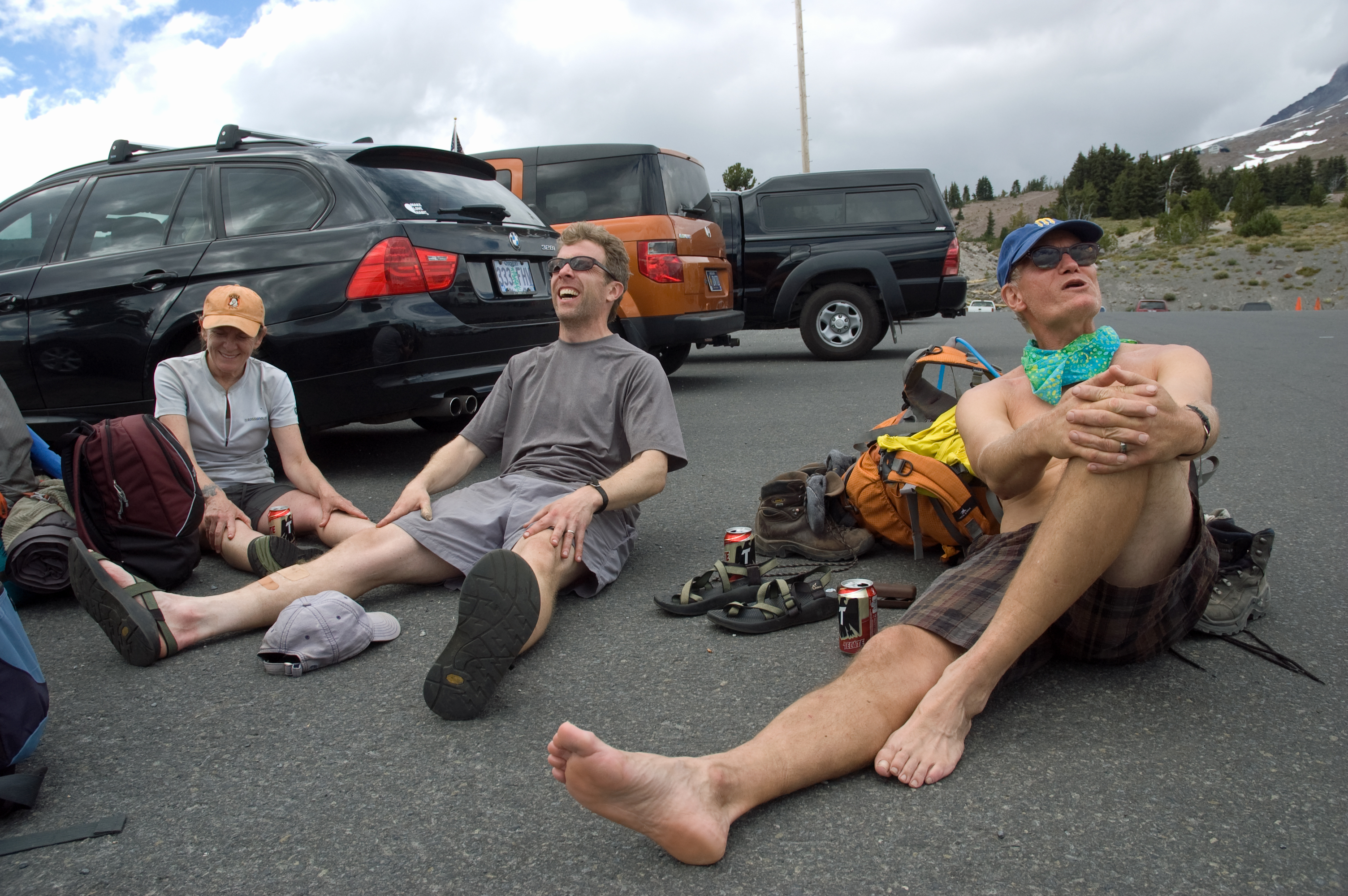
You want, instead, to drop your pack in the parking lot and crumple to the asphalt. You want to listen, all of you together, to the ice that is somehow still slushing around in the cooler and taste the cold Tecate. You want to prolong the sensation that you’re still on the Timberline Trail, under that spell, and so, even though it is bound to break at some point, you do.
By the time I set my foot on the Timberline Trail just behind Timberline Lodge again in August 2013, it had been eight years since Amy and I set out on the very same trip back in 2005. Not the exact same trip, though. One thing I realized after the second time around: you’ll never have the same experience on the Timberline Trail, no matter how many times you do it.

No kids, no job. Camping near Cooper Spur during a five-day trip on the Timberline Trail in 2005.
This one came about thanks to Portland writer Mark Pomeroy, a lifelong Mount Hood fan who’d connected with me after reading On Mount Hood when it first came out in 2011. At work on a novel set largely on the mountain himself, Mark invited me early to accompany him on a circuit of the mountain along with a few other writers: poet John Morrison and novelist and writing teacher Joanna Rose, someone I’d gotten to know through Brave on the Page.
When Amy and I finished the Timberline Trail in 2005, it felt like something I’d crossed off my list, that I’d never need to do again. But in Mark’s invite, there was a pull to revisit that I couldn’t resist.
We set out on August 24, an incredible summer day on Mount Hood — but not as a team. I’d been invited to a book signing event at Timberline the same day, so my plan was to catch up with the crew at the first night’s campsite along the Sandy River. Morrison’s 21-year-old son, Jackson, who joined in as well, had accidentally grabbed the wrong boots that morning. I picked up the right ones for him before I left Portland, and after the book event, he and I set out.
We got a late start, not hitting the trail even until 3 p.m., so we hoofed it but still took in so much: incredible scenery, stories from friendly PCT and Timberline hikers, unreal moments of natural beauty. A few of the latter, before we met up with the crew on the other side of the Sandy River:

Fading bear grass near Zigzag Canyon.
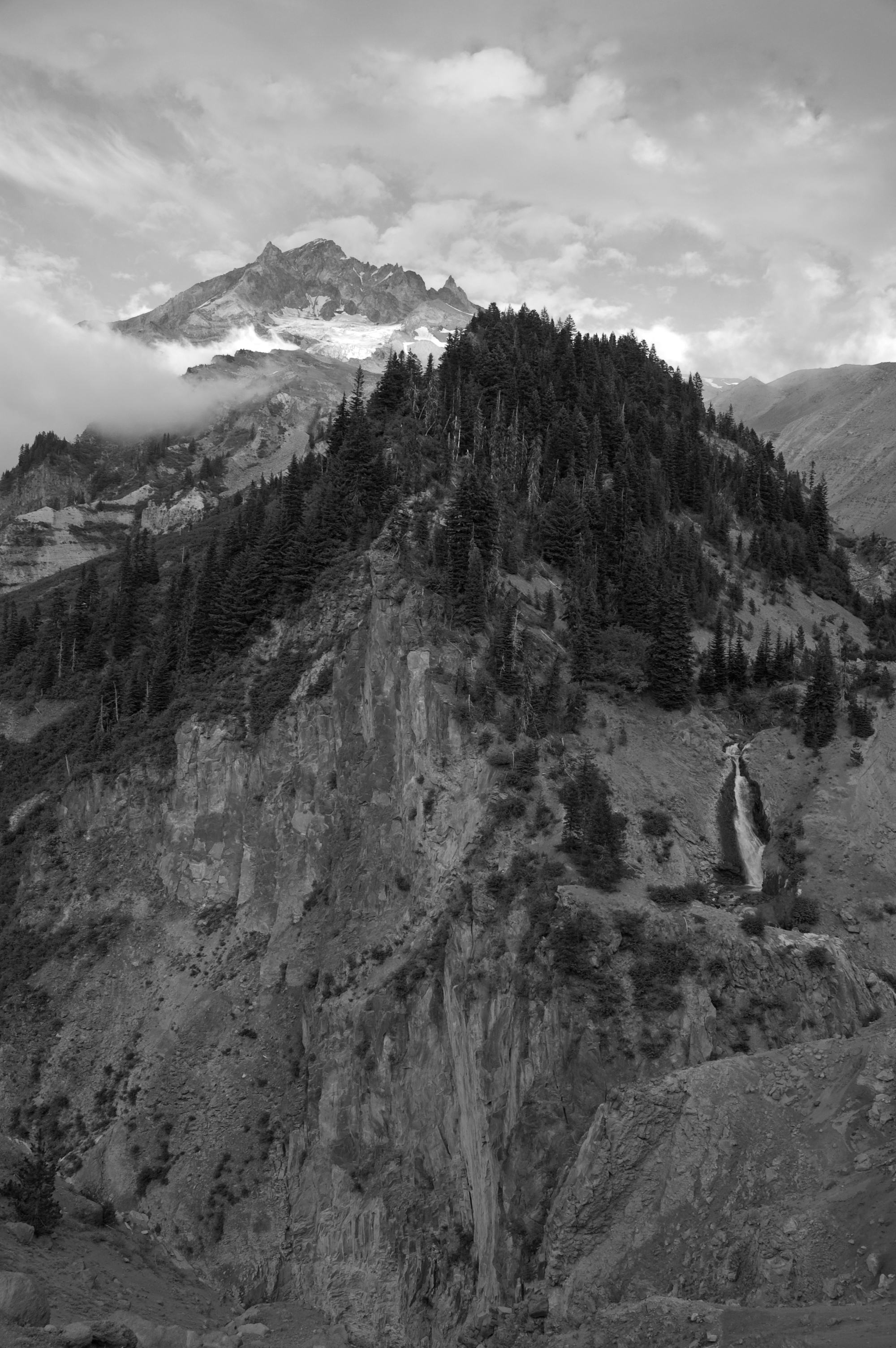
Mount Hood from just beyond Paradise Park.

Crossing the Sandy River with a PCT hiker who’d been on the trail since April.
The beginning of day two dawned cloudy and heavy, not like a normal August morning in Oregon. But on the mountain, you never know. Breakfast and breakdown got us on the trail a little later than we’d idealized, but at that point, we had the whole day in front of us: Ramona Falls, the Muddy Fork, McNeil Point, Cairn Basin.
I’d not been back to Ramona Falls in years. It was every bit as majestic as I remembered. We stopped to fill our water bottles and soak it in. Morrison chose just the right word to describe the falls: luminescent.

The first 7 or so miles that we initially set out to hike that second day were quiet and enjoyable. We clambered across the Muddy Fork on a huge double-tree bridge and broke for the first of many canned meats just after the first sprinkles had started then stopped.

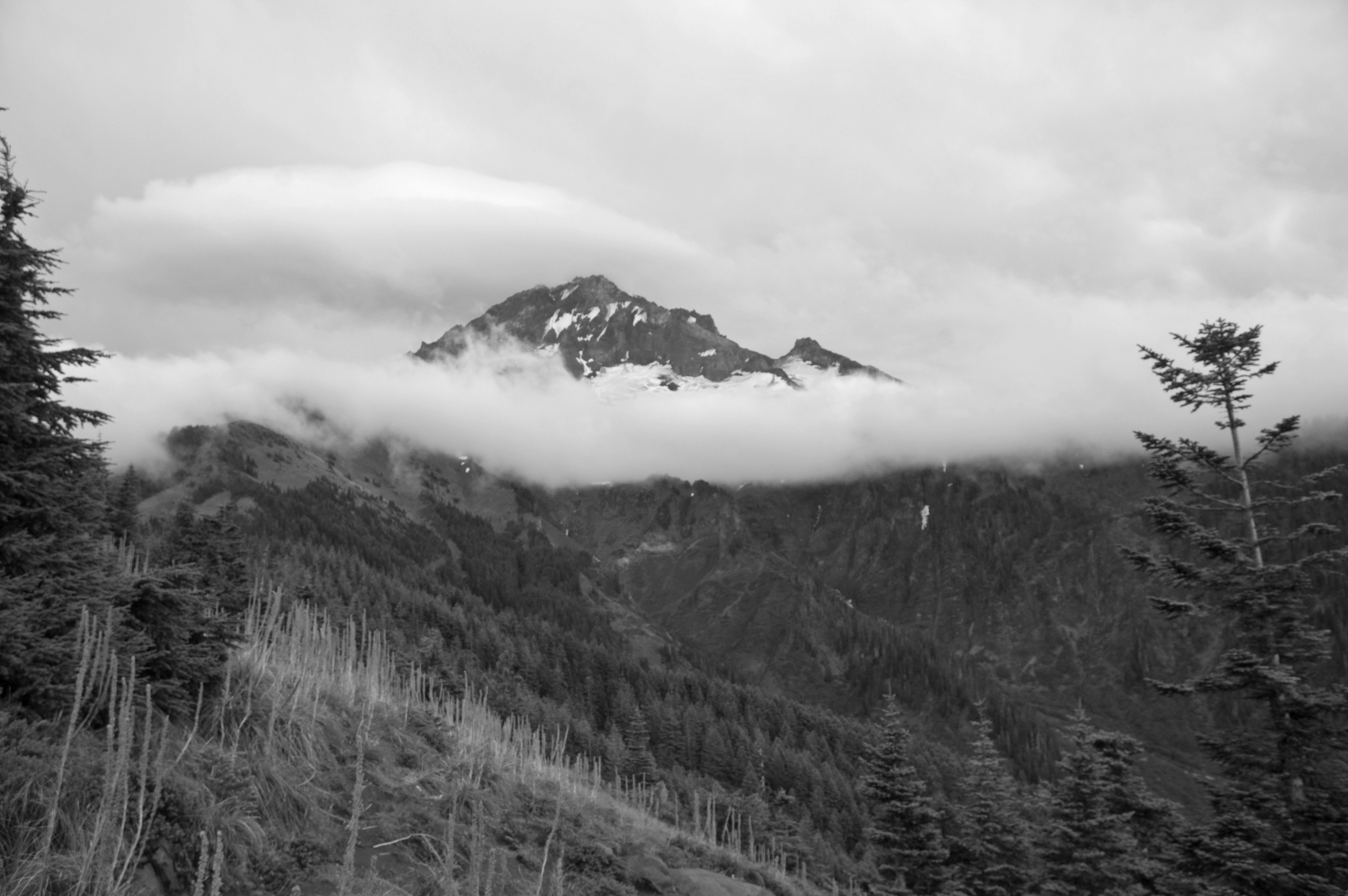
Our lone glimpse of the mountain for the day came just before we hit McNeil Point. By then, the rain had stopped altogether, and it felt good to take a load off and gaze up, even though it wasn’t the most comforting of mountain views.
Now, I have been in the rain before. Light drizzles, sudden downpours, one 24-hour deluge in the Gorge that sent Amy and me running for the car. I have been in whiteouts, too, wandering around Mount Adams for hours in search of camp, knowing that I was on the summit of Mount McGloughlin only because I had a GPS in hand. But the elements that blasted us on the Timberline Trail over the next 12 hours were among the most trying I’ve been through outside.
The cold rain started just beyond McNeil Point. It came down easy at first but soon soaked and chilled. There was a distant clap of thunder that we tried to ignore. We passed a big group crossing Ladd Creek who looked like they’d had enough already. On the other side of the creek, we topped our waters and pressed on, yet to be stifled by this tightening storm. The whipping wind, the chill, the water, it always has a way of invigorating me. Such conditions engage the senses so acutely that you can’t help but feel completely alive. Throw in the eerie scenery created by the fog and the remnants of the Dollar Lake fire, and the entire experience became nearly surreal.
No worries, however, as we were close to the stone shelter at Cairn Basin where, if we were lucky, we’d be able to step out of the rain, fire up the stoves, and regroup. It should have showed up any minute there as we marched on and on.
It never did.
When we stopped at the next trail junction and finally lifted our heads up, we realized we’d plowed right past Cairn Basin without ever seeing the shelter. By then, we were a mile beyond it.
Gigantic thunder clap.
Cold, soaked, and nervous, there was nothing to do but power on to Elk Cove and hope for the best.
We knocked off the mile-and-a-half or so to Elk Cove in relative silence — I think Morrison and Joanna maybe were chatting about the meter of some line in some poem — and in no time came to the sign I remembered directing us left to the campsites off in the woods on the edge of the meadow. Ideal thoughts of a couple empty sites sheltered by fir bows deflated as we strolled up to find two other campers already buttoned up in what should have been our spots. We chatted briefly, scoured the surrounding area for a plan B, then came back and, in so many words, crashed the party.
Thankfully our hosts, Angela and Heather, were incredibly inviting and accommodating, sharing not only stories but hot chocolate and hand warmers as we rushed to set up our tents in the pouring rain and swelling puddles. There would be no dinner that night, no cocktail hour, no star gazing. I know my main goal was to get out of the rain and get dry. It was not an easy thing to do. My pack was soaked, as was just about everything in it: sleeping bag, long underwear, fleece. I for some reason have always scoffed at the pack cover, but there in my soggy tent, with a damp and heavy sleeping bag and a fleece that felt like it’d just come out of a washing machine, I saw the light. My night — all of our nights — would have been a lot different if we’d had them.
We didn’t, though, and so we spent 12 wet, cold hours wishing for a little relief from the morning and catching soggy fits of sleep. I have spent many a night outside, and I can say with full certainty that this was one of the very worst I have ever endured. I am usually one to accept and endure, to find something positive to see me through. On this night, I just about surrendered and accepted the despair. Just about.
They may not know it, but Heather and Angela helped save the day for us. Their willingness to let us crash their space, their eagerness to share advice and hot drinks and friendly voices — I never even saw the friendly face that matched Angela’s sweet voice until she unzipped her tent the next morning — added the best possible end to the afternoon that we could have hoped for. Sometimes, a little unexpected optimism and some stripped down, genuine human interaction is all it takes to persevere.
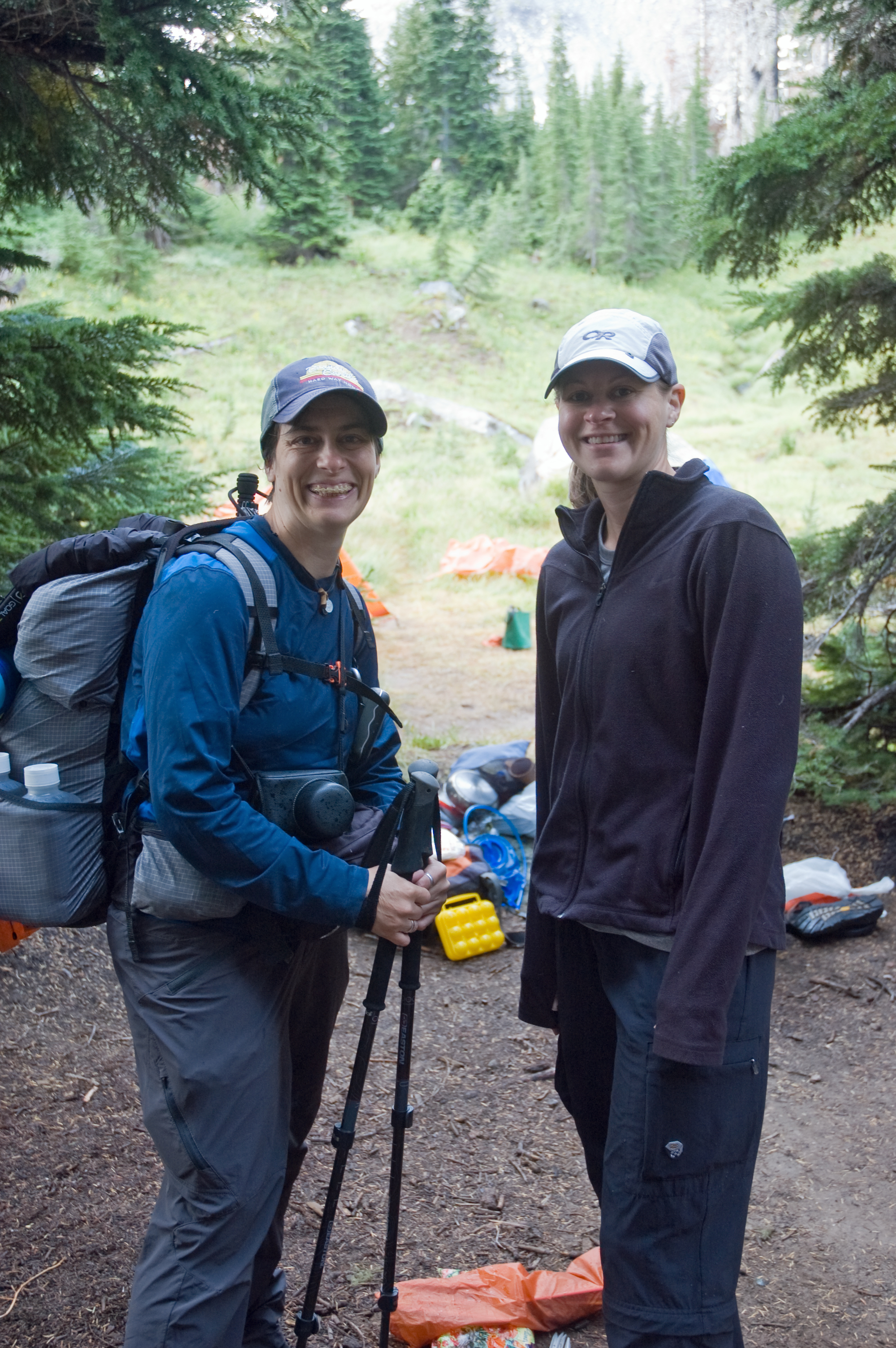
Thankfully, day three dawned dry and, though not normal Oregon August, blue enough here and there to allow a regroup.


Dried out as best as we could be, we hit the trail that morning an hour or so behind Heather and Angela, glad for the sun breaks and scenery. From Elk Cove east, the Timberline Trail winds endlessly in toward the mountain, over streams, back out over a ridge, and back in again, over and over. It’s repetitive, but it’s a kind of sameness that’s not hard to appreciate.

Though the weather was much more promising than it had been the day before, something else weighed on my mind, adding a touch of dread and uncertainty to the day: the Eliot Creek crossing. Back in 2005, the bridge over the creek had long been washed out, but getting across the creek was still manageable. But in 2006, a massive washout rearranged the terrain up there so much that the Forest Service rendered it off limits, thus eliminating any legal way of completing the entire Timberline Trail without setting up some lame car shuttle and bypassing the off-limits section.
But as the years passed, reports sprouted up that the crossing was again doable. Some said to go up high onto the Eliot Glacier itself to cross; others shared pictures of ropes down into and up out of the gully. Some hikers made it sound like it was no big deal; some turned back because they couldn’t make it across. Had we encountered something that turned us around, we had no plan B other than to stop and hoof it back to Timberline.
What we found when we finally made it to the edge of the crossing was not very encouraging.

Beyond that sign, however, was a very prominent trail, and it led (at least it did in August of 2013) very steeply to the way across the Eliot. We trudged up and up till a small clearing to the left revealed one of the rumored ropes illuminating the way down. Picking our way down one at a time took a while — the rock and scree are so loose that to descend in a group would invite unnecessary danger — and finding the right place to actually cross the creek added some time. In the end, however, crossing the Eliot was possibly more time-consuming than some of the other crossings, but it seemed no more perilous than anything else we did on the entire trail. That said, I crossed the actual creek three times to help shuttle packs, and I can safely say that no mountain stream has ever chilled my feet to the point of numbing pain the way the water of the Eliot did.

Instead of sticking to the Timberline Trail up out of the Eliot, we trudged up the incredible ridge on the creek’s east side, an exposed, amazing spine that puts the glacier and the mountain in full perspective. Up high, you can cross-country it over to the stone shelter below Cooper Spur, merge back in with the Timberline Trail, and head on around the northeast side of the mountain on your way to Gnarl Ridge.
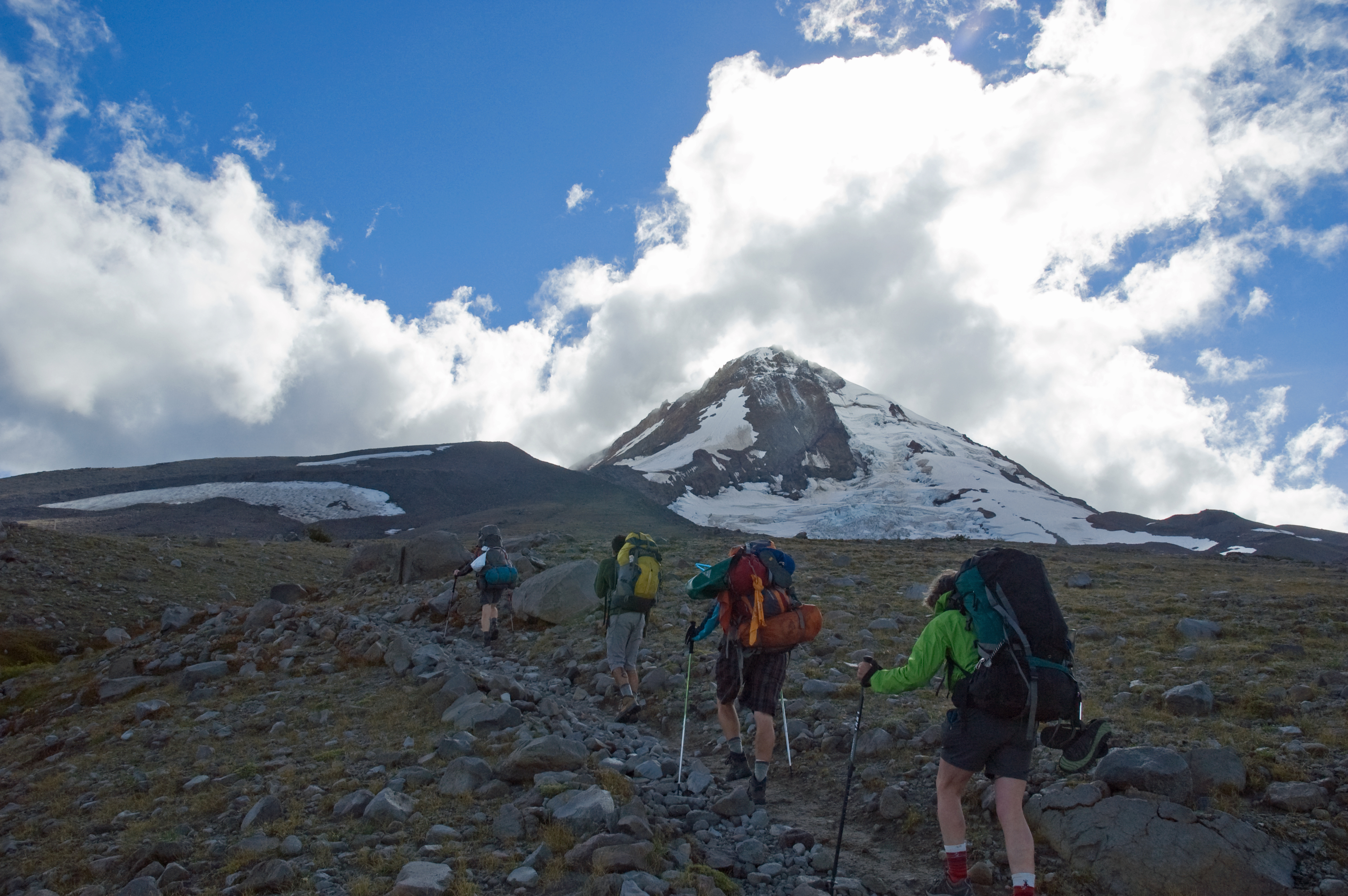
Breaking out onto the ridge gave us a taste of some burly, frigid winds. When, not a few minutes earlier, we had been stepping along in still air, now the winds whipped and gusted like freight trains, knocking us off balance and drowning us in the sounds of ocean surf.

We ticked off 10 miles this day, ending up in a campsite just across Newton Creek at dusk. Heather and Angela were just off in the woods nearby. Despite the long and late day, Morrison immediately whipped up one of the best and most memorable backcountry meals I’ve ever had: pasta with wild mushrooms and a red sauce with red wine. Talk about comfort.
The final day’s hike was a warm and sunny one; mild initially in terrain, marked by some musical conversations, a joke about the Pope driving a cab, and a couple startled grouses scaring the bejeezus out of Mark — and giving the rest of us a nice, big laugh.
Lunch as we passed through Meadows. We’d carried the SPAM the entire way, so I insisted on opening it.

From there, it was on to White River, the last major river crossing, which was little more than a step or two across, but amazing nonetheless.

I’ve always related how the hike up from White River to Timberline, even though it’s just a couple miles, is the longest of the Timberline Trail because you can see Timberline Lodge, the cars in the parking lot, the people milling about, almost the entire way. But the elevation and the sandy terrain and the fact that you’re knocking off the last 2 miles of a 41-mile trail somehow make all that distance last and last. By that point, there wasn’t a whole lot of chitchat. More of a determined march to get those last steps behind us, take the packs off, and savor the accomplishment. I remember passing the first tourists out for a little stroll east of Timberline and catching their curious glances as we clopped by, smelly and set on nothing more than being done hiking for the day.
And then, as we stepped and stepped our way up to Timberline Lodge, we were done with hiking for the day. A few people milled about, heads drooped to their phones, and someone in our group asked if that’s all we’d been missing. Maybe we should just turn around and do it again.
We didn’t though. We posed for a picture. We closed in as a group on our walk back to the cars, not wanting to invite anyone else in to break the spell and to just prolong that sense that we all were sensing. We’d been gone just four days, but being back felt different just then; odd, and as if we’d been overseas, somewhere foreign, and were just getting back.

Morrison had iced Tecates in the car, but on our way back to them, we heard voices from across the parking lot. Angela and Heather. We’d just caught up with them.
Then it was to the car, the asphalt in the parking lot, then the bar in Timberline. Inside, it all seemed so loud, so unnecessary, so threatening to the spell. Because that’s what comes once you’ve finished walking all the way around Mount Hood.
Endnote: I publish this now, nearly two years later, as the stubborn writers and I head back up to Mount Hood this week for another escape, this one more measured, possibly less epic and, hopefully, much drier.
Mount Hood Gifts 2014
A quick and last-minute list of some Mount Hood gifts for that alpine aficionado in your life:
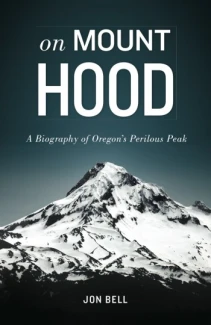
- On Mount Hood: A Biography of Oregon’s Perilous Peak — Shameless, I know, but sometimes that’s just the way the world works. If you’re in the Portland metro region, it’s not too late to get a signed copy for Christmas for just $15. You can also find it at Powell’s, Annie Bloom’s, Broadway Books and most other local bookstores. Here’s a list of stores outside of Portland, and you can always find it online at Powell’s, Abe Books, Biblio and Amazon.


A former Portland Tribune colleague of mine, Ben Jacklet, co-founded Shred Hood in 2013 as a community news and information site to cover the skiing, snowboarding and backcountry on Mount Hood.
Subscriptions come in a couple different options, including one-time and ongoing. Each has its privileges, including a sweet T-shirt and bottle opener depending on your subscription.
Find out more at Shred Hood.
- A donation to Oregon Wild or Bark —
 Feeling a little more philanthropic this holiday season? Consider making a donation to some of the environmental groups that have worked — and are always working — to protect the region’s wild places, including, of course, Mount Hood. (Bark’s mission is more Mount Hood-centric, while Oregon Wild covers the entire state; both have played major roles in protecting Mount Hood and the Mount Hood National Forest.)
And as a bonus: both organizations are all about getting out and exploring the places they protect, so each offers regular outings as well.
 On tap on Mount Hood from Oregon Wild at the moment: snowshoeing to Twin Lakes and White River, all in January. And from Bark, its monthly hike in the Mount Hood National Forest in January.
For more information about either of these groups, visit www.bark-out.org or www.oregonwild.org.
- Oregon Department of Geology and Mineral Industries Lidar Map of Mount Hood — DOGAMI released this double-sided, water-resistant map a couple years ago. It includes 75 trails around Mount Hood, wilderness areas, roads, campgrounds, information for climbers and hikers, and a geologic overview. Just $6 at Nature of the Northwest.

- Timberline Lodge Ram’s Head Fire Poker — Fashioned after the larger fireplace tools used at the storied Timberline Lodge, this hand-forged wrought iron poker is classic Timberline through and through. I met Darryl Nelson, the blacksmith behind much of the ironwork that’s been installed at Timberline over the past 30 years or so, and he told me guests regularly try to heist these out of the rooms. Not good. Instead, find them at the Timberline gift shop for $75. (Looks like they might be sold out online, but they usually have some in the store.) The shop also has a nice array of vintage-looking posters and artwork, books, souvenirs and more. Check it out.

The Timberline Trail, Mark Pomeroy and Powell’s Books
I got an email out of the blue in the early days of 2013 from a Portland writer named Mark Pomeroy who’d grown up with Mount Hood, spending time at his grandparents’ cabin in Brightwood. He’d just finished my book and had an idea to tackle the Timberline Trail with a handful of other writers, myself included. Not one to turn down an adventure on Mount Hood, I signed on. Last summer we did indeed have a four-day adventure on Mount Hood.
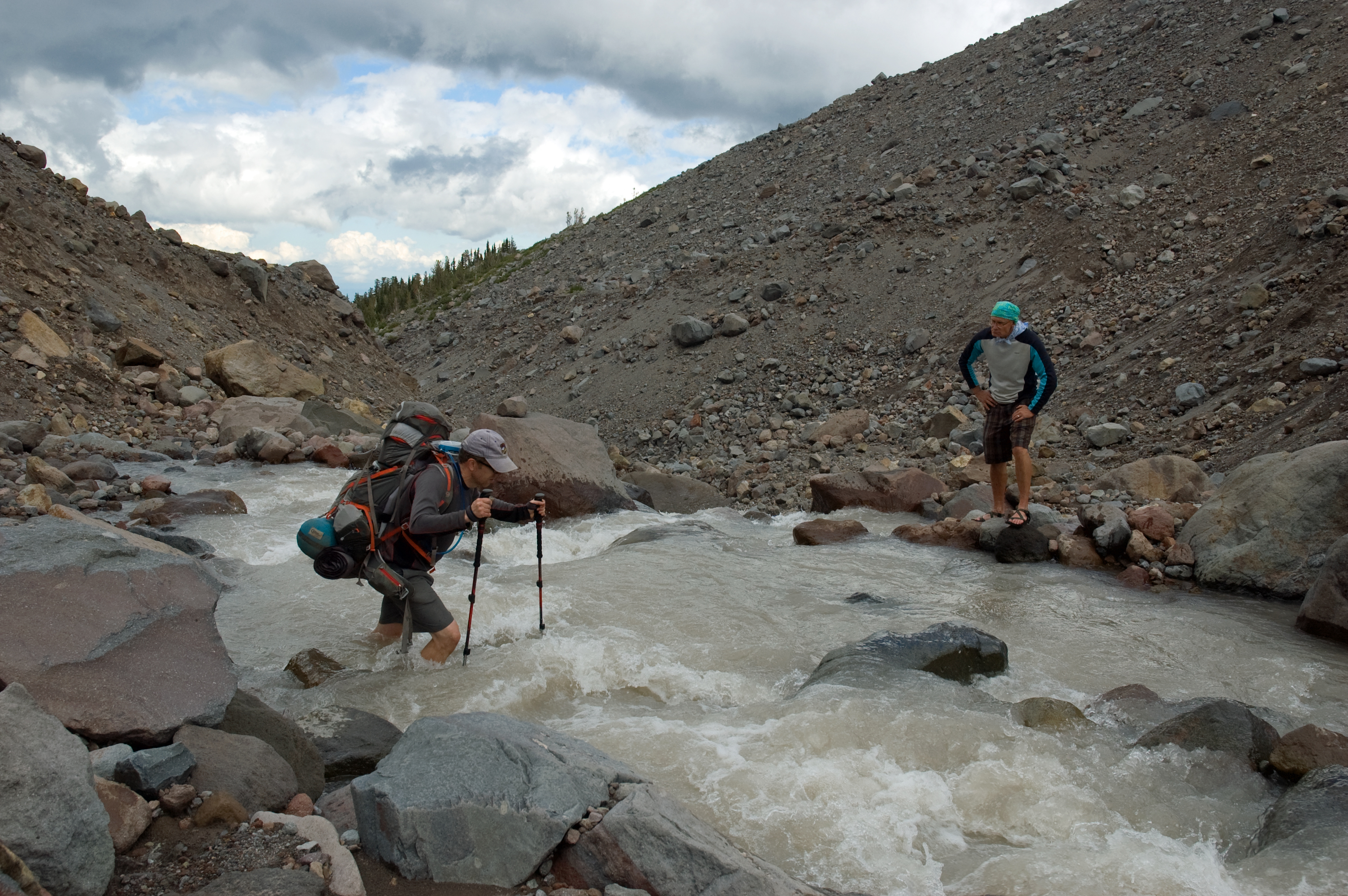
Portland author Mark Pomeroy crossing the frigid waters of Eliot Creek along the Timberline Trail in August 2013.
Since that first email, I’ve gotten to know Mark and followed him on his way to getting his first novel published. It’s a work more than 10 years in the making. Called The Brightwood Stillness, it’s only the second novel ever published by Oregon State University Press. (The first was Brian Doyle’s Mink River)
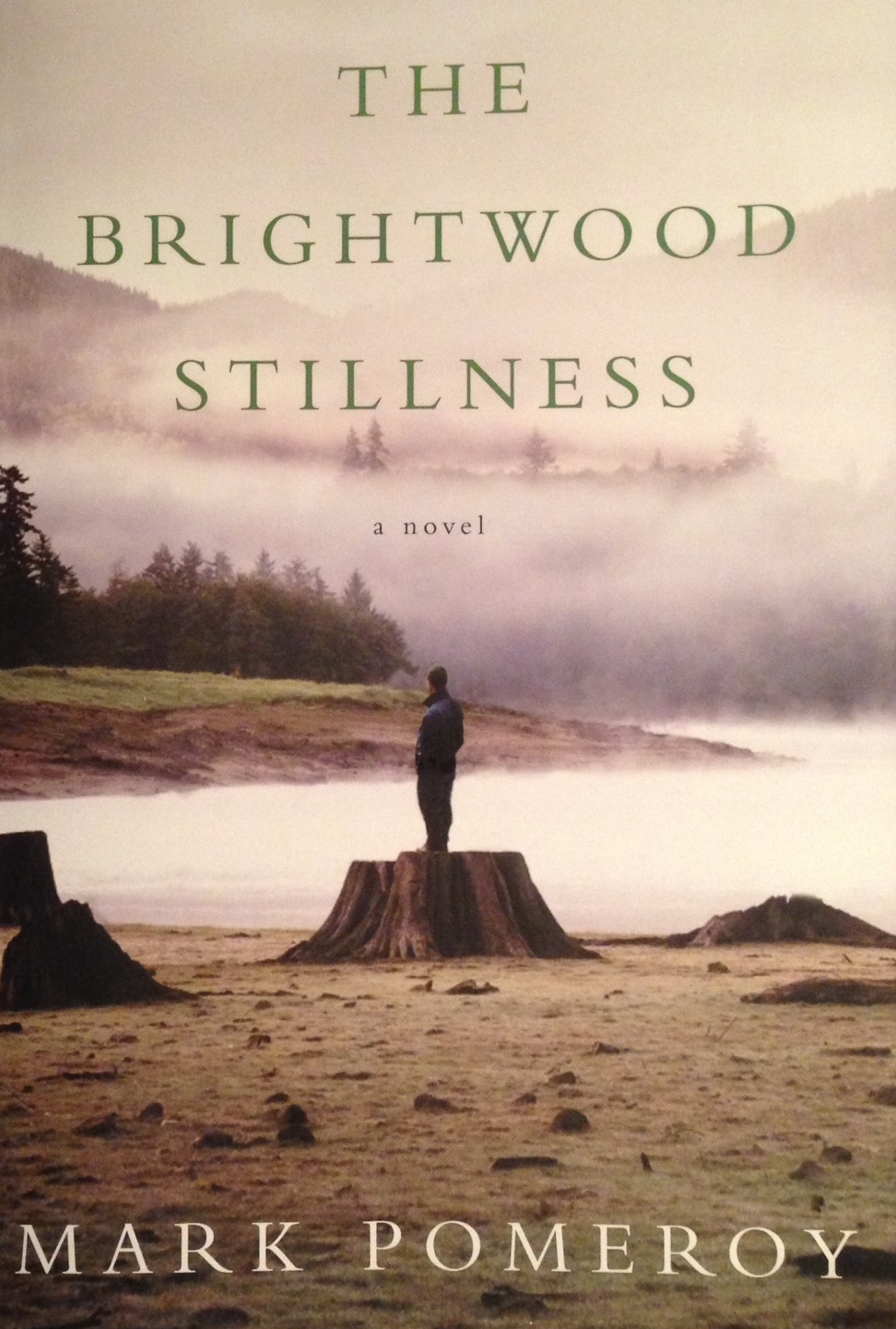
I was fortunate enough to be invited to the official invite-only launch of the book back in October. But tonight, Mark takes his book to Powell’s on Hawthorne for a more open introduction. He’ll be there at 7:30 p.m. tonight, Thursday, Nov. 20.For anyone who loves good stories and books in general, it’s bound to resonate.
If you can’t make it tonight, keep your eyes open in the coming weeks for other appearances or, at the very least, pick up a copy of The Brightwood Stillness.
You can find out more at mpomerory.com.
On Mount Hood Heads to Bend
From Seaside and Seattle to Hood River and Sisters, I’ve taken On Mount Hood all over Oregon and into Washington for slideshows, readings and more. One place I’ve not yet been with the book: Bend.
That will change this week with a couple slideshows on Wednesday and Thursday:
- Downtown Bend Library — 6 p.m. Wednesday, Nov. 5.
- La Pine Library — 12 p.m. Thursday, Nov 6.
See you there . . .

On Mount Hood Heads to Seattle
OK, I know Seattle’s got the king daddy Cascade in Mount Rainier and all, but Mount Hood’s not too shabby itself.
For anyone in the Seattle area looking to learn a little about Oregon’s signature peak, swing by King County’s Burien Library at 7 p.m. this Wednesday, August 20, 2014, for some photos, adventures and tall mountain tales.
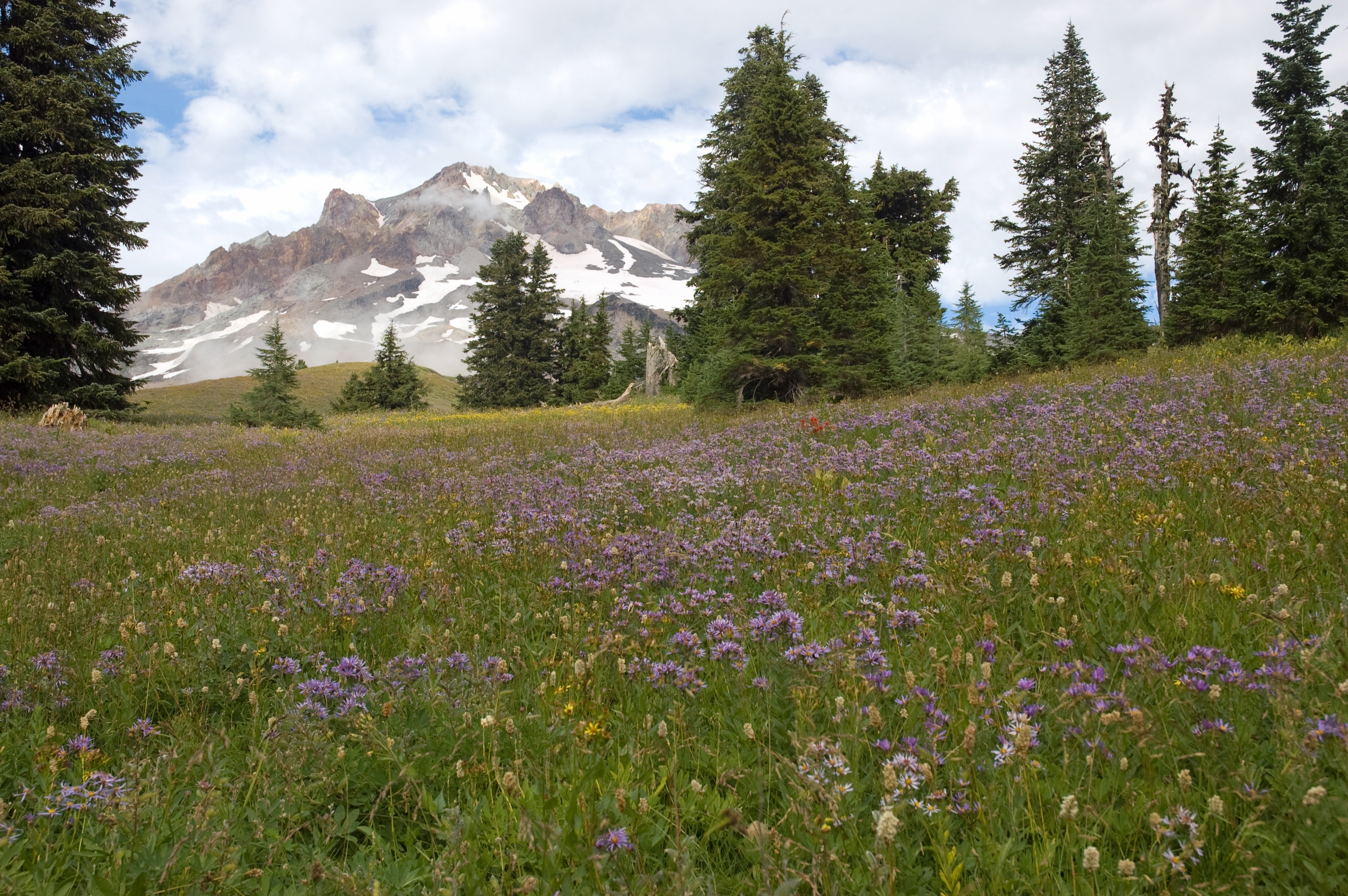
This little piggy went to Mount Hood
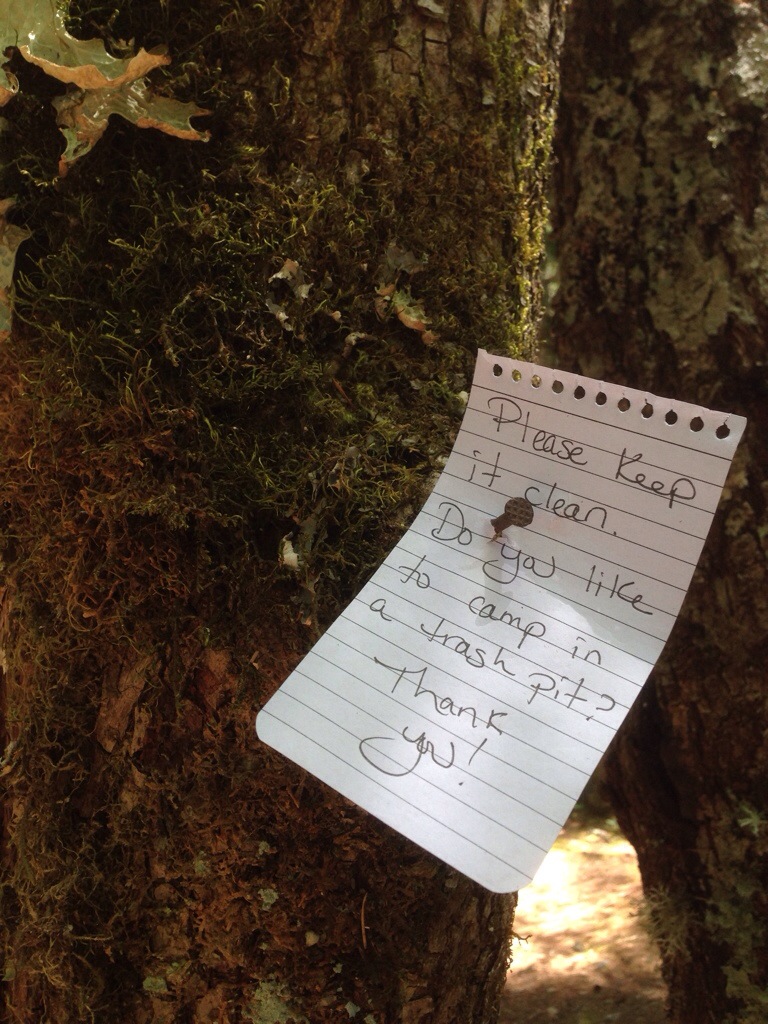
Summer’s back. Sweet! Sunshine, riversides, campfires, trails and, of course, trashed campsites on Mount Hood.
We headed out for this year’s first night in the tent a few weeks ago, that beautiful first weekend of June that felt like the last weekend of July. Since the Forest Service closed our favorite Sandy River campsites a couple years ago after John Q. Public couldn’t seem to stop using them as trash pits, we’ve branched out a bit and found some other keepers.
Unfortunately, so has John Q.
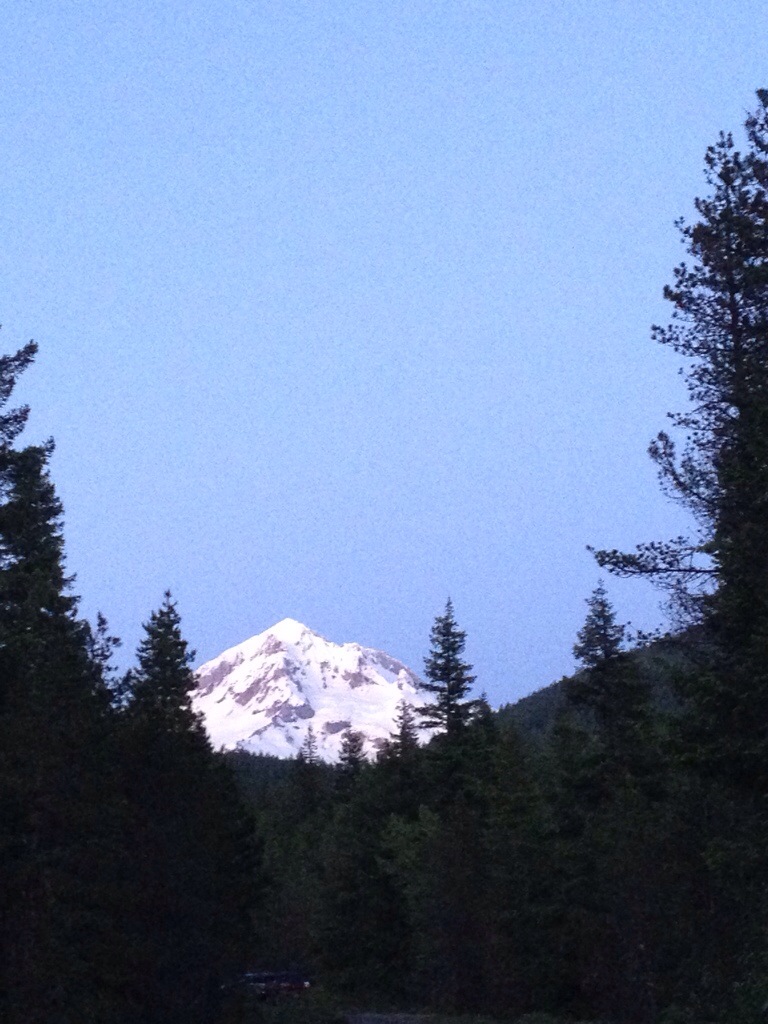
We spent the first 20 minutes or so cleaning up the pit that the prior campers had left behind: broken glass, cheap beer cans, shell casings, a rusty grill grate, blah, blah. It’s always the same. This site, a nice one with plenty of room, privacy and a killer Sandy River beach, was actually one of the cleaner ones around. It makes no sense to me the way people treat these incredible places. It’s so trashy, so redneck, so downright piggy.
And sometimes it’s just laughably unbelievable.

The Forest Service will end up closing these sites pretty soon, too, I’m sure. But no matter. After we’d cleaned ours up, we were able to settle in for a great weekend on the mountain, along the river. We soaked in some sun, hiked for the first time to Little Zigzag Falls and broke in the kids’ new pie iron.
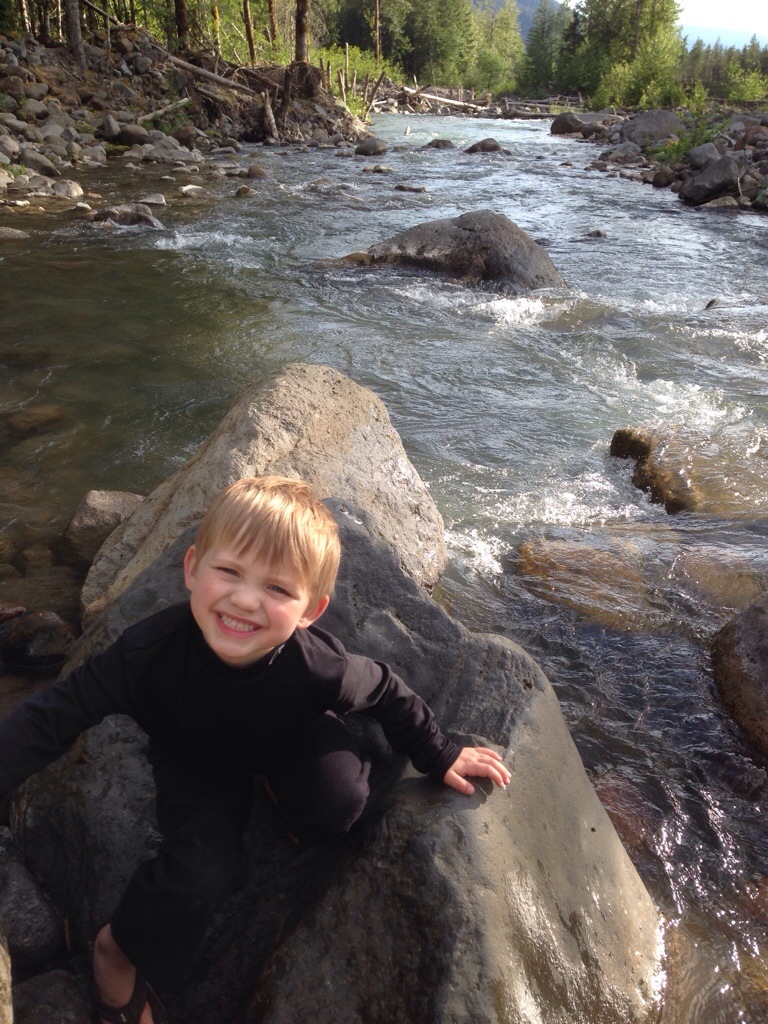


When it was at last time to head home, we packed up and, as most civilized people would do, cleaned the site almost spotless. Almost. We did, after all, leave one thing behind:
 On MOUNT HOOD