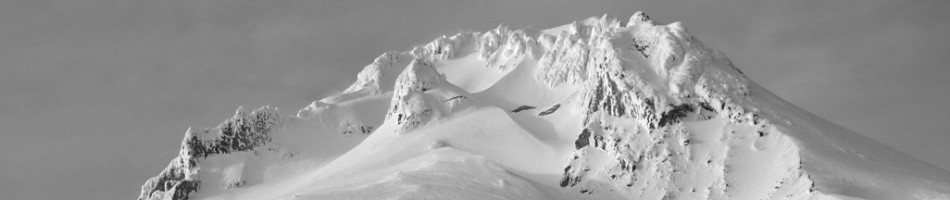
Mount Hood to a Little Kid
Somebody once said something to me about the classic mountain shape of Mount Hood that I thought summed it up perfectly; so perfectly, in fact, that I put it in the book:
If you ask a little kid to draw a mountain, he will draw Mount Hood. Every time.
Madeline reinforced that idea to me when she showed me what she had drawn at school this week. Granted, she’s got both Mount Hood and Mount Jefferson here, but the gist is the same.
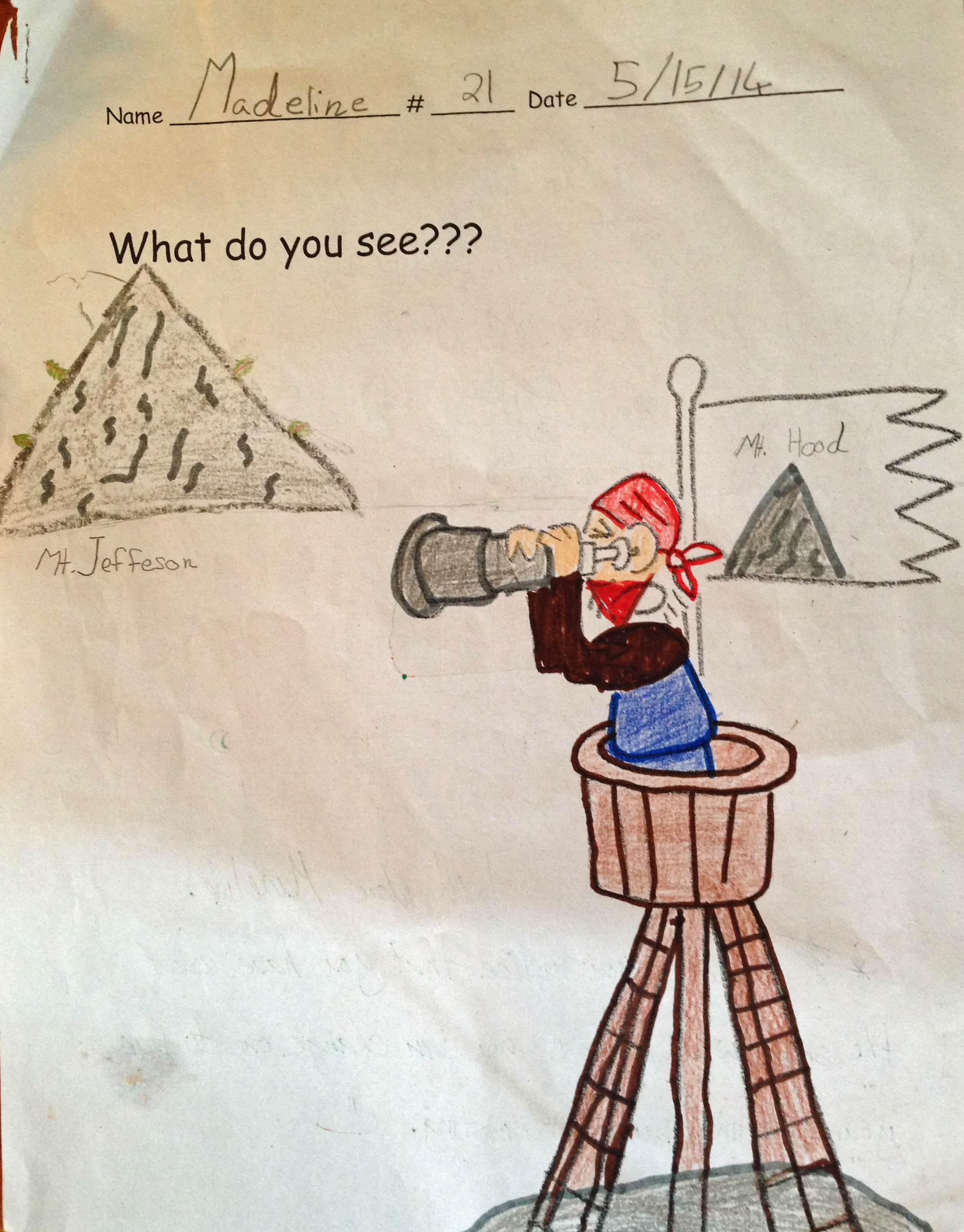 Even better to me, someone who’s written and writes a lot about Mount Hood, is the back of the sheet and Madeline’s own little take of a day on the mountain.

Mount Hood Climber’s Guide
Back in 2010 when I was researching On Mount Hood, one of the scores of people I connected with was a high tech professional, climber and Mount Hood fan named Bill Mullee. I’d been referred to him because he was working on a climber’s guide to Mount Hood at the same time I was working on my book. Unlike On Mount Hood, Bill’s book was to be a climber’s guide to the mountain, complete with pictures, routes, and write-ups from some veteran climbers, including Fred Beckey, the renowned alpinist who, along with Leo Scheiblehner, was the first to climb Hood’s notorious Yocum Ridge.
Bill and I talked back then and a few more times over the ensuing years about the mountain, our books and what was to come. Each time we spoke, he was that much closer to having his book come to fruition. And now, it’s truly coming to be.
Bill landed a publisher with the Colorado-based Sharp End Publishing, and in June it will release Mt. Hood: A Climber’s Guide.

Here’s the write-up about the book from the publisher’s site:
The unsurpassed beauty of Mt Hood awaits. Drawing on the vast experiences of over three dozen veteran Hood mountaineers, Mt Hood: A Climber’s Guide provides in-depth, firsthand descriptions of the mountain’s many routes. Contributors, such as the venerable Fred Beckey, write about weather, objective dangers, and how to stay safe and succeed. Routes are clearly illustrated on exceptional aerial photos, while stunning scenic and action images will inspire visitors and regulars alike.
The guide is likely to fill a long-standing need for some great, up-to-date information about all the different routes up Mount Hood. Nicholas Dodge’s classic A Climbing Guide to Oregon, which has a 12-page chapter dedicated to Hood, was published in 1975 — and, it seems, only in 1975. (Actually, Seattle climber Wayne Wallace, who’s in On Mount Hood and who also contributed to Mullee’s book, tells me that Dodge’s book was also published in hardback in 1968.) And Jeff Thomas’ great Oregon High: A Climbing Guide to Nine Cascade Volcanoes, first appeared in 1991 but has been hard to come by in recent times.
Mt. Hood: A Climber’s Guide is now available for preorder, which includes a free two-year subscription to the ebook version, for $23.05. For anyone looking to explore Hood’s upper reaches, it’s destined to be a classic.
Stay tuned for more about the book and any events related to its release.
Happy Mother’s Day 2014
It’s Mother’s Day, and every year on Mother’s Day, I not only remember to call and send my love to my mom in Ohio, but I also think about a particular Cascade mountain. Not Mount Hood (though we’ll probably be skiing up there and celebrating Amy today!) but St. Helens, which lies about 60 miles northwest of Hood.
There’s an incredible tradition that happens every year on Mount St. Helens on Mother’s Day. Amy and I have been part of it twice during our time in the Northwest, and I have to say, it’s one of the most unique ways to express appreciation for the mother in your life that I’ve ever come across.
In honor of Mother’s Day 2014, here’s a column I wrote about that tradition back on May 18, 2002, when I was honing my chops as a reporter and photographer for the Canby Herald newspaper.
Enjoy, and Happy Mother’s Day.
Last Sunday was Mother’s Day, and in honor of my wonderful mother, I sent a card, made the ritual phone call, and donned a blue and green tie-dyed dress for a climb to the top of Mount St. Helens.
Indeed, it was not your average Mother’s Day tribute.
But like all of those faithful sons and daughters who either bought Mom a bouquet or made her breakfast in bed on Sunday, I was not alone in my gesture of appreciation.
For one, my fiancée, Amy, was with me on the mountain. She, too, paid homage to her wonderful mother — my soon-to-be mother-in-law — by wearing a dress for the long slog up the Pacific Northwest’s most infamous volcano. (By the way, St. Helens, also known as Loowit, blew its top exactly 22 years ago today.) I reluctantly concede that Amy’s dress, with its purple, blue and pink floral patterns, was much more flattering on her than mine was on me.
And then there were the literally hundreds of other climbers who made their way up and down the mountain on Sunday. The majority of them were bedecked in dresses, skirts and gowns similar to those no doubt on display at Mother’s Day brunches — or weddings, proms, square dances or Scottish caber tosses — across the country.
On our way up and down, we saw polka dots and stripes, flowers and paisleys. There were miniskirts, bridesmaid dresses, kilts, and old schoolmarm frocks. We also noticed costume pearls, a hot-pink feather boa, and at least one blonde wig.
 Amy making her way up St. Helens on Mother’s Day 2002.
Lest the reader be mislead, these garments were worn, in most cases, over the standard climbing ensemble. Under the sunshine and blue skies of last Sunday, that included stiff boots, synthetic pants and shirts, backpacks, sunglasses, and the most essential of accessories, the ice axe.
There were, of course, those fellow climbers who were unaware of the fashion protocol of the day. One bewildered alpinist heaved up to us just below the summit, a perplexed look on his face.
“Can you explain something to me?” he asked. “What’s with all the dresses?”
We smiled between gulps of water and wished him a happy Mother’s Day.
Rumors abound as to the origin of the Mount Saint Helens Mother’s Day tradition. Perhaps it began with the Bergfreunde Ski Club, a Portland-based ski club formed in 1966 to promote skiing and other recreational activities. I called these “mountain friends,” but they weren’t sure if their club had formally come up with the dress idea or not.
I next tried the Mazamas, one of the larger and more well- known mountaineering groups in the Northwest. Their club, the name of which is Nahuatl for mountain goat, has been associated with the local mountaineering scene since July 19, 1894. It was on that date that prospective members of the club first convened on the summit of Mount Hood.
“It may have just been one of those spontaneous things that caught on,” one club member said of the Mother’s Day tradition. “Who really started it, I don’t know.”
There’s also the Ptarmigans, another climbing club that has been exploring the Cascades since the mid 1960s. Mike Dianich, a member and longtime mountaineer who has climbed Saint Helens 22 times as of Sunday, said other than the local climbing clubs, he didn’t know who may have slipped into the first Mother’s Day dress on Mount Saint Helens.
But if the origin of the tradition remains a mystery, the reasoning behind it is a bit more definitive. Simply put, those who climb the 8,300-foot volcano in a dress on Mother’s Day are honoring their moms, thanking them for all they have done over the years.
It is also a gesture of obeisance from those sons and daughters who live far away from their mothers; from those who, like me, cannot express their gratitude in person every year on Mother’s Day.
So this year, as Amy and I plodded more than 5,000 feet up the flanks of St. Helens in our dresses, I thought of my mother and how she has helped me become who I am; how she has shared her kindness with me and given so much of herself — all so that I can enjoy the life that I do.
And when we got to the top of the mountain, with Spirit Lake down below and Mount Rainier and Mount Hood floating in the distance, I looked east toward Ohio, and waved to my mom.

Mount Hood fixtures
In the picture of my office below, can you pick out the Mount Hood fixtures? There are two, not including the print on the wall.  OK, the first may be kind of a stretch. It’s my black lab there on the floor, Oliver, who’s a fixture in my office all day long as I’m working away. He loves getting up on the mountain as much as anyone, so that’s his connection. The other is the actual light fixture that hangs from the ceiling. It once lit one of the fireplace rooms at Timberline Lodge. Amy and I won it at a fund-raising auction for the Friends of Timberline last fall, and after finally updating my office earlier this spring, I installed it overhead.
  Even though it’s a super unique fixture, largely because of its history, it’s not one that is original to Timberline Lodge. According to Linny Adamson, longtime curator at the lodge, these lights were in many of the rooms in the 1970s if not before. She sent me a picture that shows one of the rooms with this fixture in 1976.
  As Amy and I left the Friends event last fall with the light in our hands, Jeff Kohnstamm, president of RLK and Company, which operates the lodge, joked that it might have been the very light that lit his bedroom growing up. Son of Richard Kohnstamm, the man largely credited with saving Timberline from ruin in the 1950s, Jeff grew up at Timberline in the 1960s and spent many a night there as a kid. Adamson said that in about 1986, she and others working at the lodge found some of the original light fixtures in the attic. The Forest Service gave them permission to remove the newer ones and re-install the originals, which they did just in time for Timberline’s 50th anniversary celebration. And because of that, one of the replacement fixtures now lights my office with a little bit of Timberline glow.
On Mount Hood, the Mazamas and the Timberline Trail
Last summer, the morning that we kicked off our 2013 hike around Mount Hood on the Timberline Trail, I had a quick book signing event at Timberline Lodge with a few other mountain writers. One of those was Sonia Buist, a physician whose book, “Around & About Mount Hood: Exploring the Timberline Trail, Access Trails, and Day Hikes,” is one of the most detailed guides for the trail.
She’s giving a presentation on her book at 7 p.m. Wednesday, April 2, for the Mazamas and has graciously invited me to share a few pictures and stories from our epic trip around the mountain last summer. The free event will be at the Mazama Mountaineering Center at 527 SE 43rd Ave.
If you’ve ever wanted to hoof all 41 miles of the Timberline Trail in a single backpacking trip or explore this classic trail in digestible segments, this night should provide information — and inspiration — aplenty.

Crossing the White River on the last few miles of the Timberline Trail, Aug. 2013.
Rain, rain, go away
Twice in the past two weeks now, we’ve had grand plans to spend the day skiing on Mount Hood, only to have those plans flooded out by unending rain. It’s been a pretty bad snow year so far, but still, we never counted on two outings to be so thoroughly saturated that we wouldn’t even be able to set foot or ski on the slopes. (Nor did we find any humor in the fact that the days immediately after each of our rainouts were sunny, bluebird days on the mountain.)
While those days may have taken an unexpected course, we still made what we could of them, which was hardly anything to complain about.
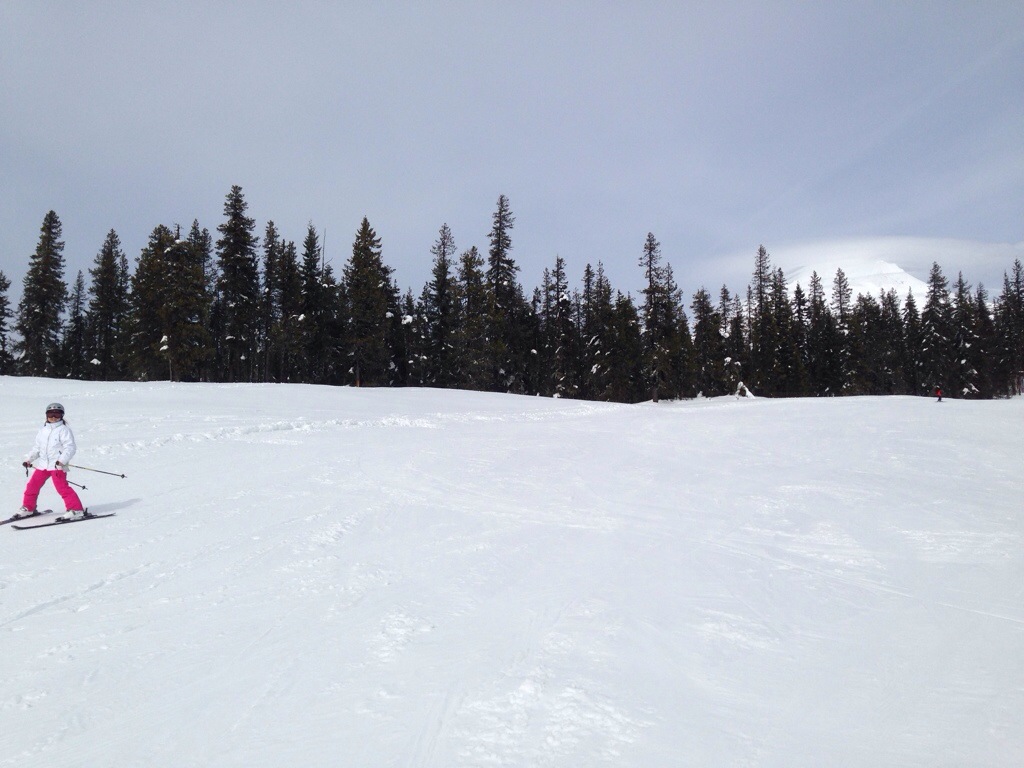
Sneaking in a day’s worth of runs at Summit before the evening rains set in.
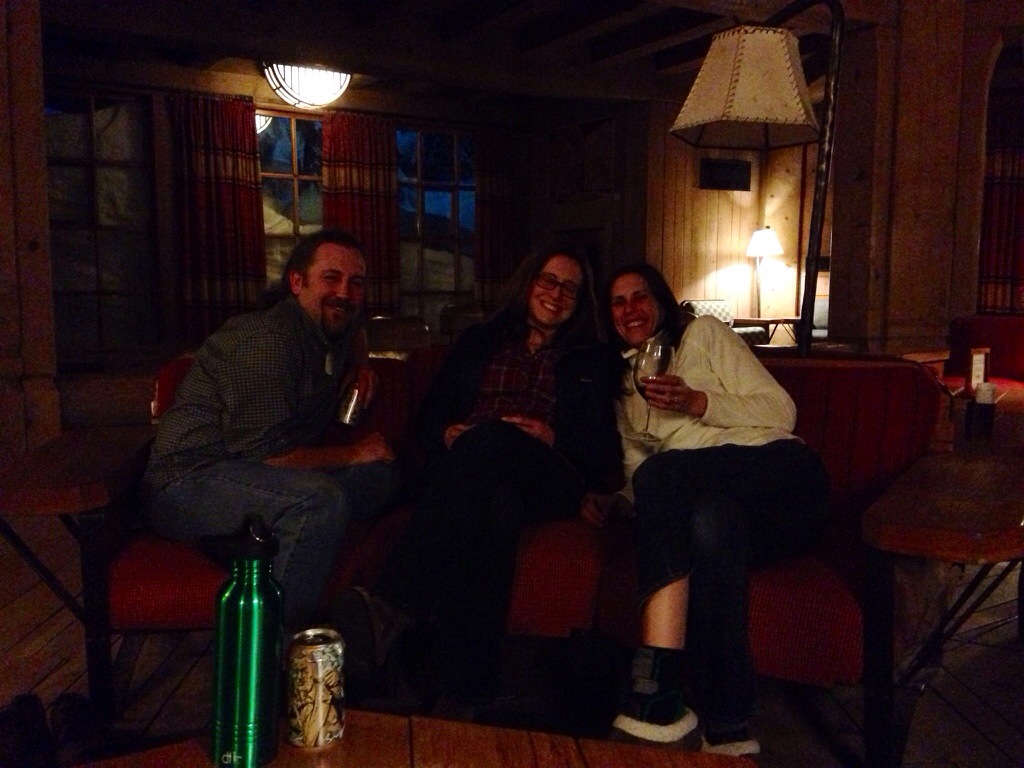
Late-night around the fire at Timberline Lodge, eager for an early ski morning.
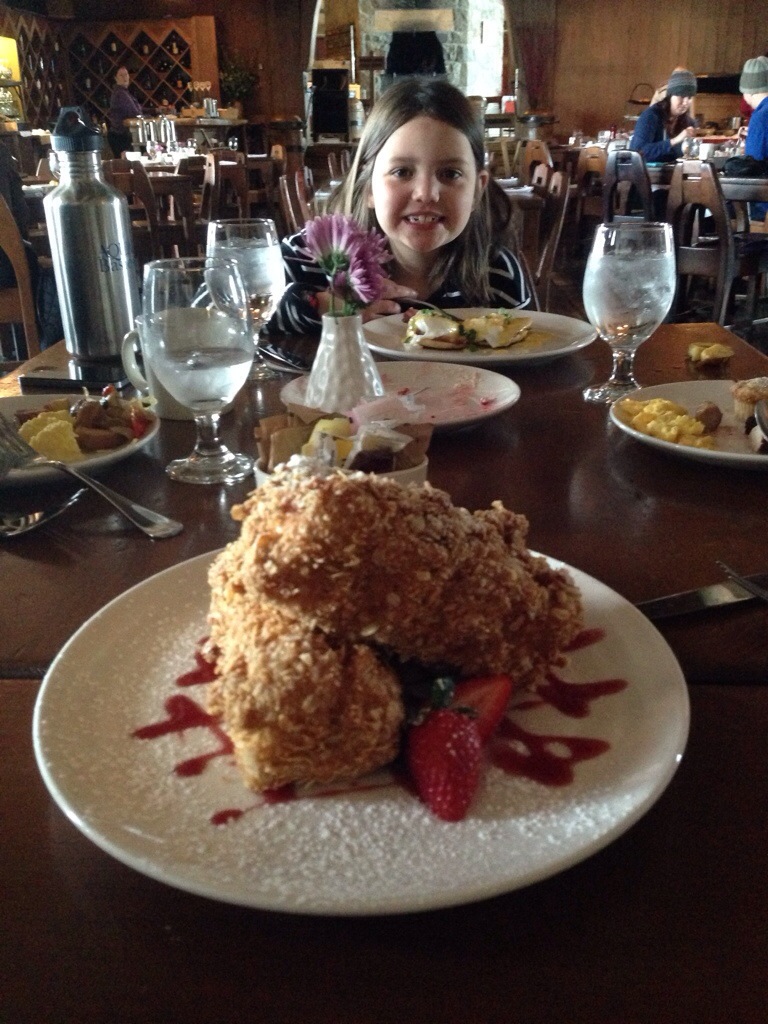
Thwarted by rain, we opted for the lodge’s storied Timber Toast instead.

Celebrating Spencer’s 4th birthday in Hood River after giving an On Mount Hood presentation to around 100 folks for Gorge Owned’s Sense of Place lecture series.
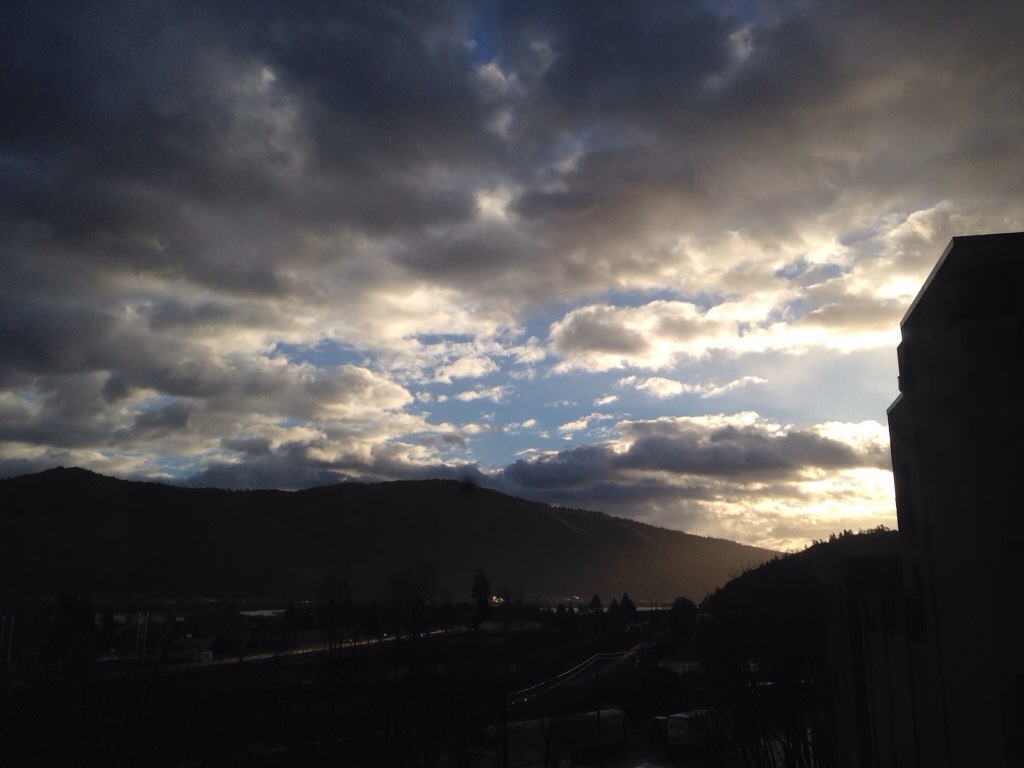
Sunrise from our room at the Hood River Hotel was promising.

But the rains returned in full force, leaving us to stroll the streets of Hood River and hope for another, snowier day to head back to the mountain.

 On MOUNT HOOD