Camping lesson
The Mount Hood National Forest was host to one hell of a party a few weeks ago.
We’d pitched our tent in a favorite area out near the rushing Sandy River, a place we’ve spent many a night over the past few years. The specific spot that we usually favor was already taken when we rolled up, but no worries. There were a few other options nearby, and the one we landed in boasted a nice view of the mountain through the trees and more shade than the old faithful spot.
This place has been great to us ever since we stumbled on it a few years ago. Because it’s not a campground, but instead a handful of dispersed sites, it’s relatively free of the crowds that flock to the more developed areas. And though you don’t have to hike in to get to it, it’s got a measure of serenity and beauty that almost hints at wilderness. Plus, the river’s just a short jaunt away.

Once we had our camp on in the late afternoon hours, the cars started rolling by. First one. Then another. And another. A Jeep with four young guys in it. A pickup truck rumbling with bass. A little sedan that had no business on such a rough road weighted down with folks.
The party, in the site a couple down from us, kicked off as the first cars pulled up. A car door would slam, some loud greetings would exchange, and then the beverages would crack open. I know how it works. I’ve been to my fair share of those, especially back in the pre-21 days. This was one of those.
It raged throughout the night, as the sun set, the mountain faded, the stars shone. Loud laughter, obnoxious machismo, breaking glass. Because we were a few sites away — and because we remembered what we had been like at that age — it wasn’t so bad. Just different than our normal escapes up there. Louder, mainly. And surprisingly, we just about outlasted the rowdies. By the time we retired from our own quiet campfire, it was pretty close to silent throughout the woods.
The next morning, the same cars we’d watched roll in the night before rolled back out in the early morning sun. My five-year-old daughter and I took a walk down the dusty road to survey the damage. And that’s when I changed from a slightly annoyed but somewhat understanding neighbor into an incredibly disappointed and perturbed curmudgeon. There was trash along the road, broken glass in the bushes. A pair of pants with who knows what on them sat crumpled up under a tree. Toilet paper streamed from the manzanita, camping chairs lay broken and bent on the ground, and the last car to leave loaded up the fire pit with trash, set it ablaze and drove away.
It was not pretty.
It needed to be cleaned up. I didn’t want to do it, but I knew we’d probably be back up for another weekend sometime this summer. I also knew that the Forest Service had been tolerating these unregulated sites, but that they were beginning to rethink that approach. Posted on all the sites in the area, for the first time since we’d camped there three or four years ago, were some unfortunate signs.

After mulling it over at breakfast and not being able to leave it alone, my daughter and I grabbed some plastic bags, headed back over to the trashed site, and cleaned it up. Five garbage bags, two wrecked camping chairs and a couple bucks worth of returnables later, it looked hospitable again. Probably still needed a good rain before I’d pitch my tent there again, but it was on its way.
I’d like to think that when I was that age, I would have been a little more conscientious about the things I did and didn’t do, but to be honest, I’m not sure I would have. Back then, a lot of it was about having new fun and, sometimes, not holding onto any evidence. I understand that. But years later, my perspective has swung over to the other, more adult and responsible side; the side that cannot fathom how anyone could leave a campsite just a few hundred yards away from the Sandy River and with a lovely view of Mount Hood in such littered disarray.
Who knows how many more scenes like that the Forest Service will have to walk up on before they do actually close those beautiful sites to everyone. I consider myself lucky to have found a place like this, to be able to enjoy an escape like this.
It’s easy to take these places for granted. It’s best not to.
Good stories
One of the things that I’ve found really interesting and unique in my time with Mount Hood is that almost everyone seems to have their own stories and connections with the mountain.
I met a guy on the beach in Clearwater, Florida, last spring who used to make annual skiing trips to Timberline Lodge with his college friends. Another guy, Rocky Henderson, kicked off a long stint of search and rescue missions on Mount Hood in 1986. His first mission ever was the search for a group of Oregon Episcopal School students lost in a storm on the mountain’s south side in 1986.
A sister of an editor I work for used to work up at Timberline Lodge, and she put me in touch with the guy who’s been running Silcox Hut for Timberline since 1993. One woman who read my book contacted me about a brief passage where I mentioned a plaque left on a boulder up near Cooper Spur. The plaque, which reads in part “Walk gently, friend, you are walking in the path of those who went before,” memorializes five Mazama climbers who were killed in a fall while descending Cooper Spur in 1981. One of those climbers was the woman’s husband. She herself helped place the plaque.
With Mount Hood, the stories go on and on.
Just the other day, a reader from Bremerton, Washington, Tom Blakney, dropped me a note to share some of his Mount Hood recollections. He remembered watching his father and other climbers through a telescope at Timberline Lodge in the 1940s as they made their way toward the summit. His father, an amateur climbing guide on Hood and St. Helens, once found himself on the summit of Hood with a frightened Irishman who refused to walk back along the exposed summit ridge when he saw how steep the north side drop off was. With no other options, Blakney’s father and another guide blindfolded the man and led him, tied between the two guides, across the ridge.
Blakney, who twice climbed the mountain himself, also sent along a couple great old photos of his father on the summit of Mount Hood, back when there was a lookout up top.

Courtesy of Tom Blakney
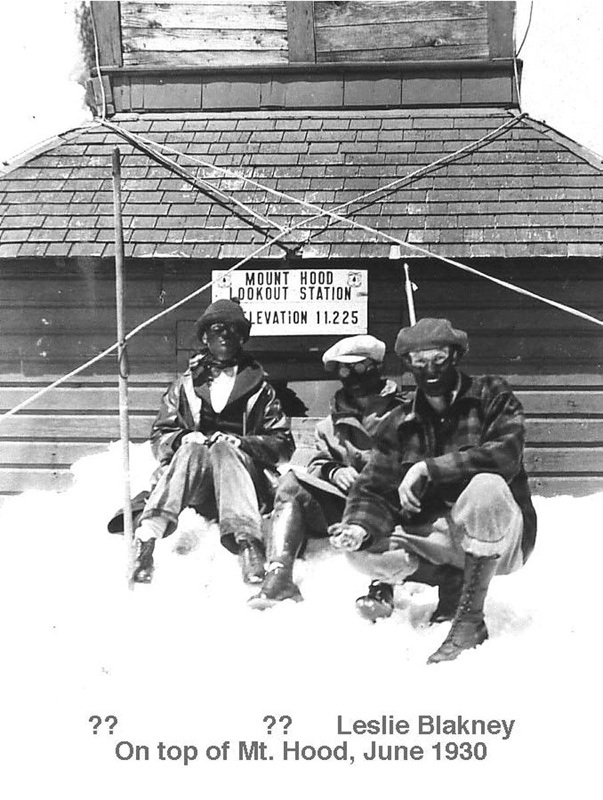
Courtesy of Tom Blakney
Ever since I first started exploring Mount Hood back in 1997, I’ve been fascinated by not only the mountain, but by all of the stories that help make it the spectacular peak it is. That’s part of the reason that I wrote a book about Mount Hood, and it’s a big part of the reason why I’ll keep exploring the mountain and writing about it.
Have your own Mount Hood story to share? I’d love to hear it. Drop me a line.
The piper
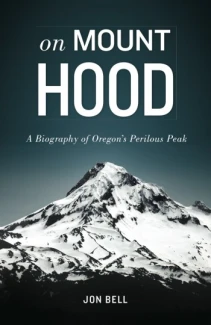
Every now and then, I’ll do a vain little search on the web to see where On Mount Hood pops up, just to see what people might be saying about it or where it’s ending up. So far, I’ve not found it in too many unexpected places. Some bookstore web sites, the Michigan State alumni magazine, the Portland Hikers web site.
But last night, as I was snooping around, I came across someone who’d shared a short passage of the book with his Facebook fans. His name is Brian Kidd, but I’ve never met him, nor did I even know his name until I perused his site a little bit. Instead, I knew him as one of the unique characters who add a little splash of color to Portland here and there.
My daughter and ran into him near Pioneer Courthouse Square during the holiday season back in 2008. He was hard not to notice, because he was wearing a Santa suit, playing Christmas carols on the bagpipes and riding a unicycle.

At the time, I thought, Only in Portland. I wrote a quick blog about it on my (now) old site, and the image stuck with me enough that I mentioned Brian Kidd, aka “The Unipiper,” in my book.
You’ll find him on page 60.
Pickathon 2011
This weekend is Pickathon, the annual indie music festival that finds a few thousand music lovers out at a Happy Valley farm just outside of Portland for a three-day musical menagerie. Across five completely different stages, more than 35 bands and artists bring their divergent sounds and create some incredible moments. I wrote about one such moment at last year’s festival — a dark Saturday night when the Heartless Bastards took the main Mountain View Stage — for my friend, Tim Labarge’s, new book, Pickathonography, which he’s unveiling this weekend.
You never really know who’s going to create those moments and when, but among the folks I’ll be watching closely this weekend: Truckstop Darlin’, Black Mountain, The Buffalo Killers, Pine Leaf Boys, Corinne West & Kelly Joe Phelps, Sunday Valley, Jesse Sykes, Grupo Fantasma, Vetiver, The Sadies, and many, many others.

The music’s sounding great, the weather’s finally looking like beautiful summer, and the Pickathon vibe has been setting in all week. In anticipation of this year’s fest, a tiny little excerpt from On Mount Hood and a picture from last year’s Pickathon, both of which help to illustrate the mountain’s subtle yet undeniable connection to one of the best music festivals around.
From the Volcano chapter of the book, which talks all about the geology behind not only Mount Hood, but the entire region:
Farther from the mountain toward Portland, direct fallout from Hood’s past eruptions is less evident. But there is plenty around to keep the volcanism that built the mountain and the entire region close to people’s everyday thoughts. Portland landmarks like Powell Butte and Rocky Butte — a city dweller’s quick fix for climbing — all rose from vents in the Boring volcanic field less than a million years ago, when Hood was itself beginning to burble. Shooting a three-pointer on the court at Mount Tabor Park, a characteristic Portland gem, puts you squarely on top of the vent that built the 643-foot cinder cone of the same name. And if ever in early August you head to the Pendarvis Farm in Happy Valley, just outside southeast Portland, for the fantastic three-day music festival known as Pickathon, you’ll be swaying to the tunes on the eastern flanks of Mount Scott, an extinct volcano named for Harvey Scott, editor of The Oregonian in 1889.
And from last year’s festival, a shot that shows just why it’s called the Mountain View stage:

 On MOUNT HOOD