The Book. The Mountain. Everything in between.

Latest

Mountain legs

I first got into climbing back in 1998, a year or so after we moved to Portland. Amy and I made our way up Mount St. Helens first, then I took a mountaineering course and climbed Mount Hood in 1999. Over the next few years, I ticked off most of the major Cascades, including Shasta, McLoughlin, Thielsen, Diamond Peak, South Sister, Middle Sister, Washington, Adams, and, in 2003, Mount Rainier. I never considered myself a technical climber by any means, just someone who loved — and still loves — to slog up the big boys and see the world from their summits every so often.

But with jobs and houses and, eventually, kids, my climbing slimmed down to a fraction of what it once was. Still, I do my best to tackle at least one of the major Cascades every year. Two years ago, we did St. Helens and Adams; last year, I returned to the top of Mount Hood for the first time in far too many years.

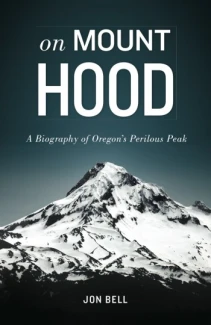
This year, I’m hoping to visit Hood yet again. With On Mount Hood officially coming out in just a few weeks, it only makes sense.

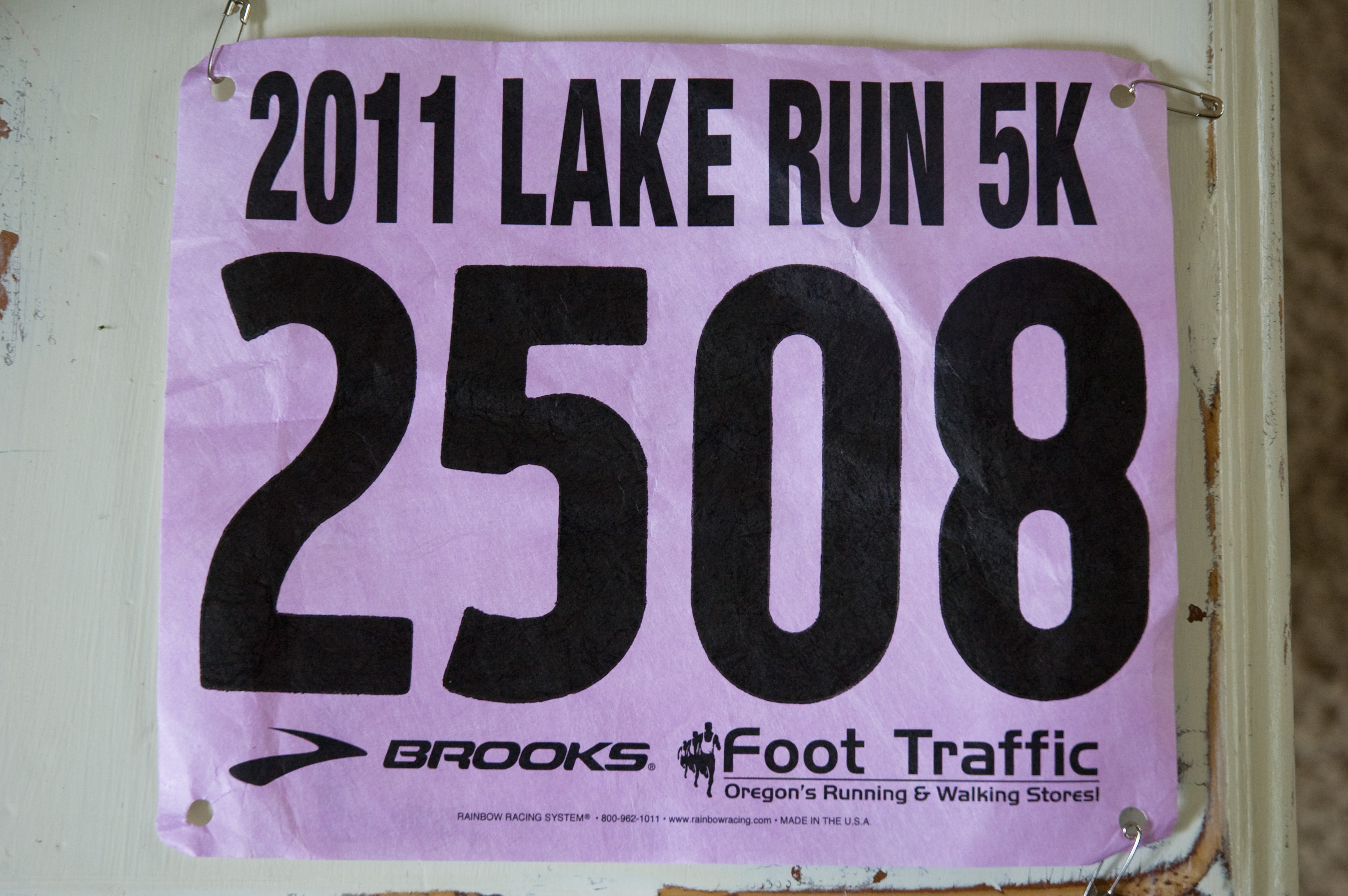
To help get the old mountain legs ready for a heave up the south side of Hood this spring, I’ve been running with Oliver, hiking here and there  — a couple miles along Suttle Lake in April and a trip up Angel’s Rest on Easter weekend — and this morning, I joined a few thousand runners for the annual Lake Run around Oswego Lake. I’m not such I runner that I could tackle the whole 12k around the lake, but the 5k, now that I can do.
It’s real now

I walked out to the mailbox today, excited but reserved. I’d been expecting something to arrive yesterday, but it didn’t. So I kept my hopes in check just in case the results were the same today.

Sure enough, when I opened the mailbox there was little more than a letter from the water co-op, a program for the local theater company, and a whole lot of empty space.

Sigh. Close the mailbox. Wait till tomorrow.

But  on my way back down the driveway, there it was. A nice, big, yellow envelope propped up next to the front door. The return address said it all: Sasquatch Books.

Inside was the physical manifestation of months and months of work and years and years of exploration, recreation, and fascination with Oregon’s signature mountain.

On Mount HoodIn stores June 2. Available for pre-order now.

Sustenance

Over the years, we’ve spent a lot of time on Mount Hood, but also a fair amount of time driving to and from and around it. And so, after long hikes up to McNeil Point, afternoons climbing at French’s Dome, long, scenic drives around the Mount Hood loop with out-of-towners, and day trips to canoe, ski, sled, or just visit, we’ve sampled a few of the local restaurants and watering holes around the mountain. Some have been forgettable, others have become go-to favorites. A few of the latter to consider next time you’re in the area:

Calamity Jane’s Hamburger Parlor 

Calamity JaneAnyone who’s driven by Calamity Jane’s in Sandy on their way to or from the mountain and not been at least intrigued to know what that inviting blond with the burger on the side of the road is really all about must have been asleep at the wheel. We pulled in years ago to check it out, and now no hike under 5 miles ends without a Calamity burger on the tail end. The place is homey and traditional, the menu packed with close to 40 burgers served in three different scales: the third-pound City Slicker, the two-thirds-pound Wrangler, and the just plain scary one-pounder known as the Trail Boss. Some of the burgers sound more novelty than anything —the George Washington has sour cream and pie cherries — but paired with fries and giant 34 0z Bridgeport IPAs, just about anything from Calamity’s caps off a day on the mountain in a satiating, near gut-busting way.

El Burro Loco

El Burro LocoThere came a time when it seemed as if we were running out of options for better food around the mountain. But then someone recommended El Burro Loco in Welches, and that changed that. Unassuming but friendly, this Mexican joint has fantastic, reasonably priced food, a huge beer selection — at least five different IPAs on tap last time we stopped in — and chummy staff. Great for when you’ve not earned a Calamity burger but still want some real satisfaction.

 3 Rivers Grill 

When you’re not rewarding yourself for a long and dirty day on the trail but instead seeking out a touch more refinery, 3 Rivers Grill,  on the north side of the mountain in Hood River, makes an excellent choice. A little more upscale but still laced with Oregon informality, 3 Rivers sits high on a hill lot in downtown overlooking the city and the Columbia River. Outside seating is scenic and comfortable, and the salmon I had there on our first visit was something I’ve not soon forgotten.

Of course, there are a ton of other options, including breweries, pizza joints, historic lodges, and even a renowned donut shop. But this site is new. We’ve much to cover. And we will.

Guidebooks

While there really aren’t that many books out there that tell the story of Mount Hood — Jack Grauer’s essential “Mount Hood: A Complete History” and Fred McNeil’s “Wy’East: The Mountain” notwithstanding — there are quite a few great hiking books that can really show people how to get to know the mountain through exploration.

Among my favorites are three from Oregon author and lifelong hiker Douglas Lorain.

Backpacking OregonI first saw one of Doug’s slideshows probably 10 or 12 years ago at a regular meeting of the Ptarmigans, a Vancouver mountaineering club that has since gone on indefinite hiatus. It was all about his newest and maybe first book, “Backpacking Oregon.” Filled with trips all across the state, it also contains the definitive description and itinerary for the Timberline Trail on Mount Hood. Even though that hike, as mentioned yesterday, is supposedly no longer possible as a single loop, it was still in good shape in 2005, when Amy and I did it. “Backpacking Oregon” helped us plan our trip, stay on track, and have a memorable time.

Afoot and Afield: Portland/VancouverLorain is also the author of “Afoot & Afield: Portland/Vancouver, A comprehensive hiking guide.” It’s a thick tome of more than 200 hikes within an hour’s drive or so of the Portland metro region. I’ve barely tapped into it myself — there’s nearly 50 trips around Mount Hood alone — but it’s got some great, little-known excursions. Among my favorites: Cape Horn, a light 3-mile walk to the edge of some amazing cliffs on the Washington side of the Columbia River Gorge, and Hood River Mountain, an easy 3-mile loop just outside of Hood River with jaw-dropping views of the Hood River Valley, Mount Hood’s north face, the Columbia River, and St. Helens, Rainier, and Adams.

One Night Wilderness Portland When I first got to Portland in 1997 and started backpacking every weekend, Amy and I talked about doing a backpacking guidebook full of the best trips you could fit into a single weekend. It seemed like the perfect guidebook for people who had just the standard two days off every week to get out of town. I missed my opportunity, but Lorain nailed it with “One Night Wilderness Portland: Quick and Convenient Getaways within Three Hours of the City.” Filled with more than 60 trips, including 12 on Mount Hood, this book is just what I’d had in mind — and what true weekend backpackers had been looking for.

Cooper Spur

The hiking on Mount Hood is all quintessential Cascade rambling: scenic lakes like Burnt and Mirror, pristine rivers like the Salmon and Sandy, wildflower meadows and expansive vistas like McNeil Point and Paradise Park.

Mount Hood from White River. 

More than 1,000 miles worth of hiking trails wind their way all around the mountain, from the forested Badger Creek trail on the mountain’s southeast base to the little-known Owl Point trail in its northwest shadow. There’s also the storied Timberline Trail, a classic, 41-mile circuit around the entire mountain. Massive flooding in 2006, however, wiped out the trail’s crossing at Eliot Creek, supposedly to the point that it’s no longer possible to safely cross the creek nor, as a result, complete the entire Timberline Trail in one go.

But of all the hiking on Mount Hood, there is one hike that, for me anyway, truly rules the day: Cooper Spur.

Quite possibly the most amazing hike on all of Mount Hood, Cooper Spur is about as close as you can get to climbing the beast without actually donning crampons and an ice ax. And that’s not because it’s physically such a kicker. The trail’s rugged three-and-a-half miles do gain more than 2,000 feet of elevation, but somehow it’s not as grueling as it sounds.

What really gives this hike a mountaineering feel is its height. By the time you break out of the thinning hemlocks and firs above the Cloud Cap Saddle campground on the Timberline Trail,  you’re already well above the 6,000-foot level. From there, you pass an old stone shelter and then slowly wind your way up broad, sandy switchbacks that eventually lift you up onto the spur itself. The ridge becomes fairly narrow before the trail comes to a halt at Tie-In-Rock, where climbers rope up before moving on. You’re now at about 8,500 feet, and with views stretching from Mount Adams, Mount Rainier, and Mount St. Helens to the desert of Eastern Oregon and the massive Eliot Glacier right there on Hood’s dramatic north face, it’s hard not to feel like you’re sitting atop the mountain itself.

Cooper SpurTop of the hill: where the Cooper Spur hike ends and the climb to the summit, just 2,700 feet higher, begins.

For more information on hiking Cooper Spur — it’s usually best from late July through mid September — read this Forest Service sheet. 

A few Mount Hood favorites

After fourteen years of exploration, I’ve amassed plenty of photos from on Mount Hood. Sunsets. Hiking trails. Kayaking and canoeing on Trillium Lake and Lost Lake. Timberline Lodge. Cooper Spur. The summit.

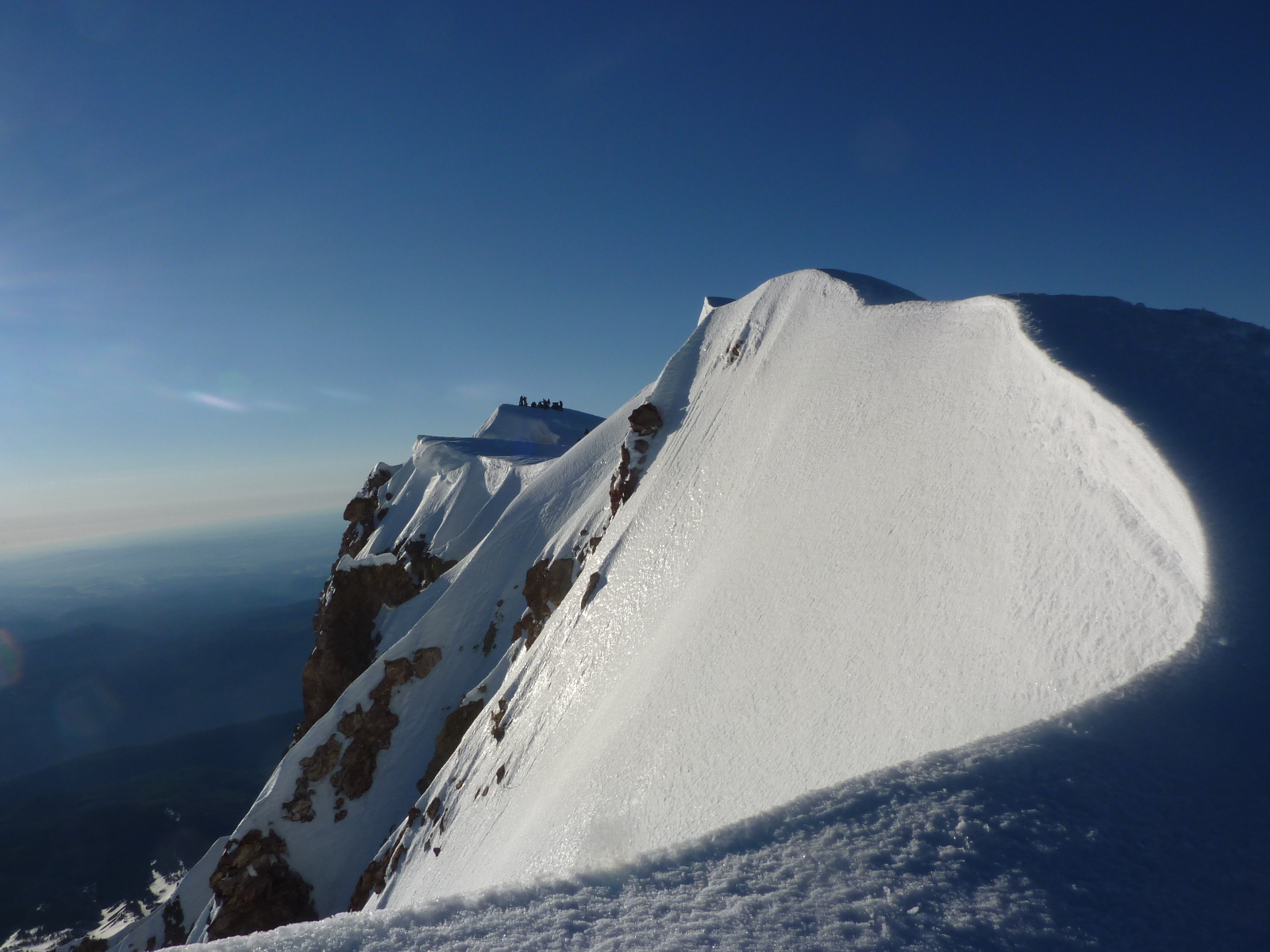
Photo of climbers on the summit of Mount Hood by Daryl Houtman

The mountain is incredibly photogenic. Of course, what you’re doing on the mountain and who you’re with has a big impact too. What follows are a few of my very favorite Mount Hood images.

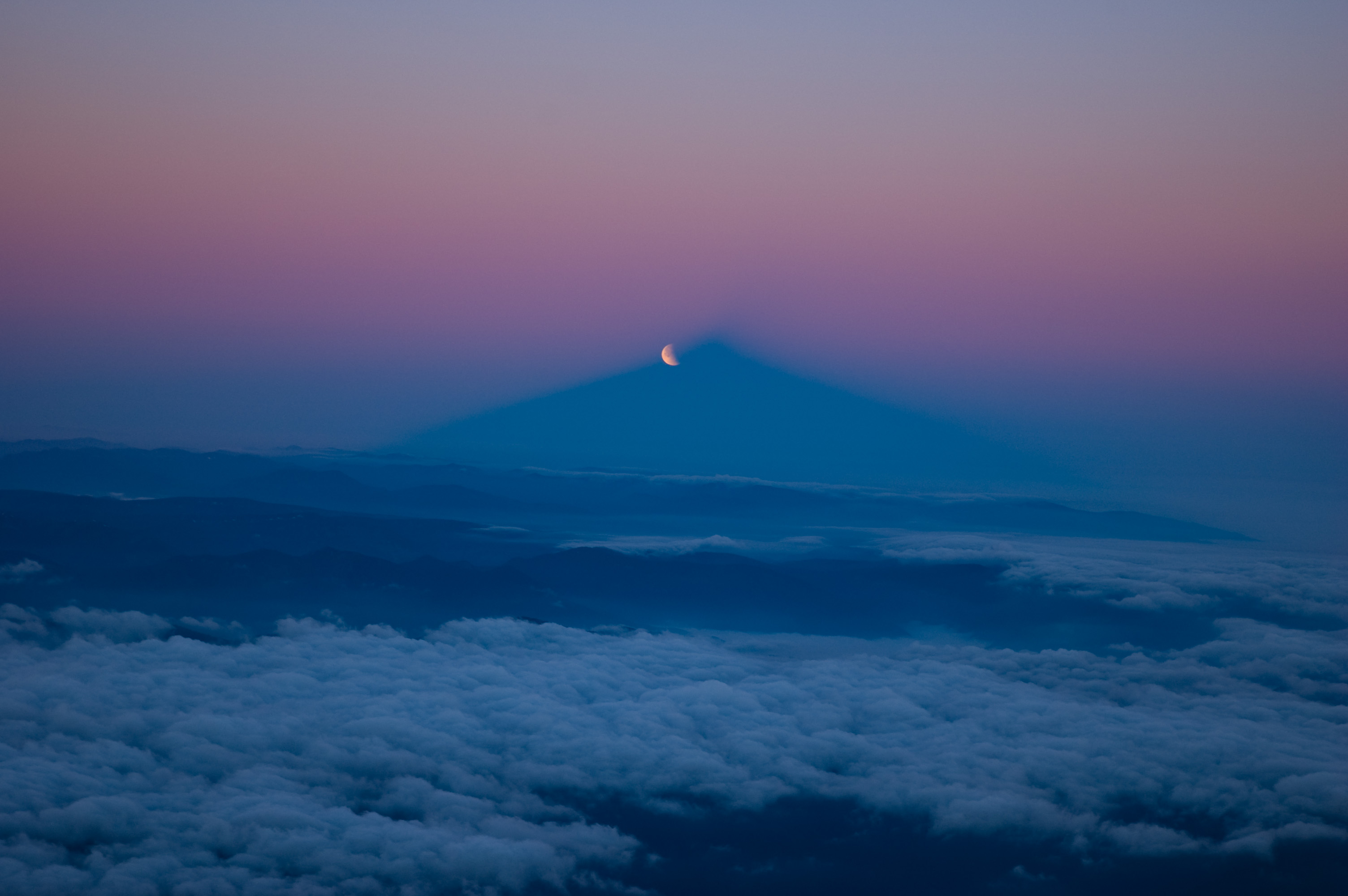
This one’s been published elsewhere, but to me it’s one of the most unique images of the mountain I’ve ever seen with my own eyes. Four of us were climbing the standard South Side route of Mount Hood in June 2010, and as we approached Crater Rock, the sun began to rise and the moon began to shrink. In the early morning light, the mountain’s shadow was cast upon the valley sky down below, and the nearly full moon darkened under an unexpected lunar eclipse.

You can’t see the mountain in this photo, but it’s there in the background, way off in the distance above the trees. This shot is from the banks of the Muddy Fork, a small but beautiful river that drains from the Sandy Glacier on Mount Hood and eventually joins the Sandy River, which itself emanates from the mountain’s Reid Glacier. We stumbled upon some great campsites along the Muddy Fork, and for four years now have made it a multi-annual outing. We love it, and obviously, Oliver, my Black Lab, does too . . .

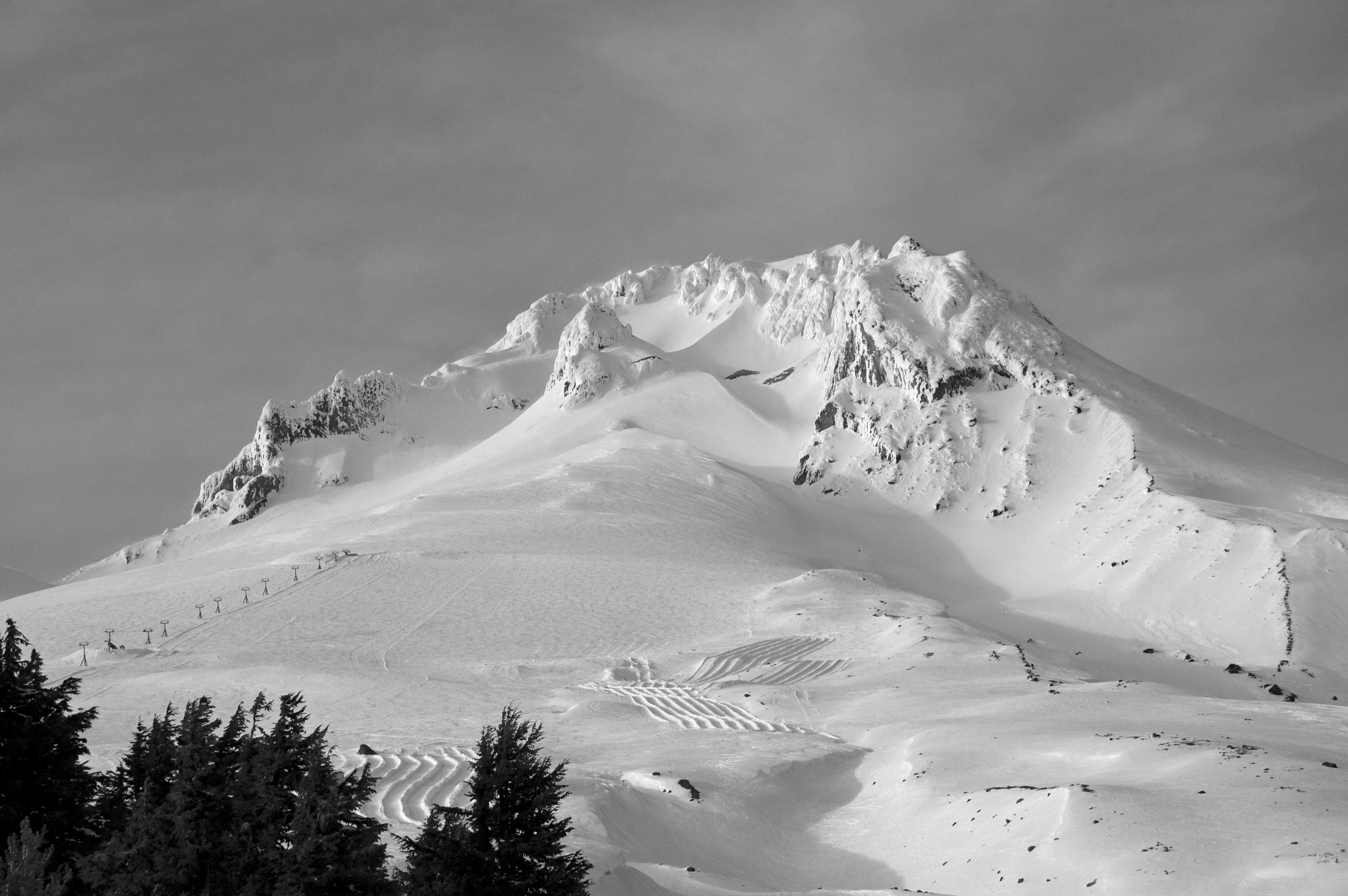
This one, to me, shows just how photogenic Mount Hood is. We’d headed to the mountain for a fairly routine visit. Just drove up when Spencer, my son, was a few weeks old, hung out in a Steiner Cabin, and paid a quick visit to Timberline Lodge. I stepped out of the car, walked up a steep snowbank, and took a few seemingly forgettable pictures of the mountain from a spot that serves most tourists well. But when we got home and I looked at my pictures from the day, I felt like I’d really gotten something.