On Mount Hood in Sisters and Redmond
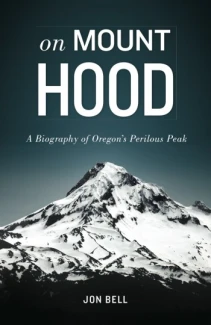
 I’ve taken On Mount Hood all around the mountain, into the Gorge, across Portland, and even out to the coast for different readings and events.
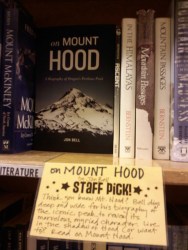
One place it’s not been yet, however, is Central Oregon. That will change this weekend with two events at Paulina Springs Books. The first is tonight at 6:30 at their store in Sisters; the second is tomorrow night at 6:30 at the Redmond store. Always love spending time in this beautiful part of Oregon, so we’re looking forward to a fun weekend…
Friends of Timberline
For years now, I have been wanting and meaning to get involved in some kind of community service effort to give back a little bit with some of my free time. Sure, I’ve donated books here and there, I put a little time in at my daughter’s school, but it’s been pretty unfocused so far.
Part of that has to do with a limited amount of hours to spare from what seems like a pretty spoken-for supply. But part of it also has to do with the fact that I just haven’t quite found something that syncs well with what I care about and what I can do. It’s probably just that I haven’t thought about it hard enough, but who knows.
This summer, however, something stared me straight in the face and pointed me in the right direction. It came in mid August during a book event at Timberline Lodge with a few other authors. It was a beautiful summer day. The mountain was out in full, the lodge was bustling with tourists and summer camp skiers and Pacific Crest Trail hikers from all over the world. I sat outside on Timberline’s back patio talking about the mountain with people and feeling like a lucky person to have such a direct connection to the lodge and the mountain.

So I’m sitting there, on the back patio of Timberline Lodge, staring at incredible Mount Hood, not to mention talking to Sarah Munro, author of Timberline Lodge: The History, Art, and Craft of an American Icon, and thinking, too, about how I can get involved with something that really matters to me, and it finally dawns on me — Duh, how about the Friends of Timberline?
Founded in 1975 to conserve and restore the art and furnishings of the lodge, the Friends of Timberline have been involved in a range of projects that, essentially, care for the lodge, its artwork and furniture, and its history. Among their more recent efforts, they completed the first phase of a project to light up some of the artwork in the lodge, and they restored the outdoor amphitheater and front steps. Over the years, the Friends have also been involved with public outreach, story and photo archives, and pathways and landscaping outside the lodge, among many other projects.
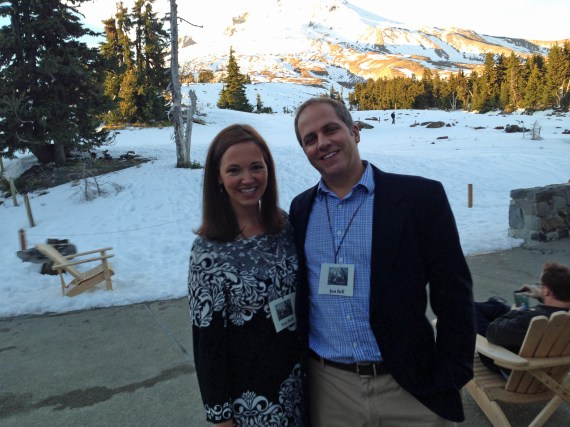
It’s such an obvious choice for me, for all the reasons already mentioned, but also because the Friends had invited me to speak at their annual meeting and fund-raiser at the lodge this past Saturday. Amy and I went up there on Saturday — another beautiful mountain day — and had a great time talking with so many fans of Mount Hood and Timberline Lodge. We also explored parts of the lodge we’d never seen before, and came to appreciate the lodge and the mountain even more than we already did.
To top it off, we were lucky enough to spend the night at Timberline, wake the next morning for a swim in the pool, and then enjoy a fantastic breakfast in the Cascade Dining Room. It was hard to leave when we had to, but the entire experience gave us even more cause to support Friends of Timberline and to continue enjoying and taking care of not only the lodge, but the amazing mountain it sits on, too.
Mount Hood, Timberline, and The Shining — again . . .
It only took a couple of exterior shots of Timberline Lodge to forever link Mount Hood to Stephen King’s classic novel, The Shining, or, more appropriately, Stanley Kubric’s interpretation of the book. Most of the movie was shot in a sound stage in England, but there are a few opening scenes that are unmistakably Mount Hood.
I’ve been a Stephen King fan since middle school and a long admirer of The Shining. Even more so since writing On Mount Hood.
So it was with great excitement that I heard about King writing a sequel to The Shining, which just came out a week or so ago. It’s called Doctor Sleep and centers around the now grown up Danny Torrance, the clairvoyant little boy from the original story.
I bought a copy at Powell’s over the weekend and am anxious to get into it. I read the original every couple years, and every year around this time I watch the movie, so it’ll be nice to add a new chapter to the Shining story. . .

Stevan Allred at Powell’s Books
Thanks to being included in Laura Stanfill’s Brave on the Page book last year, I made a bunch of great new connections in the Portland writing scene. Among them: Laura herself, who started Forest Avenue Press; Joanna Rose, a local writer and teacher who was on our Timberline Trail adventure last month; Scott Sparling, author of Wire to Wire, a great novel set in a corner of northern Michigan that’s near and dear to my heart: and Stevan Allred, a local writer and storyteller who included me as part of his annual Writers Night at the Springwater Grange earlier this year.
Now, Stevan’s book, a fantastic collection of related stories called A Simplified Map of the Real World, is being published (as Forest Avenue’s second title!), and they’re releasing the book in the biggest way possible in Portland — with a kickoff event at Powell’s City of Books on Burnside. The event starts at 7:30 p.m. tomorrow, Sept. 12, and promises to be a great one.

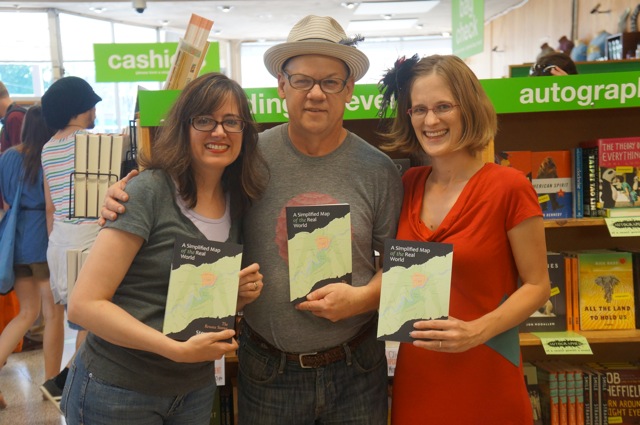 Gigi Little, graphic designer for Forest Avenue Press, Stevan Allred, and Forest Avenue publisher Laura Stanfill at Powell’s City of Books.
A little more on McNeil Point
Before we camped in the McNeil Campground along the banks of the Sandy River with some friends from Atlanta last weekend, before I hiked the Timberline Trail with four other adventurers a week earlier, and before Oliver and I returned to McNeil Point up the Mazama Trail back in July, I felt like I knew a decent amount about Fred McNeil.
A journalist for The Oregon Journal for nearly 45 years, from 1912 to 1957, McNeil was a huge fan of Mount Hood. According to the preface of McNeil’s Mount Hood: Wy’East the Mountain Revisited, a 1990 re-issue of McNeil’s classic Mount Hood book, the Cascade Mountains captivated him from the day he arrived in Portland from Illinois in 1912. He “pursued and reported events on the peaks with a passion” and “became personally involved in their protection as well as their development, especially for skiing.” If something happened on Mount Hood — someone got lost, a plane crashed, a fire broke out — McNeil would instantly turn his news focus to the mountain, no matter what else was going on.

Oliver at McNeil Point.
He also enjoyed the mountain, hiking all over it and climbing to its summit long before the road was blazed to what would become the site of Timberline Lodge. He was a member of The Mazamas, the Cascade Ski Club, the Wy’East Climbers and other mountain organizations.
According to the preface of McNeil’s Mount Hood, written by journalist Tom McAllister, McNeil made sure that a story about the long closure of Lolo Pass Road landed on the front page of The Oregon Journal. The closure had been designed to keep people out of the original bounds of the Bull Run Watershed. Even after those boundaries changed, however, the closure remained, blocking access to some of the mountain’s most incredible west-side geography. After several stories and photos and a supporting editorial, the gates to Lolo Pass were opened.
Which is a great legacy, because otherwise it would be much harder to get to places like McNeil Point and the quiet McNeil Campground, both, of course, named for Fred McNeil.
Most of this I kind of remembered from my own research. But I’d forgotten something else about McNeil.
As we rolled out of the campground last week, headed toward Timberline Lodge and then Lost Lake, I stopped to read a plaque near the campground’s entrance. It sums up nicely McNeil’s life and his love of the mountains. It also notes that McNeil “rests four miles eastward and upward at McNeil Point.”
His friends hiked up to the point and spread his ashes there in July of 1959.

Pickathon 2013
It’s kind of a stretch to connect Pickathon, the annual indie music fest happening this weekend in Happy Valley, with Mount Hood, but I’ve been doing it for a while now, whether it’s sharing a picture of the Mountain View stage, which offers a glimpse of the mountain in the distance, or using a line from the Heartless Bastards’ song “The Mountain” as an epigraph for the first chapter of the Mount Hood book. (I first got turned on to them at Pickathon 2010.)
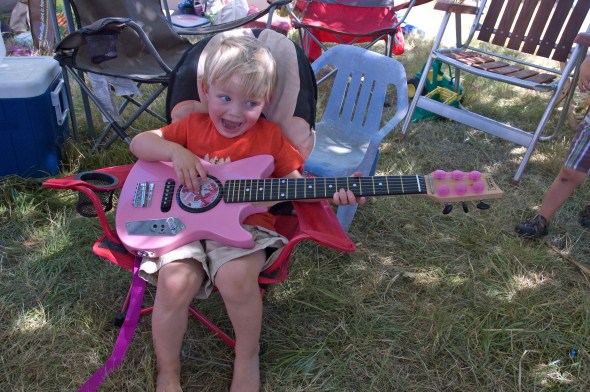
Not sure I have any new connections to make between the festival and the mountain just now, but who knows, maybe I will after this weekend. In the meantime, a few images from last year’s Pickathon to get ready for this year’s . . .


 On MOUNT HOOD