Mount Hood Views
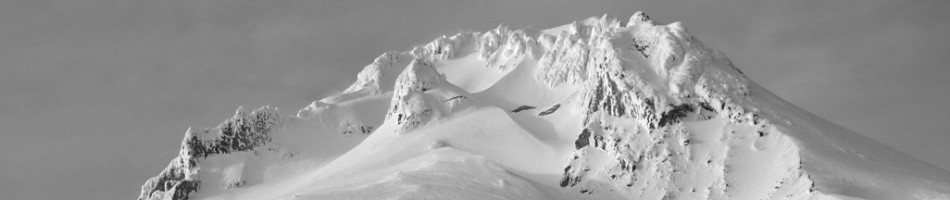
Before all the nonstop rain and impenetrable clouds settled over us this week, the recent views of Mount Hood were incredible. A clear day in mid to late autumn is, to me, when the mountain looks just about as good as it gets: new white snow, some fall foliage, deep blue sky, and cold, clear air that seems to sharpen the view just a touch.
That was the view when we headed up to the Portland Japanese Garden for, ridiculously, our first time ever since moving to the area in 1997. Unfortunately, the fall sun was so bright up there that it washed out the mountain in this shot. But it was there. Trust me.

In addition to the view of Hood from the Japanese Garden, there are great vistas of the peak from every side. Below are a few others of mine. Anyone else have a favorite view to share?
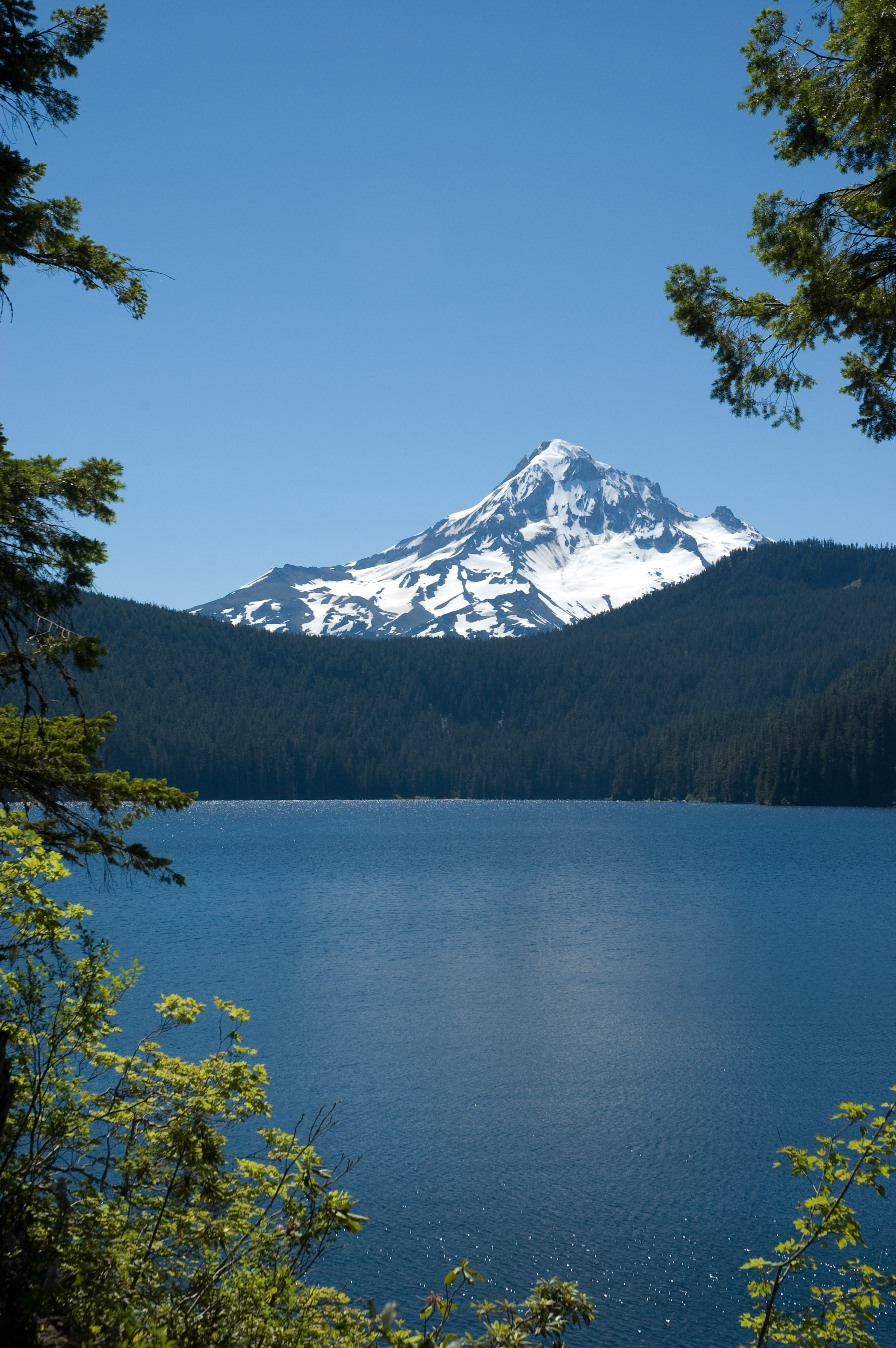
Mount Hood from Bull Run Lake

Mount Hood from Gnarl Ridge.
 Mount Hood from about 10,000 feet up on its south side.
On Mount Hood Events
 It’s shaping up to be a busy season of books around here, with On Mount Hood scheduled for five events in the next few weeks. There’s one slideshow, a couple big author/artist festivals, a Friday night art walk, and a 30% off sale at a great college bookstore. Surely one of them will help check a name or two off your Christmas list . . .
Book signing, 12-4 p.m. Saturday, Nov. 19, at the Audubon Society of Portland’s annual Wild Arts Fesitval.
Book signing, 1 p.m. to 3 p.m. Thursday, Dec. 1, at The Willamette Store’s annual book blowout in Salem.
Book signing, 6:30-9 p.m. Friday, Dec. 2, at Chapters Books and Coffee during First Friday Art Walk in Newberg.
Book signing, noon to 4 p.m. Sunday, Dec. 4, at The Oregon Historical Society’s Holiday Cheer author celebration in downtown Portland.
Slideshow, 7 p.m. Wednesday, Dec. 7, at The Mazamas in southeast Portland.
Mount Hood questions — and answers
Every time I give a slideshow or presentation about On Mount Hood — the next one’s coming up on Saturday, Nov. 19 — I get some questions near the end. A lot of them I have answers to; some take a little more digging, and still others find me punting altogether or simply admitting that I have no clue.
My ultimate goal is to be able to answer any question about Mount Hood or, at least, On Mount Hood, that comes my way. That’s a steep goal, considering just how much material Mount Hood, the mountain, encompasses. But to me, it’s also a fascinating goal worth pursuing.
A few questions from recent events:
Q: What does Wy’east mean?
A: The mountain’s modern name, Mount Hood, comes from an Englishman, Samuel Hood, who never saw the mountain and who actually fought against the United States during the Revolutionary War. William Broughton, a member of an expedition under the command of Captain George Vancouver, is credited with naming the mountain after admiral Hood in 1792. But for hundreds of years before that, many Native Americans who lived in the area supposedly called the mountain Wy’east. Lewis McArthur’s invaluable Oregon Geographic Names, says that Wy’east does not appear in any available books on on native dialects of the area, but the term nonetheless found its way into Native American folklore. Nobody seems to know exactly what the word Wy’east means, but according to the lore of the Klickitat tribe, who lived along the north shore of the Columbia River, Wy’east was one of the mythical sons of the Great Spirit. He got into a massive and fiery fight with his brother, Pahto, over a beauty named Loowit. Their battle scorched the land and so infuriated their father that he turned all three into volcanic peaks: Loowit is Mount Saint Helens, Pahtoh is Mount Adams, and Wy’east is Mount Hood.
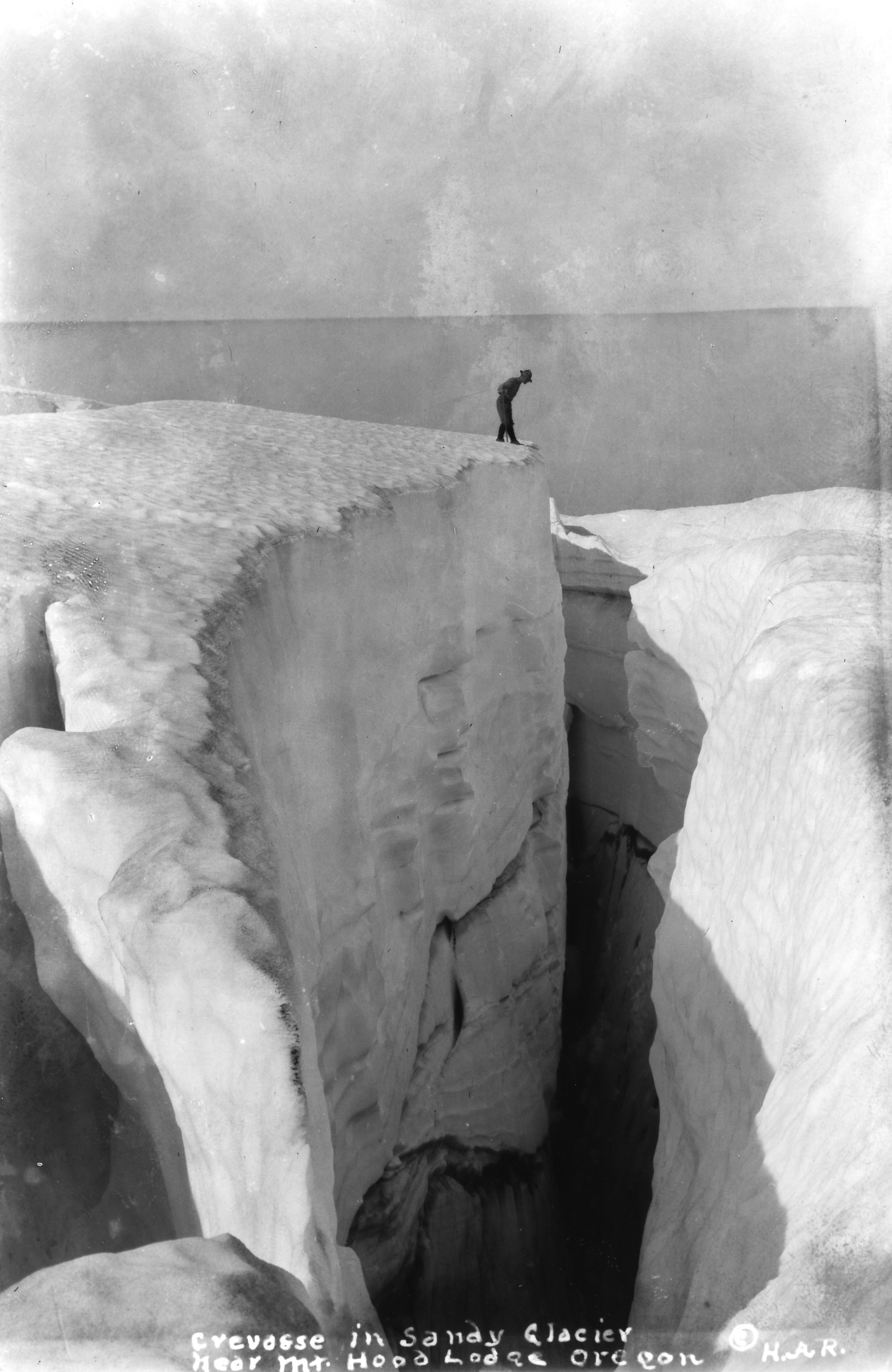
Q: What’s so bad about the fact that the glaciers on Mount Hood are shrinking?
Courtesy of the Mazamas
A: In the very near term, maybe not much. But if global warming continues on pace and the scientific models play out they way geologists suppose they may, glacial shrinkage on Mount Hood could have some very noticeable effects. Shrinking glaciers mean less water to irrigate orchards in the Hood River Valley. The ice that currently blankets the mountain also helps cement its unstable volcanic mass together. Less ice holding Hood together means more landslides, erosion and flooding, which already comes into play whenever Highway 35 washes out on the mountain’s east side. Mountain maps are already highly inaccurate because they depict glacial coverage that simply doesn’t exist anymore, which can be challenging for climbers and other folks working their way up or around the mountain. And as the temperatures rise, so do the snow levels. Eventually, Hood’s renowned ski and snowboard industry could feel a mighty pinch.
Q: What kind of skis do you use?
A: Rentals. (See the “Down the Hill Chapter” of On Mount Hood.)
Q: What’s the latest on the Cooper Spur land swap?
 A: At present, the Forest Service is reportedly moving slowly through the process that will likely approve a swap of 770 acres of land owned by Mt. Hood Meadows on the north side of the mountain for about 120 acres of developable property in Government Camp. The swap, which is dependent upon environmental reviews, appraisals and other considerations, will ultimately protect the acreage on the north side of the mountain from development and will give Meadows the opportunity to develop land in Government Camp. The original timeline for the process appears to have extended past its deadline, but last I was told, the process is still moving forward, albeit slowly.
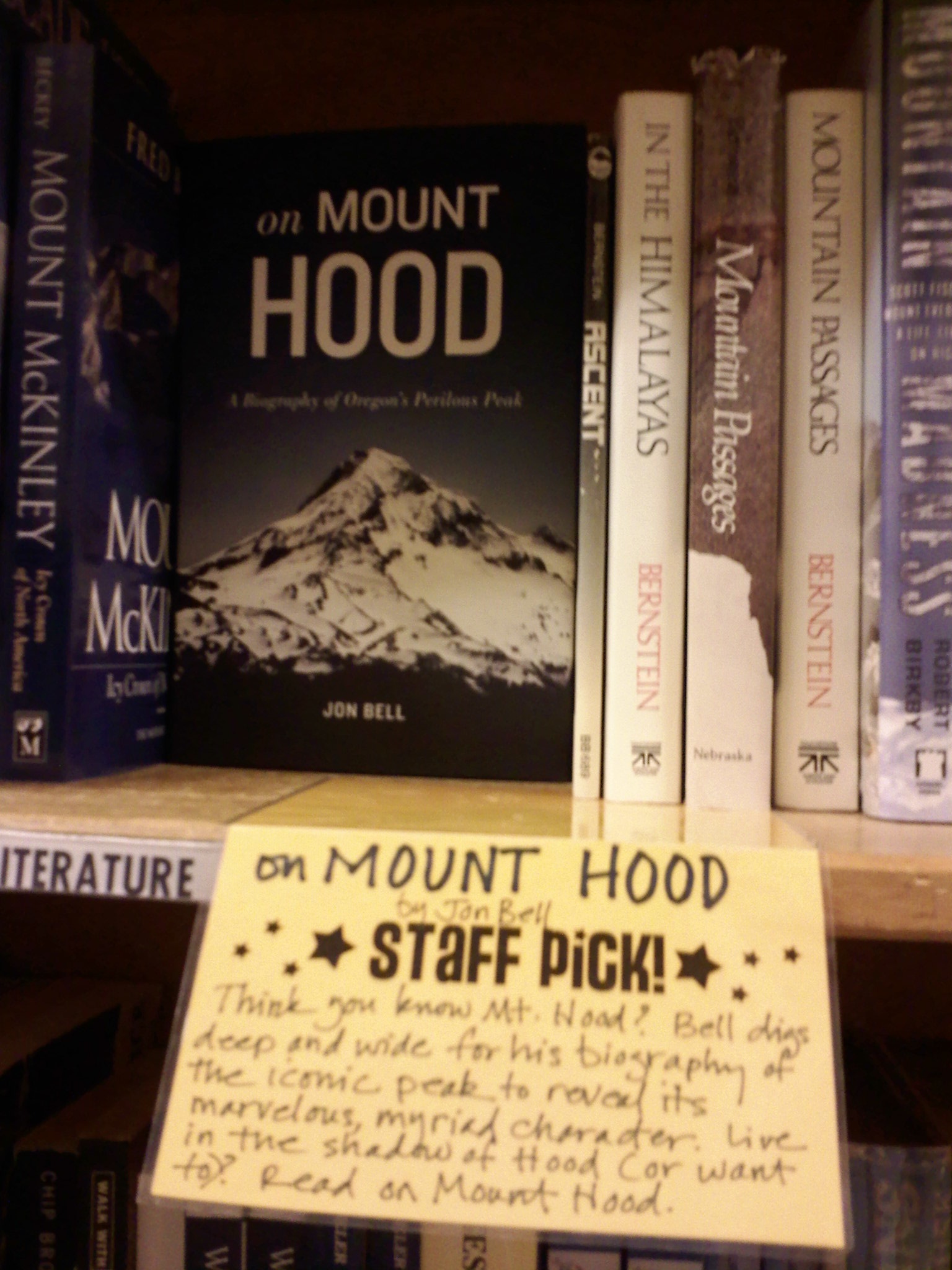
Picking books
It had been a while since I’d stopped in my favorite book store, Powell’s City of Books, so I dropped in today after a meeting for work. In addition to some browsing, I picked up a couple new books. One, Bruce Cameron’s A Dog’s Purpose, has been repeatedly recommended by some trusted sources. The other, Andrew Krivak’s The Sojourn, I grabbed on impulse after hearing an engaging interview with the author on my way to Powell’s. I considered some of Jim Harrison’s novels too, after reading a profile of him in the latest issue of Outside magazine, but I had to draw the line somewhere.
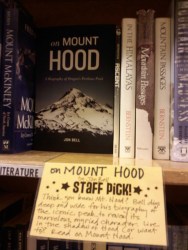
Before leaving, I of course had to scan Powell’s Oregon section and the mountaineering section. Glad I did.
Last leg: the Sandy River and Lost Lake
Just like that, the chance of any really nice, warm, Indian summer-like weather here in the Pacific Northwest has left us. While that may be a little bit of a drag, it’s also fairly fine. Not only have we so far had a relatively mild and enjoyable autumn, but we also had a warm and sunny stretch near the end of the summer that almost made up for the lingering gray that hung around far too long early in the season.
And from that last leg, we also have the fond and bright and warm recall of a few of those days. One we spent on the banks of the Sandy River with a stunning view of Mount Hood.
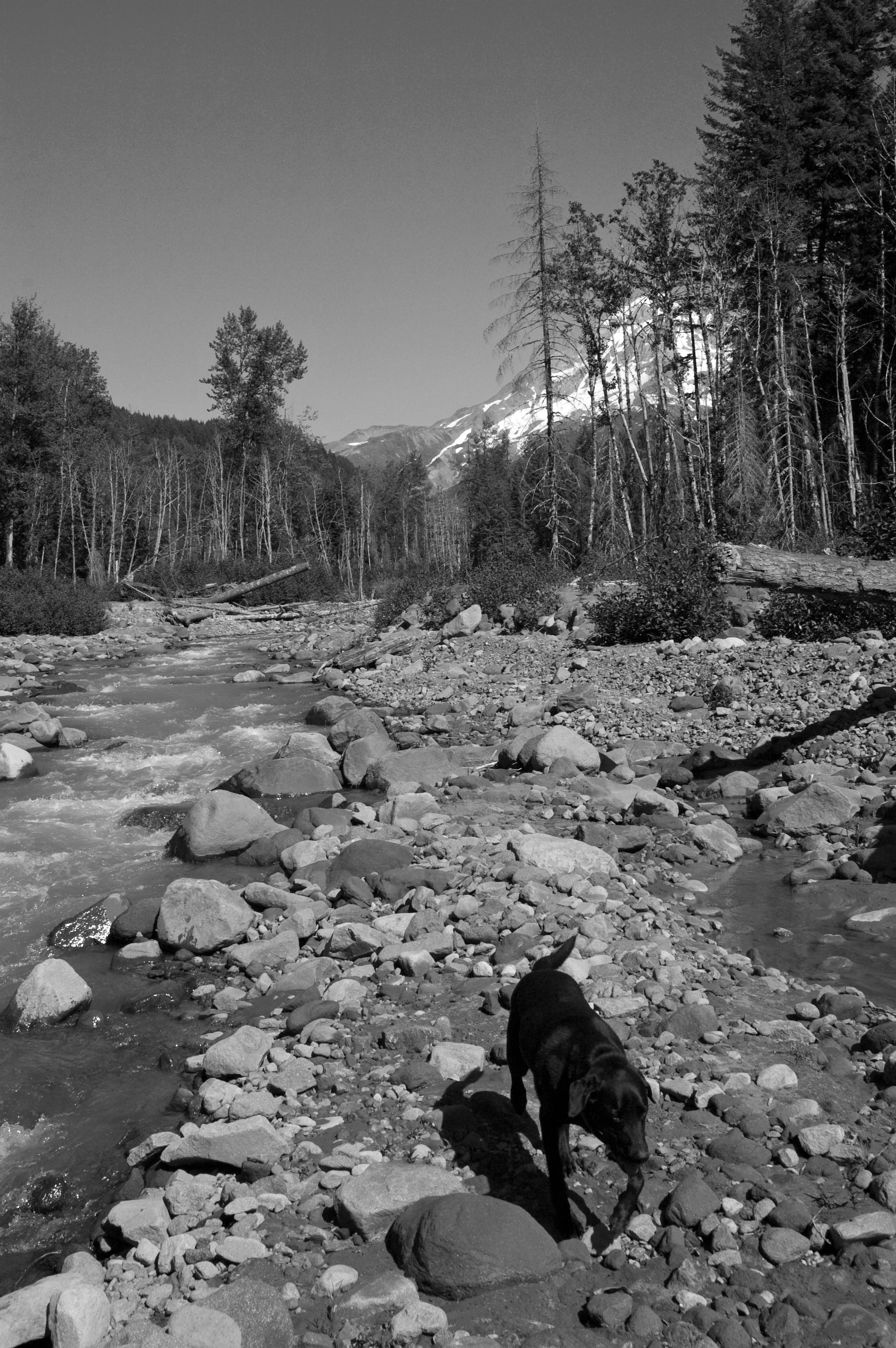
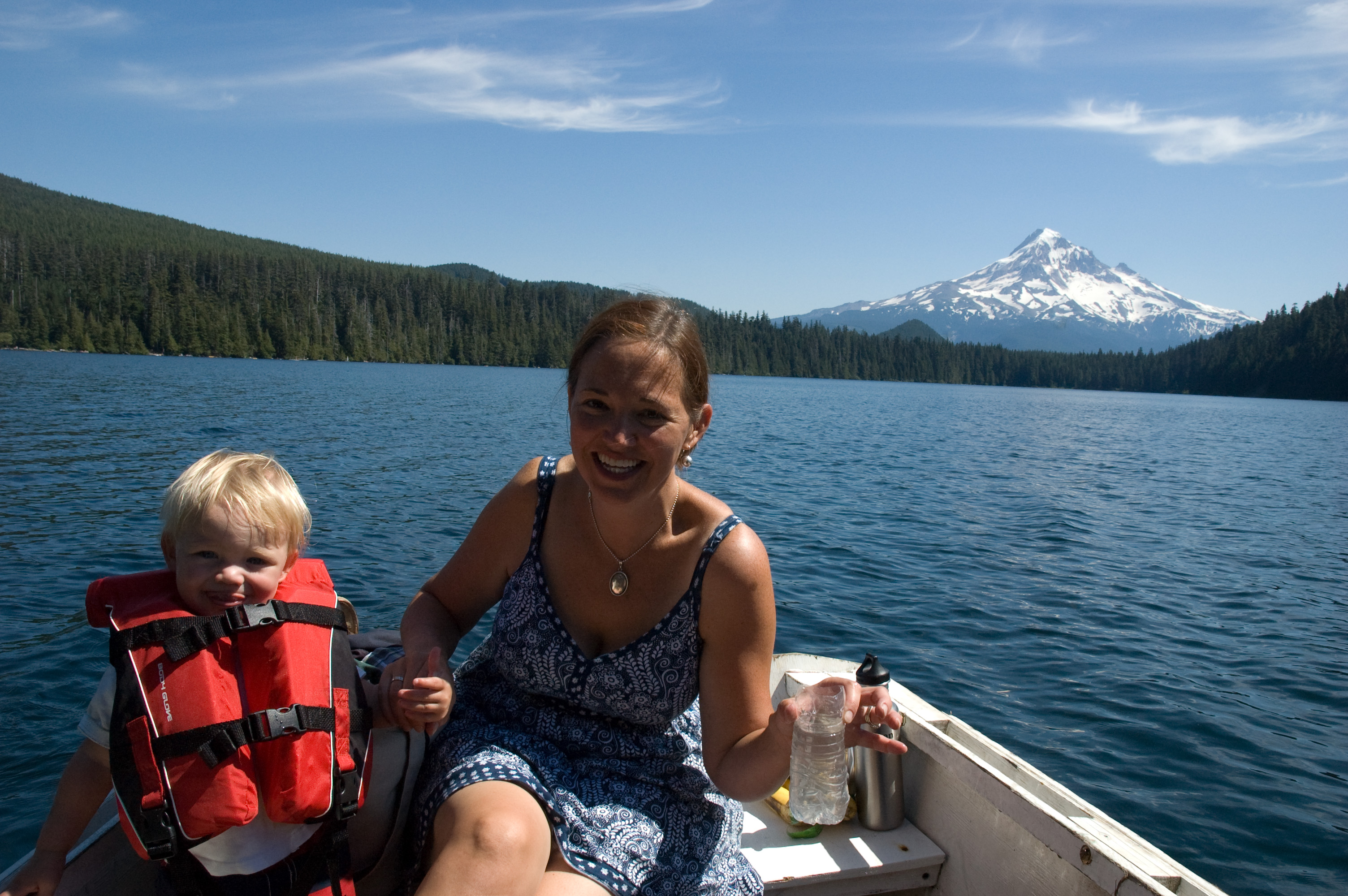
Another found us in pure summertime mode, rowing a leaky rental boat around the picturesque Lost Lake — also with an unmatched shot of the mountain — soaking in every bit of the fleeting season, as if storing up the sunshine and winds and refreshing waters for the inevitable days ahead, the cold and drizzly days, when nothing sounds more inviting than rowing a leaky boat around an amazing alpine lake in the middle of the summer.
 On MOUNT HOOD