The Book. The Mountain. Everything in between.

Latest

An eruption reminder

It was 32 years ago today (May 18)  that Mount St. Helens blew its top in the most destructive volcanic eruption in the recorded history of the United States. Fifty-seven people were killed, hundreds of homes, bridges, miles of highway, and more were obliterated, and the landscape of the region was forever changed.

St. Helens erupting on May 18, 1980. Image accessed through Wikimedia Commons.

This day is always a good one to remember. Not just because it’s the birthday of one of my very best friends, but because it serves as a good reminder of just what these mountains here in the Pacific Northwest might be capable of. According to a 2010 USGS top ten list of the most dangerous volcanoes in the U.S. based on size and potential damage of an eruption, seven of the them are Cascade Peaks. In order on the list: St. Helens (2), Rainier (3), Mount Hood (4), Shasta (5), South Sister (6), Lassen Peak (7), and Crater Lake (10).

According to the geologists that I talked to for my book, there’s a good chance that we won’t see Mount Hood erupt in our lifetime. It’s been a while since it’s erupted — about 230 years — and even though there are constant rumblings deep underneath the mountain and active fumaroles up higher, there don’t seem to be any major signs that the mountain is coming back to life anytime soon. That said, it doesn’t mean that people haven’t planned for the possibility of an eruption or that the door isn’t always open for the possibility. With volcanoes, it has to be.

“Until the volcano chooses to give us some indication that unrest is beginning, things motor on and are just fine,” said Cynthia Gardner, a geologist at the Cascades Volcano Observatory, who I interviewed for the book. “And then one day they aren’t fine anymore.”

The USS Mount Hood

For a few months now, my daughter has been on a huge shipwreck kick: the Titanic, the Lusitania, the Bismarck, and most recently, the Edmund Fitzgerald. We’ve been reading about them, watching movies about them, talking about them, and just about everything else, bordering on obsessing about them. It’s been interesting, because while I’ve long known the basic details of most of these famous shipwrecks, there’s so much more behind their surface stories that makes them even more fascinating.

I got her a book out of the library today all about shipwrecks — her eyes lit up with fireworks when I handed it over — and it gave me a topic idea for today’s post. (I’m participating in Michelle Rafter’s 2012 WordCount Blogathon, so I’ve been challenged to post every day for the entire month of May. And let me tell you, it can be a challenge some days.)

That topic: The USS Mount Hood (AE-11).

The USS Mount Hood (AE-11) in 1944. Public domain Image accessed from Wikimedia Commons.

It’s not a ship I really knew much about, but I did come across its name when I was writing On Mount Hood. And yes, it was named after that Mount Hood.

When the shipwrecks book gave me the idea to write a post on the USS Mount Hood, I also didn’t expect the ship to have any kind of shipwreck link or story. But it does.

Image accessed from Wikimedia Commons.

I won’t retell the story here. but here’s the introduction to the Wikipedia entry on it:

USS Mount Hood (AE-11) was the lead ship of her class of ammunition ships for the United States Navy in World War II. She was the first ship named after Mount Hood, a volcano in the Cascade Range in Oregon. Soon after 18 men who had left the ship for shore had reached the dock, the USS Mount Hood exploded in Seeadler Harbor at Manus Island on 10 November 1944 killing all men aboard, obliterating the ship itself, and sinking or severely damaging 22 smaller craft nearby.

I haven’t told Madeline about the USS Mount Hood yet, but I’m sure I will. And when I do, I’m sure she’ll want to learn every single thing she can about it — and so we will.

Memaloose Hills Loop Trail

Today, resident Mount Adams expert and photographer Darryl Lloyd sent out an interesting map of a unique and unofficial wildflower trail out in the Columbia River Gorge in between Hood River and the Dalles. I’ve never done it, myself, but it sounds pretty nice — and it’s got at least one incredible view of Mount Hood along it’s 6.5-mile way. Thanks for sharing Darryl!

From Darryl:
The wonderful Memaloose Hills Loop “trail” was first scouted by naturalist Russ Jolley many years ago. It’s known as one of the best wildflower hikes in the Columbia Gorge. Paul Slichter listed 128 species on a late-April field trip in 2009 (http://science.halleyhosting.com/nature/bloomtime/egorge/09/12.htm). 
 
The unmarked trail is unofficial and few people know the route beyond the western part. There seems to be no map of it online, so I’ve undertaken the task with this draft. Since I didn’t use a GPS device, the route sketched in red is approximate. The total distance is about 6.5 miles, and you’ll be on public land all the way.  
 
Below the map are some photos that I’ve taken over the years. There’s still a large number of flower species in bloom, but balsamroot is waning over most of the area. (All images courtesy and copyright Darryl Lloyd.)
Wildflowers on Chatfield Hill.

Mount Hood from Marsh Hill.

Even more Mount Hood favorites

Every now and then, I post up a couple favorite shots of Mount Hood. I did it here and here, and now I thought I’d do it here too.

Hood from White River. Nothing incredibly special about this one, but it is the kind of image that shows just how beautiful a January day on the mountain can be.

This one’s not actually of Mount Hood, but from it: Oliver scanning the horizon and Mount Jefferson from Gnarl Ridge.

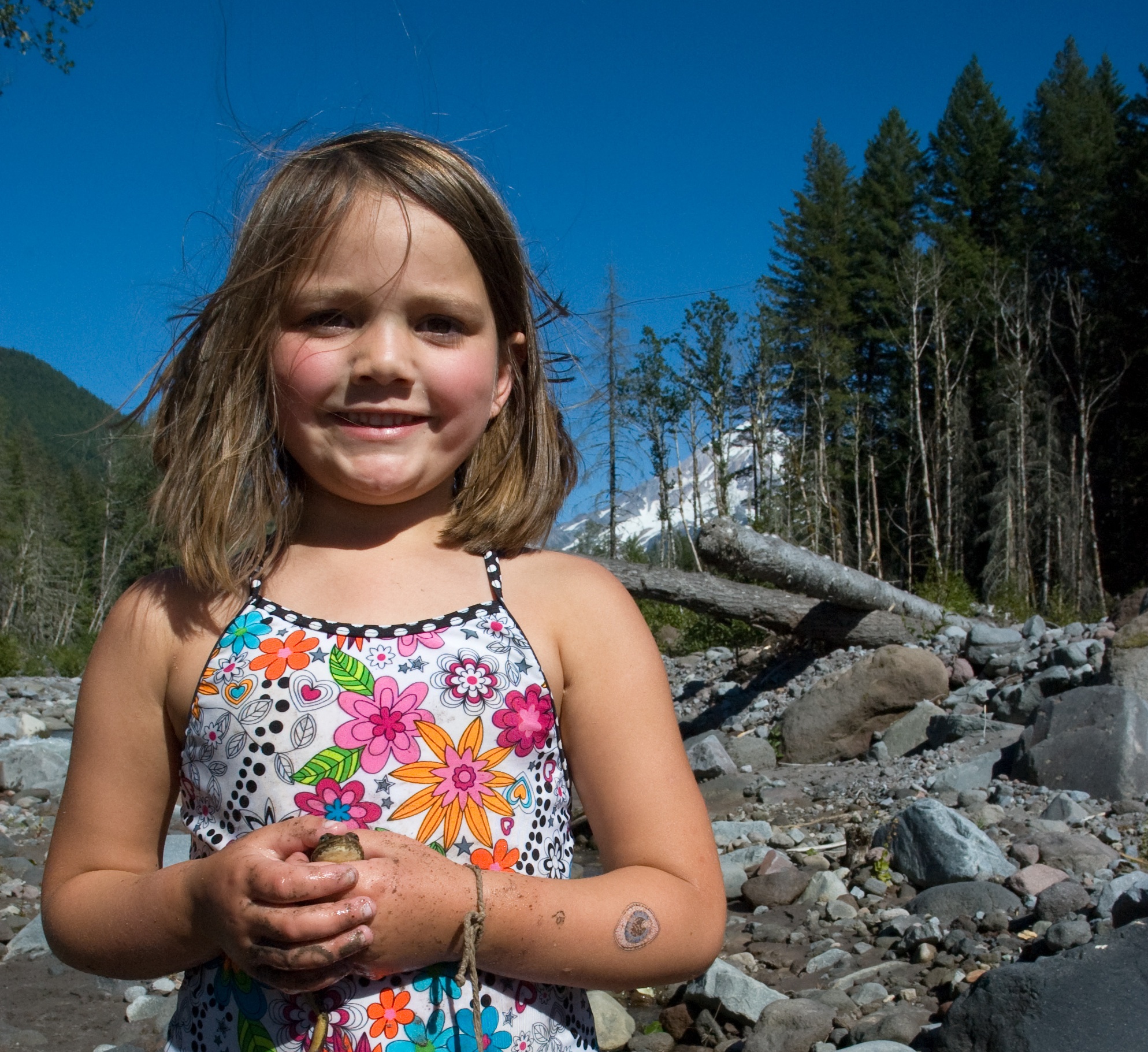
A frog, my daughter, and Mount Hood above the Sandy River.

A little wine and a mountain view

We didn’t climb Mount St. Helens for Mother’s Day this year — we will again someday though! — but we did get outside and enjoy a beautiful Oregon day. We tooled out into the country past Stafford, crossed the Willamette on the Canby Ferry, and spent a little time at St. Josef’s Winery a few miles outside of Canby.

The views of Mount Hood on the way to St. Josef’s were big, but the mountain is hidden from view once you actually arrive at the winery. No matter, it’s still an enjoyable and scenic place to stop for a sip.

But it also got me to thinking about some other wineries in the region that have not only nice wines, but nice views of Mount Hood. I wrote about a few of them in the 2012 Gorge Guide, which just came out a few weeks ago. Among my favorites, Hood River’s Phelps Creek Vineyards and Cascade Cliffs out in Wishram, Wash., both of which offer some fine wines and incredible mountain scenery.

The vineyard — and the mountain — at Cascade Cliffs.

Happy Mother’s Day 2012!

It’s Mother’s Day, and every year on Mother’s Day, I not only remember to call and send my love to my mom in Ohio, but I also think about a particular Cascade mountain. Not Mount Hood, but St. Helens, which lies about 60 miles northwest of Hood.

There’s an incredible tradition that happens every year on Mount St. Helens on Mother’s Day. Amy and I have been part of it twice during our time in the Northwest, and I have to say, it’s one of the most unique ways to express appreciation for the mother in your life that I’ve ever come across.

In honor of Mother’s Day 2012, here’s a column I wrote about that tradition back on May 18, 2002, when I was honing my chops as a reporter and photographer for the Canby Herald newspaper.

Enjoy, and Happy Mother’s Day.

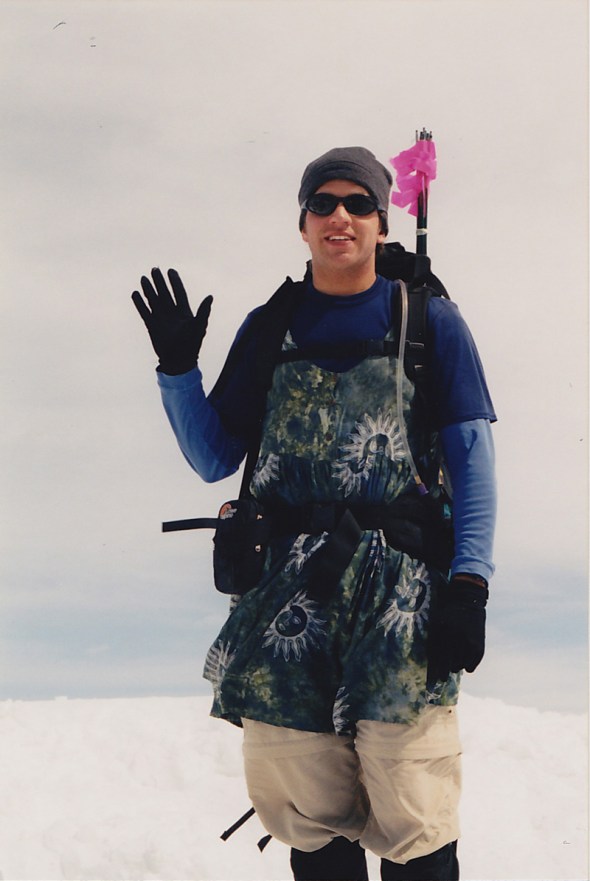
Last Sunday was Mother’s Day, and in honor of my wonderful mother, I sent a card, made the ritual phone call, and donned a blue and green tie-dyed dress for a climb to the top of Mount St. Helens.

Indeed, it was not your average Mother’s Day tribute.

But like all of those faithful sons and daughters who either bought Mom a bouquet or made her breakfast in bed on Sunday, I was not alone in my gesture of appreciation.

For one, my fiancée, Amy, was with me on the mountain. She, too, paid homage to her wonderful mother  — my soon-to-be mother-in-law  — by wearing a dress for the long slog up the Pacific Northwest’s most infamous volcano. (By the way, St. Helens, also known as Loowit, blew its top exactly 22 years ago today.) I reluctantly concede that Amy’s dress, with its purple, blue and pink floral patterns, was much more flattering on her than mine was on me.

And then there were the literally hundreds of other climbers who made their way up and down the mountain on Sunday. The majority of them were bedecked in dresses, skirts and gowns similar to those no doubt on display at Mother’s Day brunches — or weddings, proms, square dances or Scottish caber tosses — across the country.

On our way up and down, we saw polka dots and stripes, flowers and paisleys. There were miniskirts, bridesmaid dresses, kilts, and old schoolmarm frocks. We also noticed costume pearls, a hot-pink feather boa, and at least one blonde wig.

Amy making her way up St. Helens on Mother’s Day 2002. 

Lest the reader be mislead, these garments were worn, in most cases, over the standard climbing ensemble. Under the sunshine and blue skies of last Sunday, that included stiff boots, synthetic pants and shirts, backpacks, sunglasses, and the most essential of accessories, the ice axe.

There were, of course, those fellow climbers who were unaware of the fashion protocol of the day. One bewildered alpinist heaved up to us just below the summit, a perplexed look on his face.

“Can you explain something to me?” he asked. “What’s with all the dresses?”

We smiled between gulps of water and wished him a happy Mother’s Day.

Rumors abound as to the origin of the Mount Saint Helens Mother’s Day tradition. Perhaps it began with the Bergfreunde Ski Club, a Portland-based ski club formed in 1966 to promote skiing and other recreational activities. I called these “mountain friends,” but they weren’t sure if their club had formally come up with the dress idea or not.

I next tried the Mazamas, one of the larger and more well- known mountaineering groups in the Northwest. Their club, the name of which is Nahuatl for mountain goat, has been associated with the local mountaineering scene since July 19, 1894. It was on that date that prospective members of the club first convened on the summit of Mount Hood.

“It may have just been one of those spontaneous things that caught on,” one club member said of the Mother’s Day tradition. “Who really started it, I don’t know.”

There’s also the Ptarmigans, another climbing club that has been exploring the Cascades since the mid 1960s. Mike Dianich, a member and longtime mountaineer who has climbed Saint Helens 22 times as of Sunday, said other than the local climbing clubs, he didn’t know who may have slipped into the first Mother’s Day dress on Mount Saint Helens.

But if the origin of the tradition remains a mystery, the reasoning behind it is a bit more definitive. Simply put, those who climb the 8,300-foot volcano in a dress on Mother’s Day are honoring their moms, thanking them for all they have done over the years.

It is also a gesture of obeisance from those sons and daughters who live far away from their mothers; from those who, like me, cannot express their gratitude in person every year on Mother’s Day.

So this year, as Amy and I plodded more than 5,000 feet up the flanks of St. Helens in our dresses, I thought of my mother and how she has helped me become who I am; how she has shared her kindness with me and given so much of herself  — all so that I can enjoy the life that I do.

And when we got to the top of the mountain, with Spirit Lake down below and Mount Rainier and Mount Hood floating in the distance, I looked east toward Ohio, and waved to my mom.