On Mount Hood — in Eugene
Since the book published almost a year ago, I’ve taken On Mount Hood and my slideshow all over the Portland metro region. I’ve also been out to Hood River and Welches near the mountain, McMinnville, and even Seaside out on the coast.
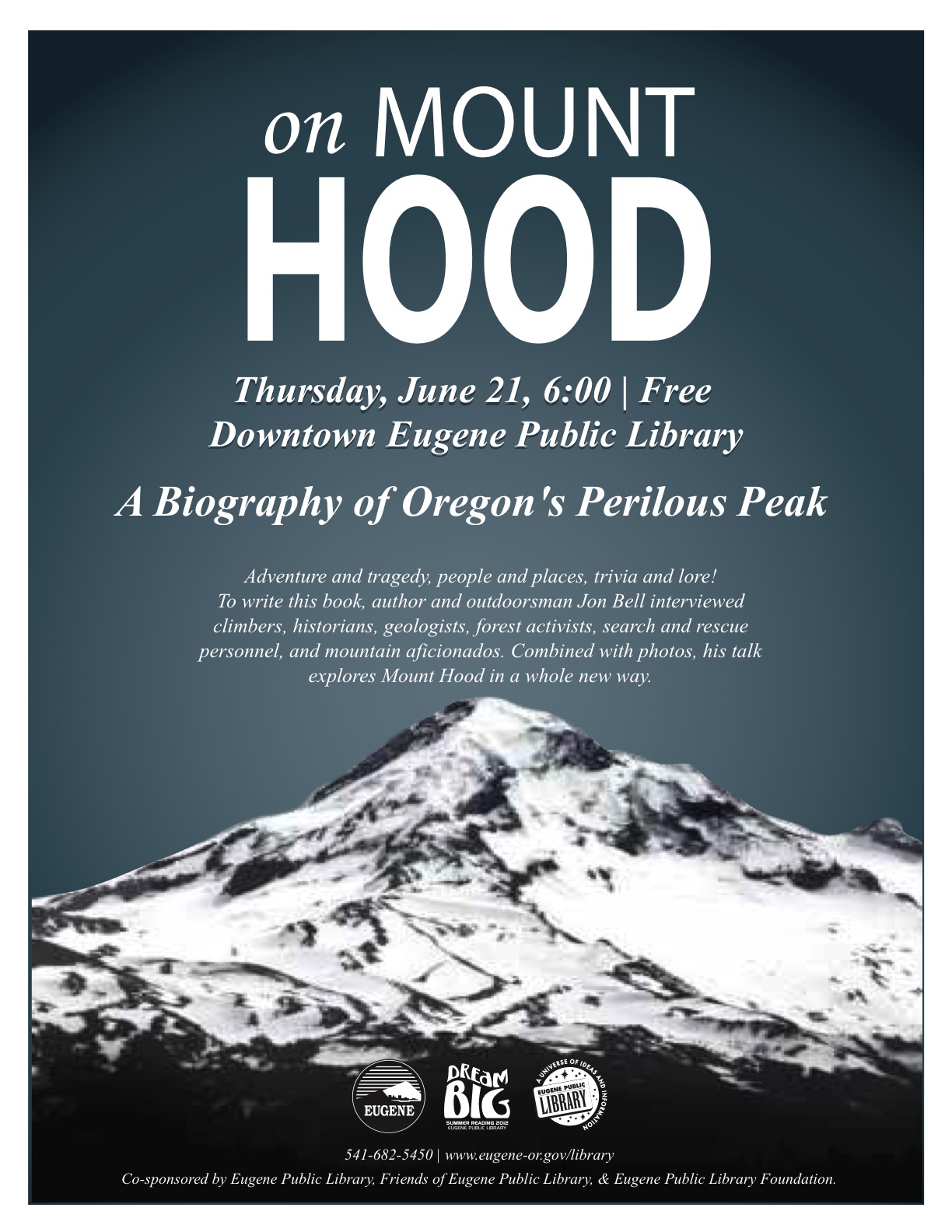
In just a few weeks, it’ll be down in Eugene at the Eugene Public Library. The free event kicks off at 6 p.m., Thursday, June 21, at the downtown library. Looking very forward to it. Here’s their poster for the event. Hope to see you there.
Searching for Mount Hood
Silcox Hut Mount Hood.
Kayak lake Mt. Hood.
Mt. Hood Meadows mid beer.
Someone standing up on a mountain.
One of the great things about blogging on WordPress (and probably most other blogging sites) is all the data you’re privy to about visitors to your blog. You get to see how many people visit your blog each day, what countries they live in, and what pages they’re checking out. You can also see all the searches they’ve done on the Internet that ended up pointing them to your site.
That list above is just a few of the searches that have lead people to onmounthood.com. Most of them, like the Silcox Hut one and the kayaking one, end up being pretty relevant. Some are a little bit more of a stretch. And some, like “crystal lemons, portland OR” and “accordion made in Germany in the 1940s” leave you scratching your head. (Though I have to admit, the accordion one probably came up as a result of this post on Shorty’s Corner.)
Whatever the case, though, it’s great to see all the different ways people are looking to learn about Mount Hood; there’s a lot to learn about this mountain, indeed.

Mount Hood from Timberline Lodge.
The USS Mount Hood
For a few months now, my daughter has been on a huge shipwreck kick: the Titanic, the Lusitania, the Bismarck, and most recently, the Edmund Fitzgerald. We’ve been reading about them, watching movies about them, talking about them, and just about everything else, bordering on obsessing about them. It’s been interesting, because while I’ve long known the basic details of most of these famous shipwrecks, there’s so much more behind their surface stories that makes them even more fascinating.
I got her a book out of the library today all about shipwrecks — her eyes lit up with fireworks when I handed it over — and it gave me a topic idea for today’s post. (I’m participating in Michelle Rafter’s 2012 WordCount Blogathon, so I’ve been challenged to post every day for the entire month of May. And let me tell you, it can be a challenge some days.)
That topic: The USS Mount Hood (AE-11).
.jpg "USS_Mount_Hood_(AE-11)")
The USS Mount Hood (AE-11) in 1944. Public domain Image accessed from Wikimedia Commons.
It’s not a ship I really knew much about, but I did come across its name when I was writing On Mount Hood. And yes, it was named after that Mount Hood.
When the shipwrecks book gave me the idea to write a post on the USS Mount Hood, I also didn’t expect the ship to have any kind of shipwreck link or story. But it does.
_explosion.jpg "513px-USS_Mount_Hood_(AE-11)_explosion")
Image accessed from Wikimedia Commons.
I won’t retell the story here. but here’s the introduction to the Wikipedia entry on it:
USS Mount Hood (AE-11) was the lead ship of her class of ammunition ships for the United States Navy in World War II. She was the first ship named after Mount Hood, a volcano in the Cascade Range in Oregon. Soon after 18 men who had left the ship for shore had reached the dock, the USS Mount Hood exploded in Seeadler Harbor at Manus Island on 10 November 1944 killing all men aboard, obliterating the ship itself, and sinking or severely damaging 22 smaller craft nearby.
I haven’t told Madeline about the USS Mount Hood yet, but I’m sure I will. And when I do, I’m sure she’ll want to learn every single thing she can about it — and so we will.
Memaloose Hills Loop Trail
Today, resident Mount Adams expert and photographer Darryl Lloyd sent out an interesting map of a unique and unofficial wildflower trail out in the Columbia River Gorge in between Hood River and the Dalles. I’ve never done it, myself, but it sounds pretty nice — and it’s got at least one incredible view of Mount Hood along it’s 6.5-mile way. Thanks for sharing Darryl!


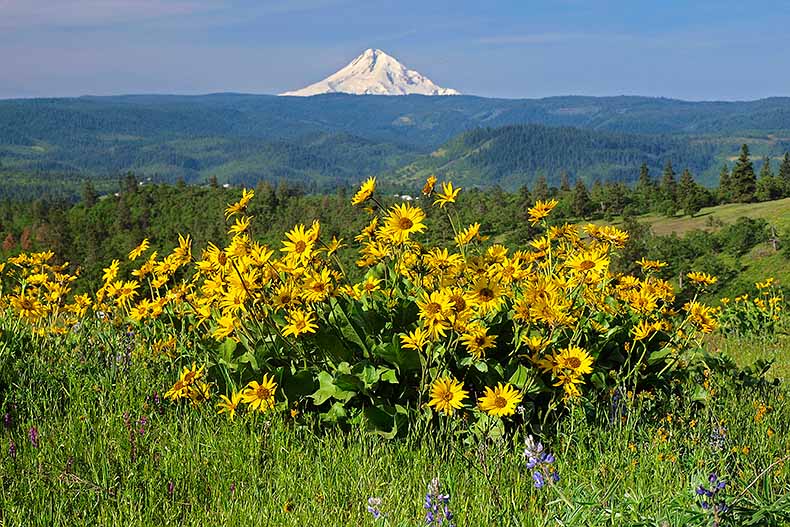
Mount Hood from Marsh Hill.
Even more Mount Hood favorites
Every now and then, I post up a couple favorite shots of Mount Hood. I did it here and here, and now I thought I’d do it here too.

Hood from White River. Nothing incredibly special about this one, but it is the kind of image that shows just how beautiful a January day on the mountain can be.

This one’s not actually of Mount Hood, but from it: Oliver scanning the horizon and Mount Jefferson from Gnarl Ridge.
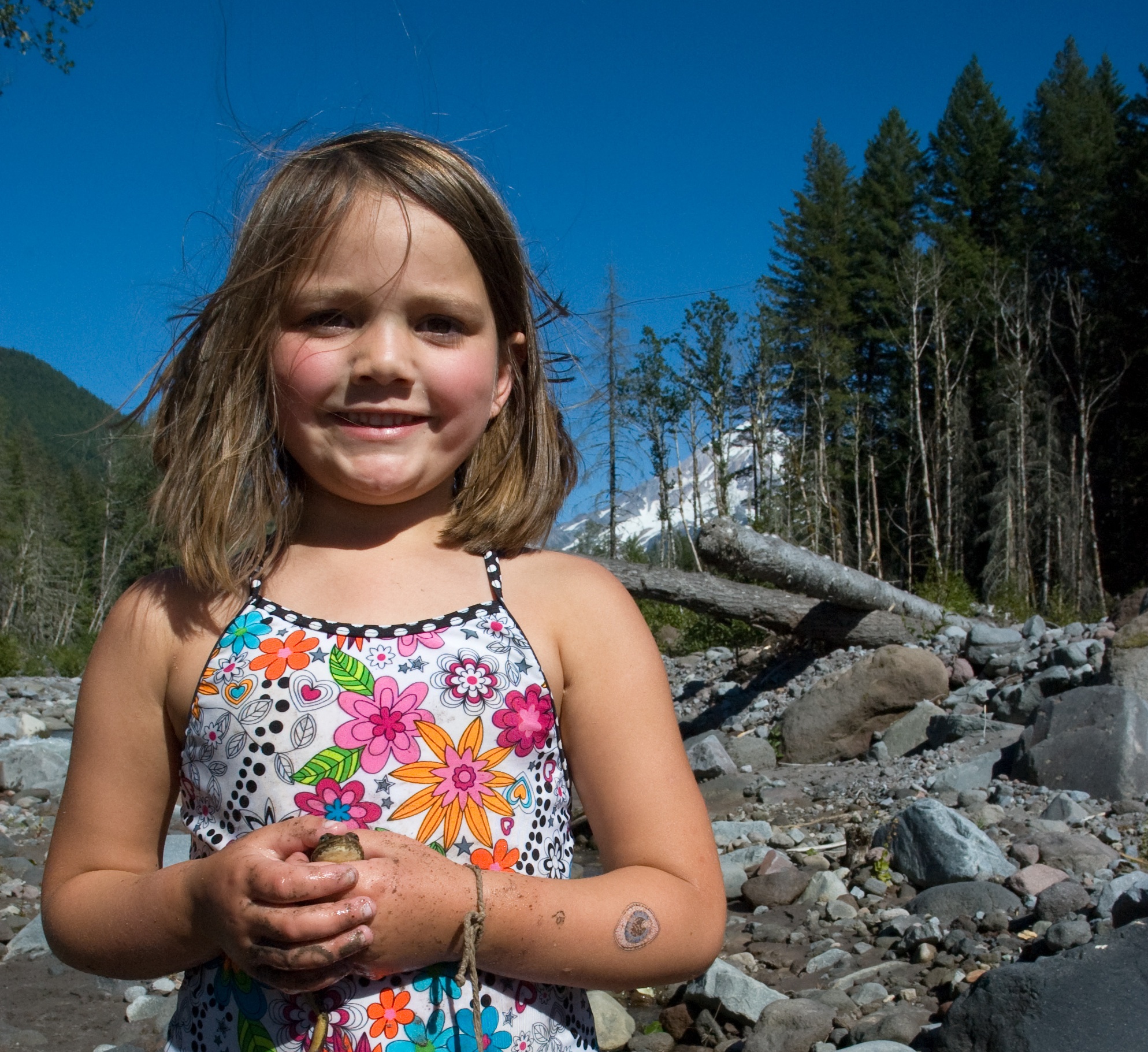
A frog, my daughter, and Mount Hood above the Sandy River.
Escaping on the kayak — at home and on Mount Hood
Five little girls descended on our house today after school for an over-the-top tea party — flowered hats, petit fours, raised pinky fingers and all.
Spence and I raided the scones, made like trees and left for the river before anyone could so much as tsk tsk us.
Our plan, other than giving the tea party a mighty wide berth, was to simply cruise the Willamette in the kayak and soak up the sunshine of a late and glorious spring afternoon in Oregon. That’s just what we did as we paddled downriver from George Rogers Park, past rowers and scullers slicing through the calm water, fishermen slowly trolling along, geese, ducks, osprey, and even a bald eagle filling the blue sky.
It was great.
It also got me to thinking about other places I love to take the kayak, especially now that the weather is shifting in our favor. I love having the Willamette so close by, but let’s face it, it’s not Lost Lake up on Mount Hood.
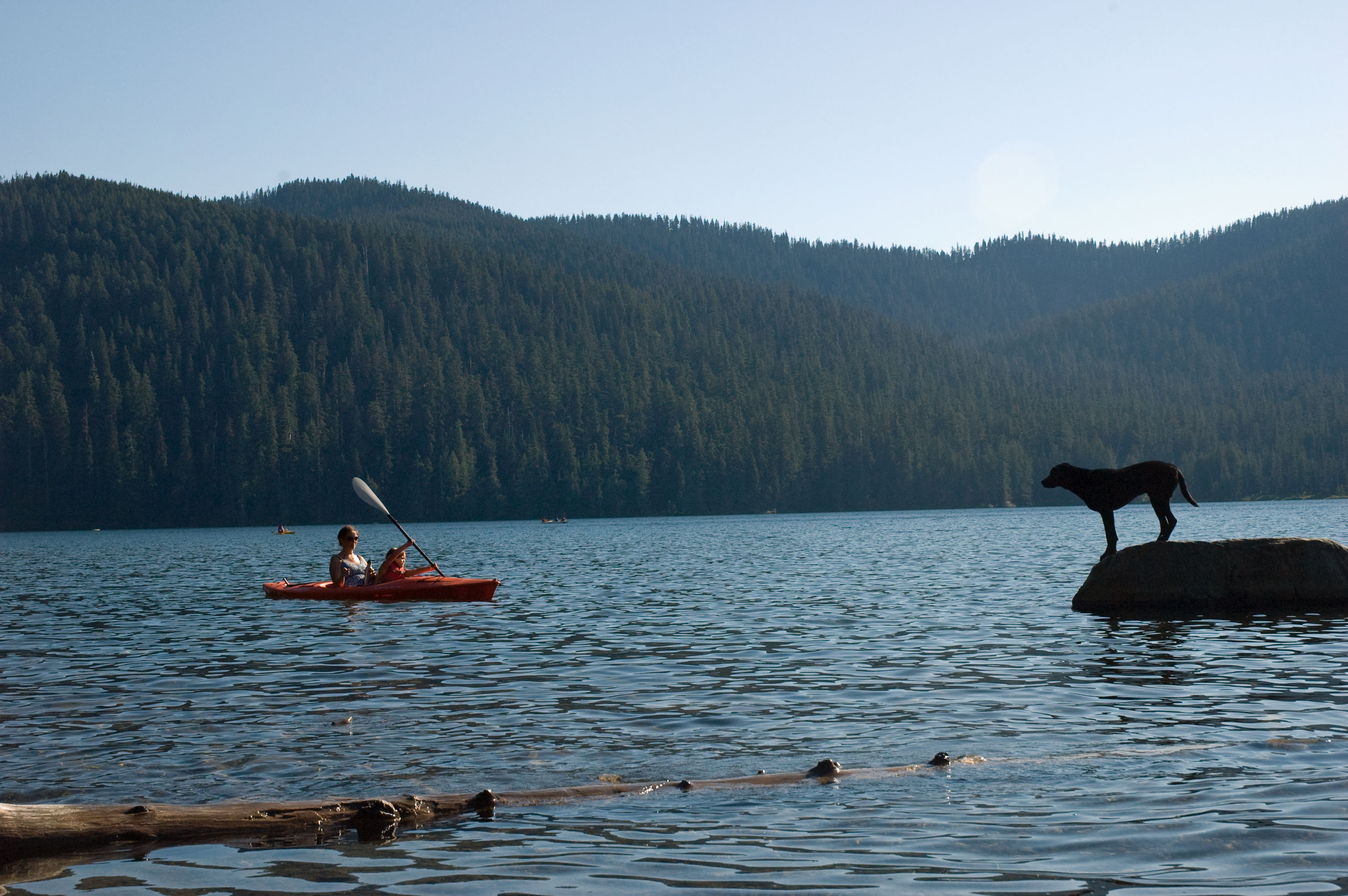
It’s not Trillium Lake up on the south side of Mount Hood either, though Trillium’s crowds these days can sometimes be more than enough to make you want to steer pretty clear of the lake despite its views and chill kayaking.
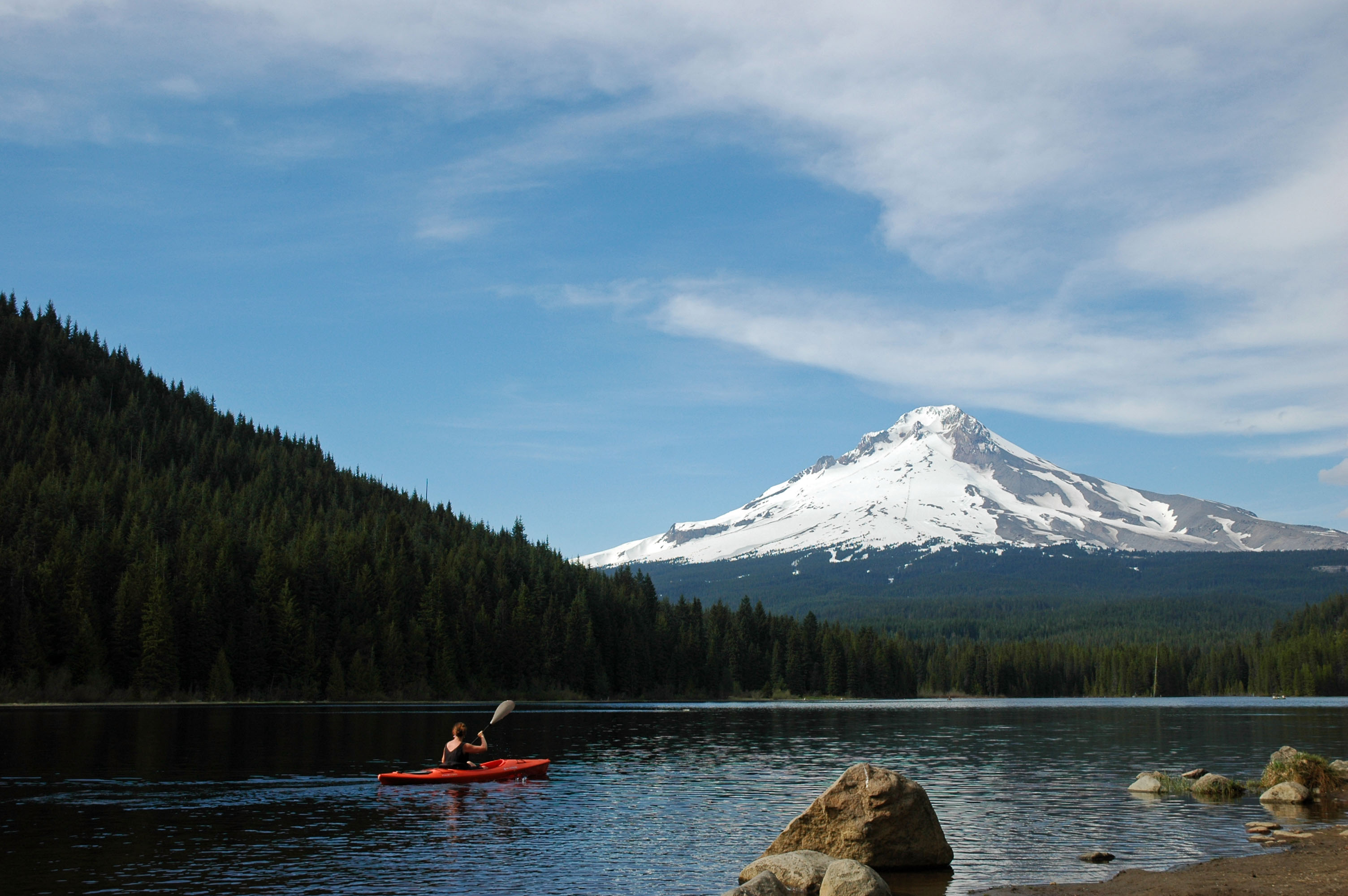
Some other nice spots for flatwater kayaking, canoeing, or just slow, easy boating up around Mount Hood also include Timothy Lake, Clear Lake, Frog Lake, and Laurance Lake. The entire Mount Hood National Forest, in fact, is full of some great offerings for boaters of all kinds — even, I’m sure, those just looking to get out on the water and a little farther away from a tea party . . .
 On MOUNT HOOD